
ICLR-2019 Graph2Seq:Graph to Sequence Learning with Attention-based Neural Networks
Paper: Graph2Seq:Graph to Sequence Learning with Attention-based Neural Networks
Graph2Seq: bidirectional node embedding aggregation
In NLP, applications that relate sequences and graphs fall into two broad categories: sequence-to-graph generation and graph-to-sequence generation; this paper focuses on the latter. The conventional approach linearizes a graph into a sequence and then generates output under a Seq2Seq framework. That design has an obvious drawback: a large amount of structural information is lost when the graph is converted into a sequence.
Accordingly, the authors propose Graph2Seq, an end-to-end model that maps graphs directly to sequences.
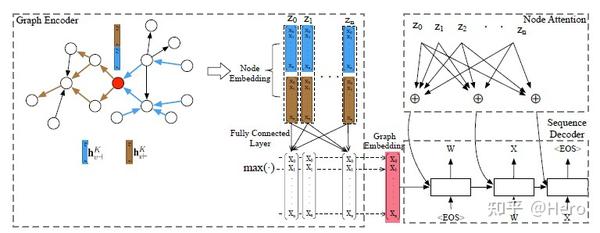
- Graphs encode more information than plain sequences, which can strengthen expressiveness and reduce information loss during propagation.
- Node embeddings: concatenate representations from forward and backward neighbors, pass them through fully connected layers and nonlinearities, and iterate this procedure.
- Aggregation structures: mean, pooling, and LSTM.
-
Graph-level embedding:
4.1 Pooling-based: apply fully connected layers to node embeddings, then max/min/average pooling—the variants behave similarly.
4.2 Node-based: introduce a super node with incoming edges from all other nodes, then run the node-embedding procedure above so it aggregates global graph information.
- Attention-based decoder: compute weighted inputs and measure similarity to nodes in the semantic space.
<HR align=left color=#987cb9 SIZE=1>