
ICML-2020 A Simple Framework for Contrastive Learning of Visual Representations
Paper: A Simple Framework for Contrastive Learning of Visual Representations
SimCLR: Combining several ideas—MLP and nonlinearity on top of representations, stronger augmentations, and large batch sizes
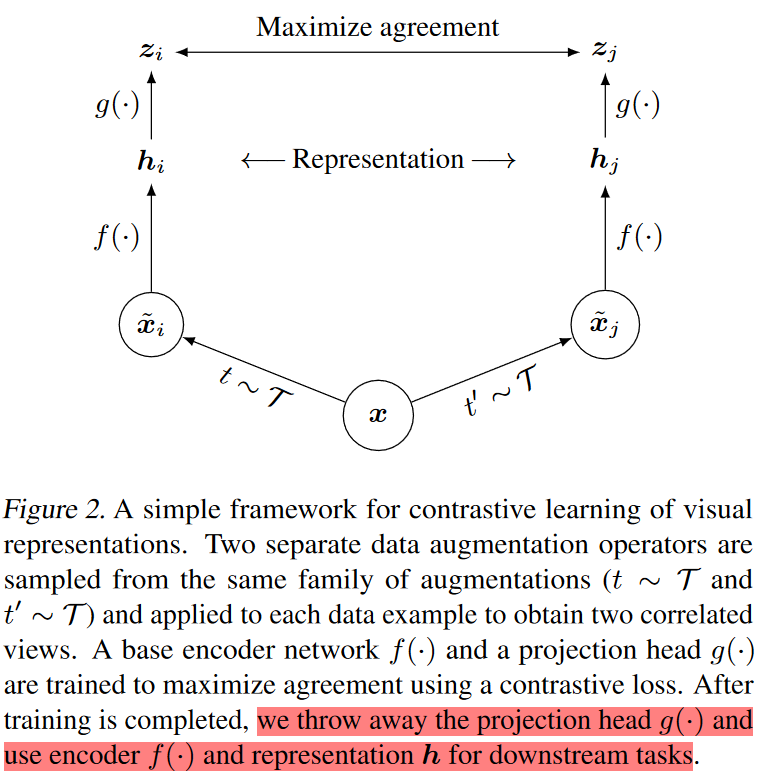
- Two augmented views of the same image form a positive pair. With batch size N, there are N positive pairs; negatives are all other samples and their augmented views, i.e. 2(N−1). The encoder weights are shared across views.
- A key SimCLR design is a projection head g—a single MLP layer plus nonlinearity—applied after the encoder h produces representation z. This head improves linear evaluation by roughly ten percentage points. g is used only during pretraining; downstream tasks use z alone. A one-layer nonlinear MLP works best; the dimension of z matters little, so a smaller dimension (e.g. 128) is sufficient.
- Contrastive learning benefits from a rich set of augmentations: random crop, rotation, color jitter, Gaussian noise, Gaussian blur, and others. Ablations show random cropping and color transformations are the most effective.
- Larger batch sizes and longer training yield better representations; LARS is used to stabilize optimization at large batch size.
<HR align=left color=#987cb9 SIZE=1>