
CVPR-2022 GroupViT:Semantic Segmentation Emerges from Text Supervision
Paper: GroupViT:Semantic Segmentation Emerges from Text Supervision
GroupViT: Clustering for unsupervised semantic segmentation
Abstract
Supervised semantic segmentation relies heavily on annotated segmentation masks. This work brings a grouping mechanism back into the network and trains on simple segmentation-style tasks using only text as the supervision signal.
Method
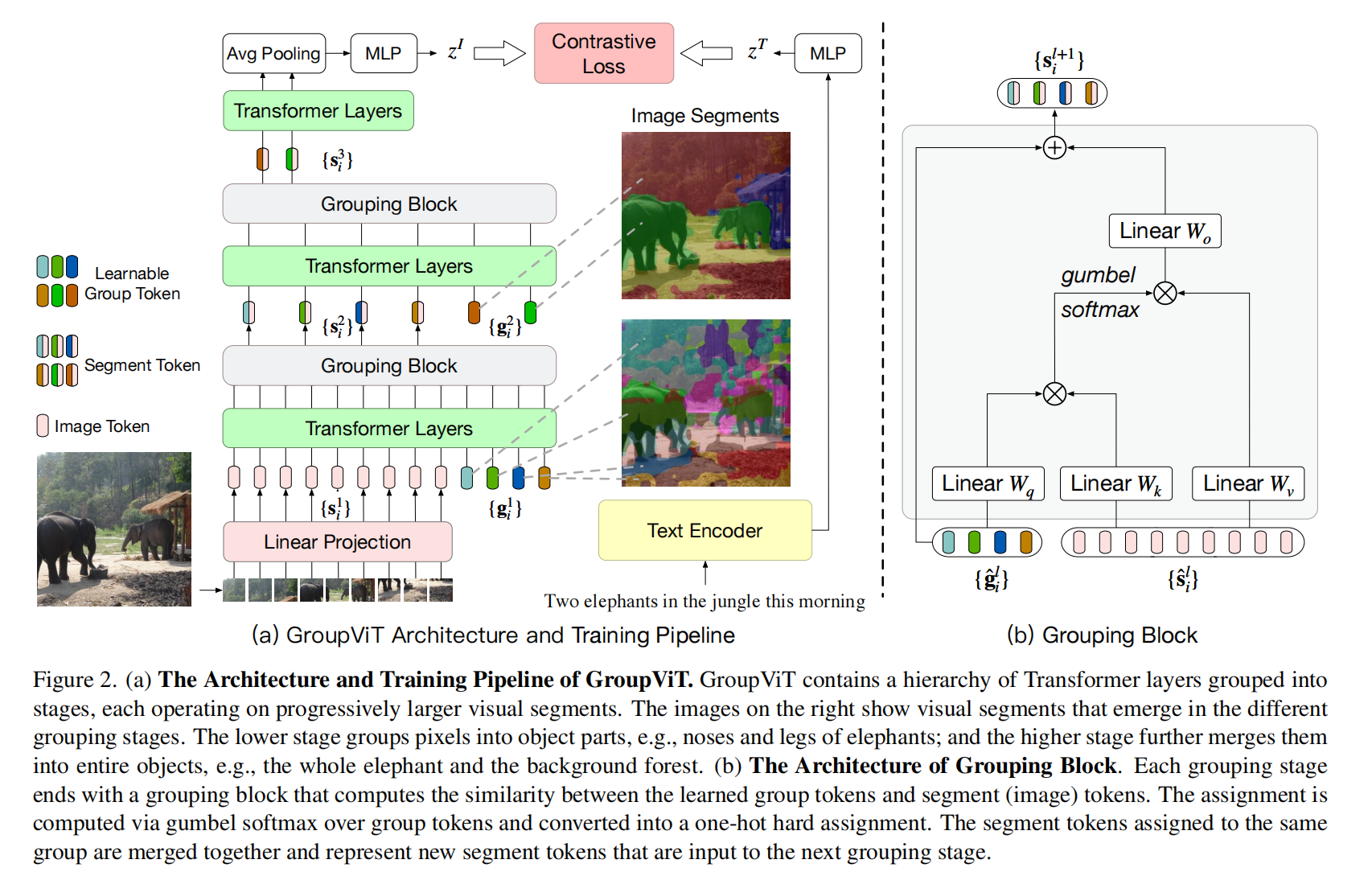
The architecture adds grouping blocks and learnable group tokens so that neighboring pixels form segmentation masks; grouping improves as training progresses.
Group tokens resemble the CLS token, but instead of extracting one global image feature, they support segmentation: each region has its own feature representation. The model uses 64 tokens rather than 1, aggregating similar pixels into 61 clusters.
The image is patchified and concatenated with group tokens; after transformer layers, patches are assigned to 61 group tokens. The authors then merge finer-grained groups by adding 8 additional group tokens.
Learning from Image-Text Pairs
Multi-Label Image-Text Contrastive Loss
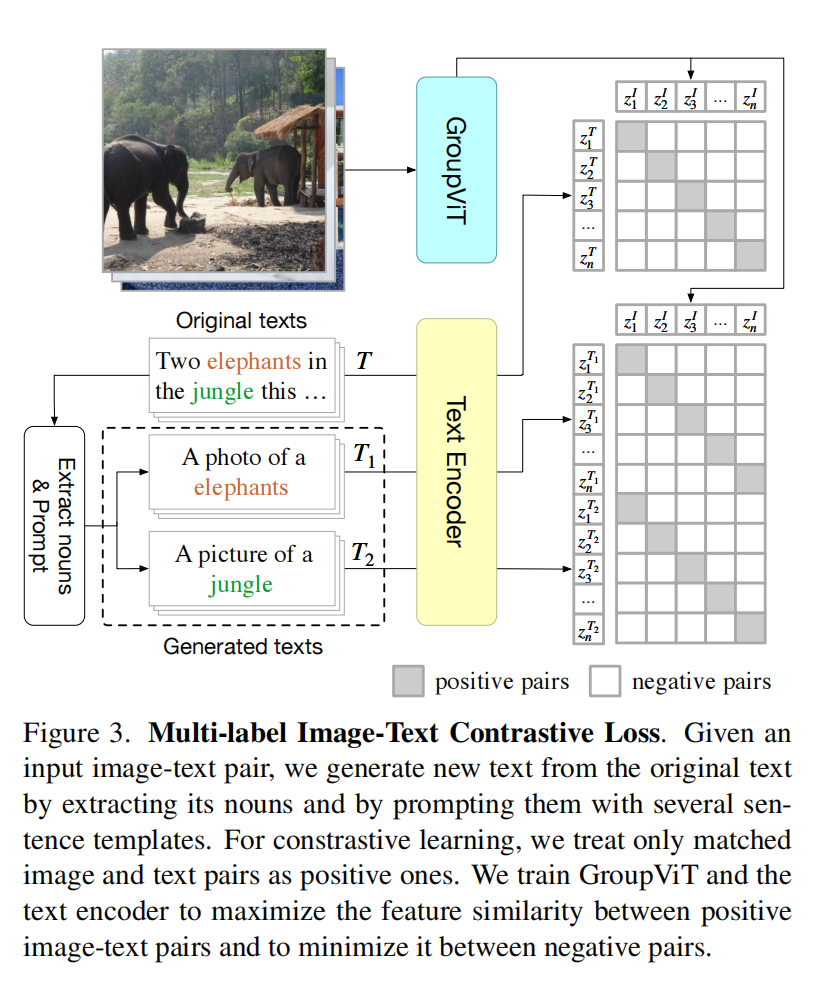
Training uses prompt learning for multi-label contrastive learning: nouns are sampled at random and turned into sentences via templates.
Zero-Shot Transfer to Semantic Segmentation
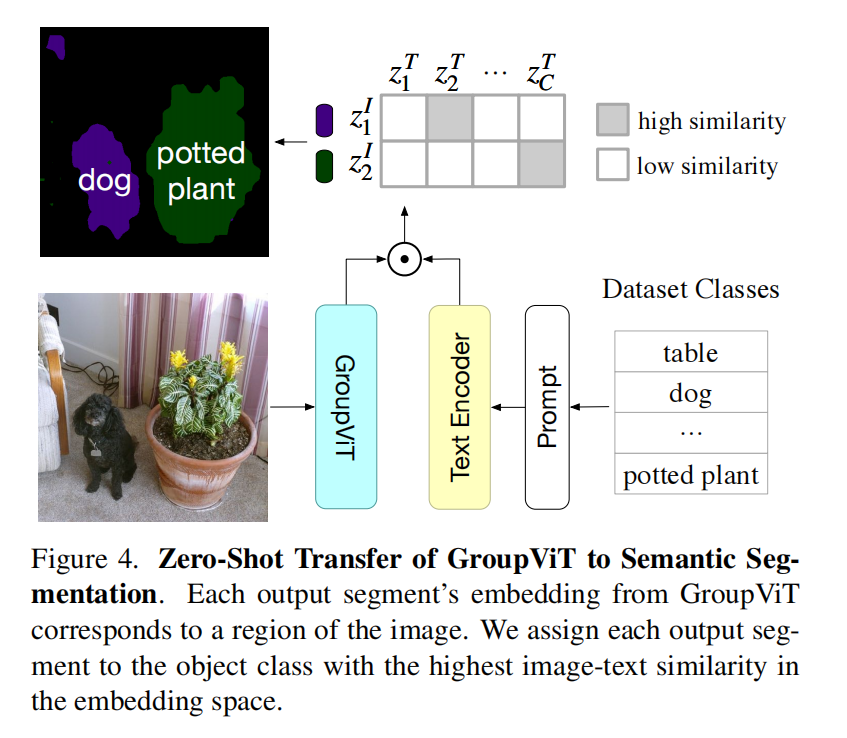
The image encoder yields 8 group embeddings; similarity to text features assigns each group to a class, which implies at most eight detectable categories.
Experiment
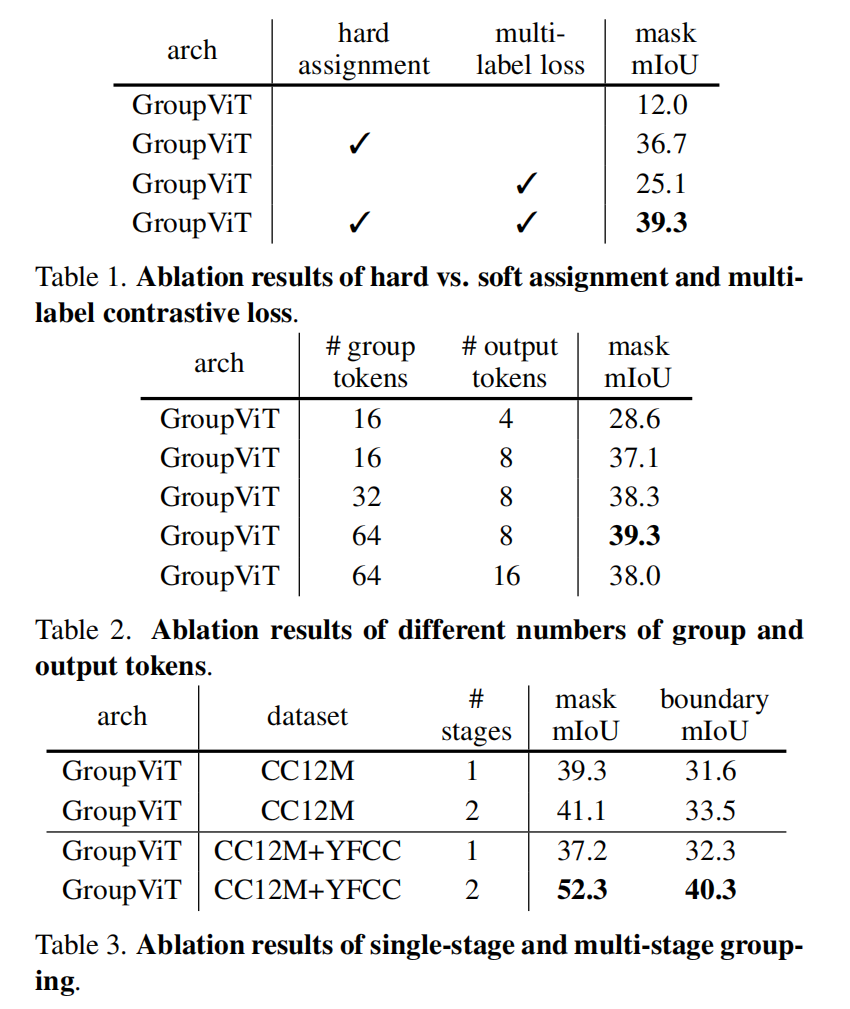
Using 8 tokens appears to work best.
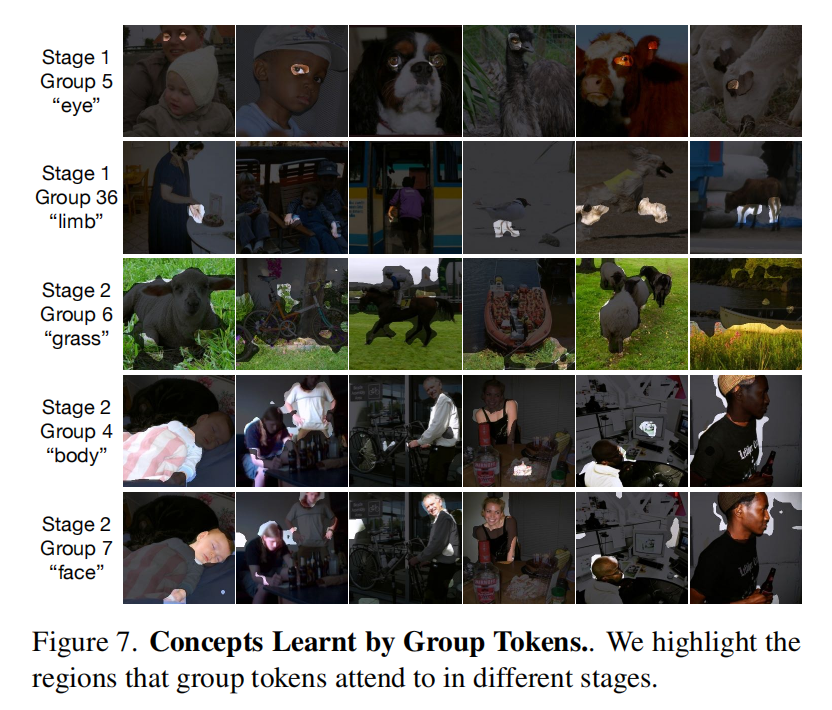
Cluster centers clearly act as cluster prototypes and achieve grouping-based segmentation.
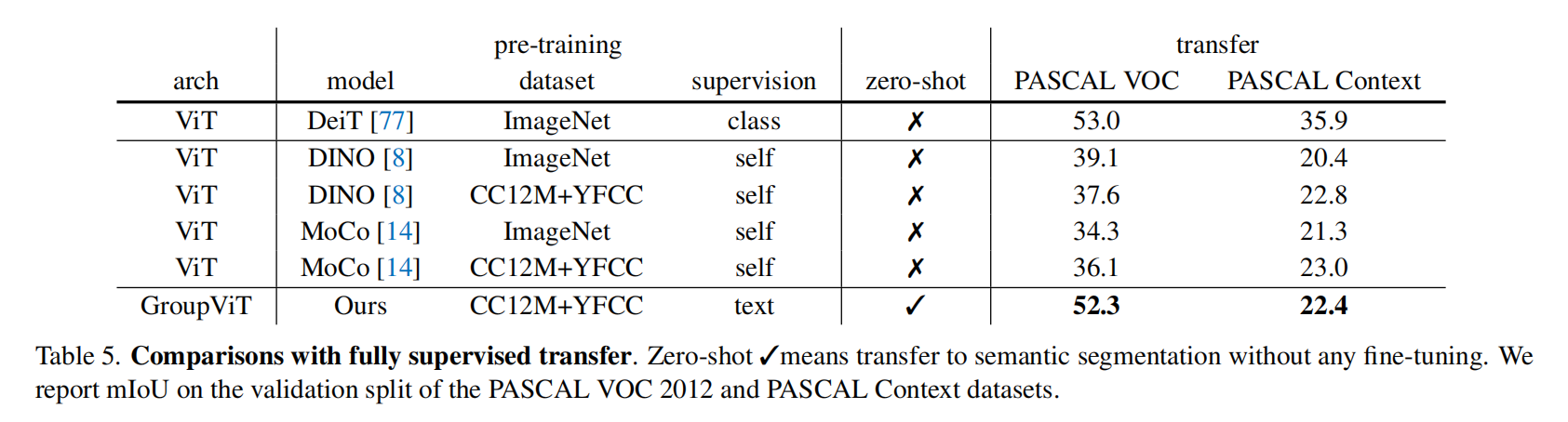
Compared with unsupervised baselines, results improve somewhat, but supervised methods already reach the mid-80s and mid-50s on reported metrics—a large gap remains.
Limitation and Future Work
- GroupViT still behaves largely like an image encoder: it does not fully exploit dense prediction, and it lacks multi-scale or richer contextual cues.
- Background handling: the authors use a threshold (e.g., a group embedding is assigned to a class only if similarity exceeds 0.9; otherwise it is treated as background). When foreground and background scores are similar, disambiguation is hard. A root cause is that CLIP-style training struggles with ambiguous regions—background is often a mixture of many categories—so the model mainly learns objects with very clear semantics.
<HR align=left color=#987cb9 SIZE=1>