
NeurIPS-2021 VLMo:Unified Vision-Language Pre-Training with Mixture-of-Modality-Experts
Paper: VLMo:Unified Vision-Language Pre-Training with Mixture-of-Modality-Experts
Code: https://aka.ms/vlmo
VLMo: Mixture-of-Modality Experts for Multimodal Learning
Abstract
The method combines mixture-of-modality experts with staged pre-training.
Introduction
Two mainstream architectures dominate multimodal learning today:
- Dual encoders (e.g., CLIP): cross-modal interaction reduces to cosine similarity between modality-specific representations. This design scales well to large-scale image–text retrieval and has strong commercial appeal, but the interaction is shallow—even CLIP often falls short of state-of-the-art methods on downstream tasks.
- Fusion encoders: images and text are encoded separately, then a shared Transformer encoder performs deep cross-modal fusion. They excel on vision–language classification-style tasks, but when the number of image–text pairs is huge, every pair must pass through the fusion stack at inference, which is slow and impractical on web-scale data.
The authors aim to combine the strengths of both paradigms so a single model can operate as a dual encoder or a fusion encoder. They propose mixture-of-modality experts (MoME): each modality has dedicated feed-forward experts, and routing depends on the training objective and inference mode.
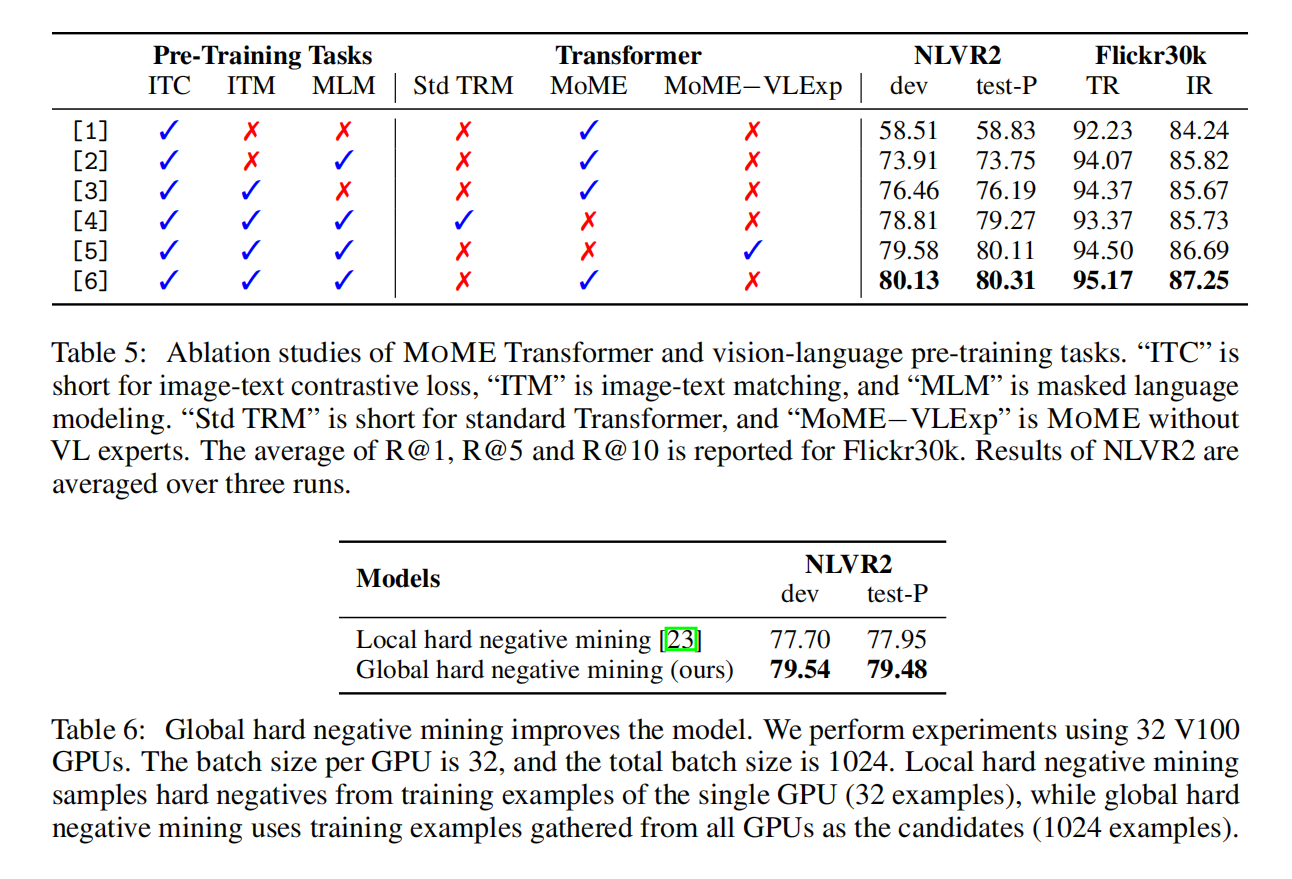
Pre-training uses three objectives: ITC (image–text contrastive learning), ITM (image–text matching), and MLM (masked language modeling).
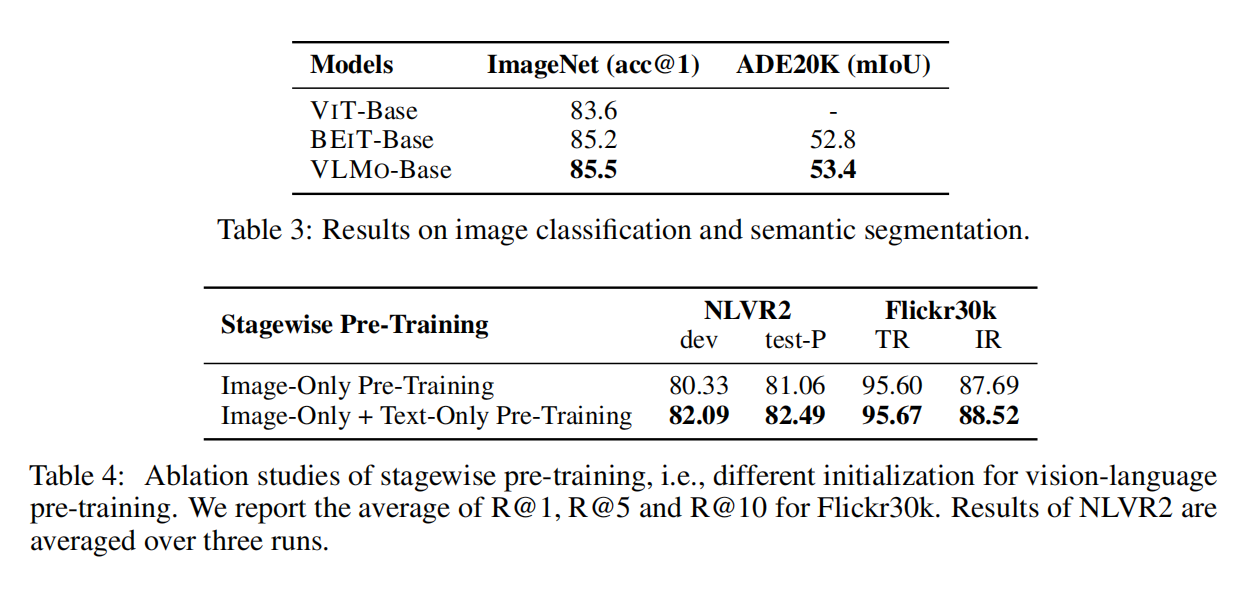
Multimodal corpora are typically much smaller than unimodal image or text pools. The paper therefore adopts staged pre-training: first fit the vision expert on image-only data, then the language expert on text-only data, which yields substantial gains before full vision–language fine-tuning.
Methods
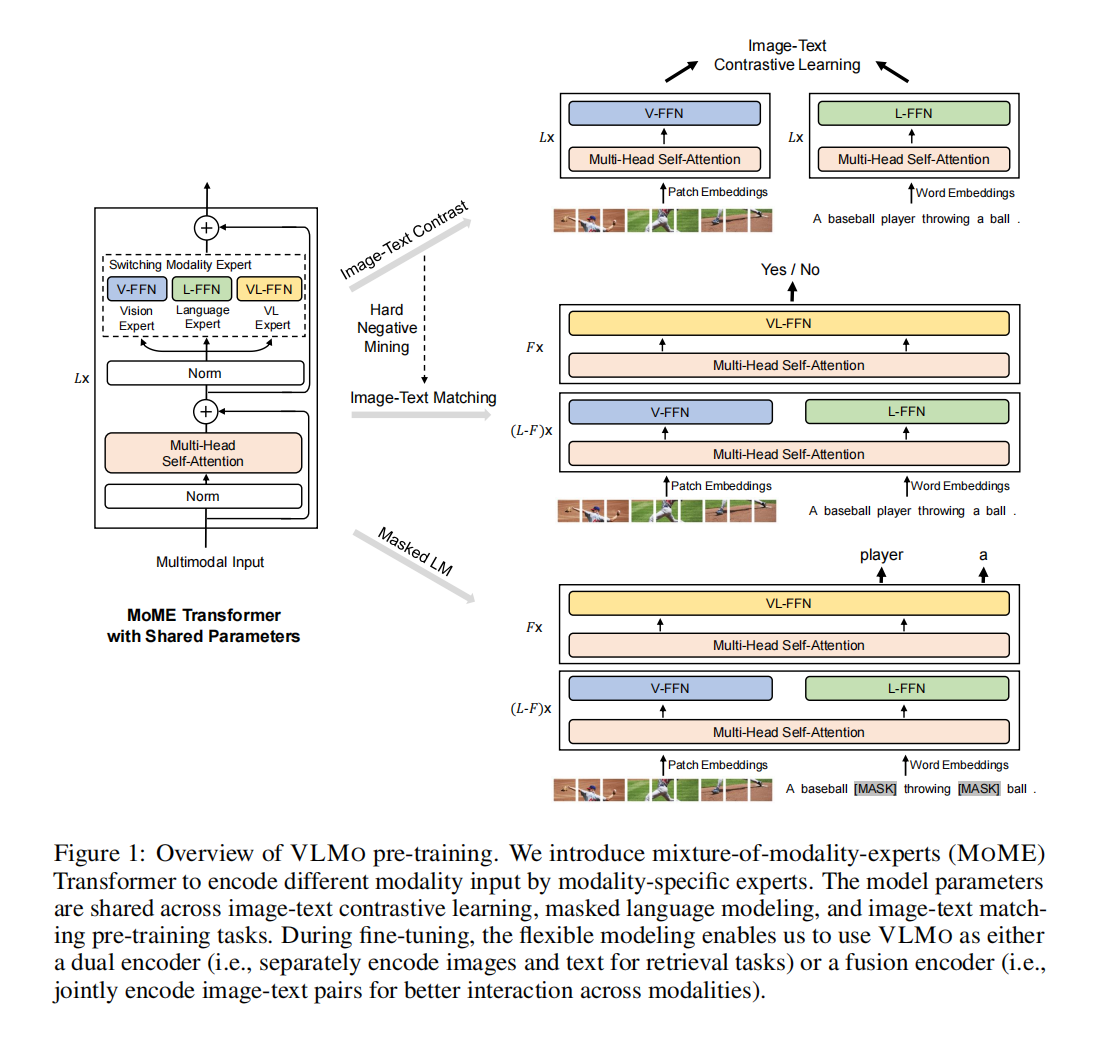
Each modality is associated with its own FFN expert (MoME) while sharing other Transformer blocks.
For ITC, the model behaves like CLIP (dual towers with contrastive alignment). For ITM and MLM, it switches to a fusion-encoder layout with cross-modal self-attention.
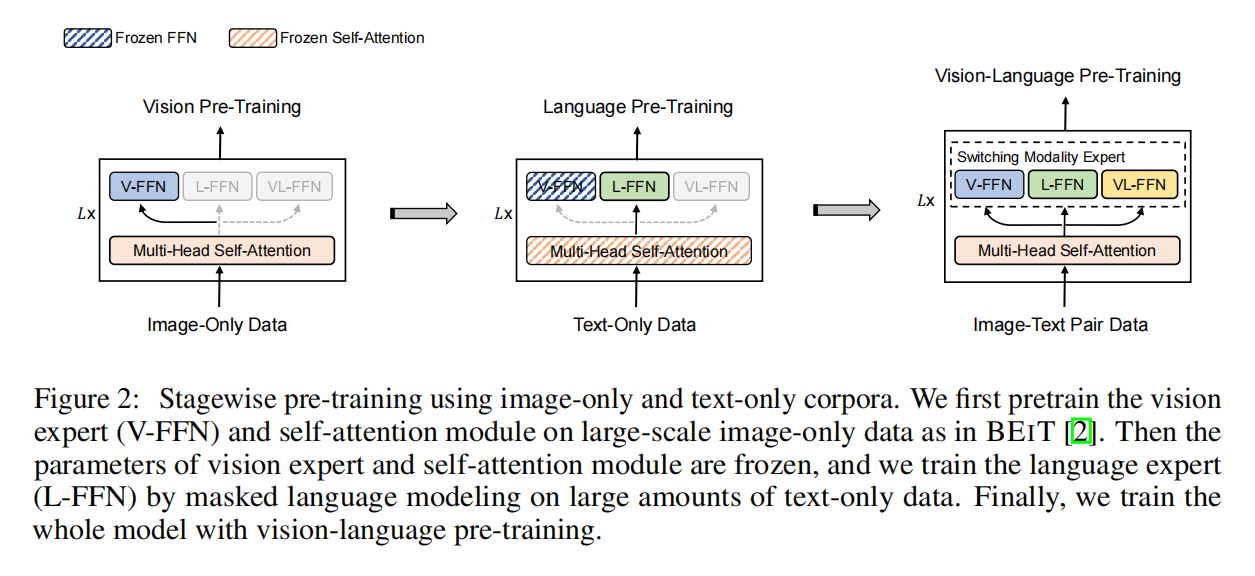
Pre-training proceeds stage by stage from left to right. During language-only pre-training, the self-attention modules initialized from the vision stage are reused as-is—unusual but effective. In the final stage, all components are unfrozen for end-to-end vision–language fine-tuning.
Experiments
Conclusion
Possible directions for future work:
- Scale up VLMo-style pre-training (e.g., BEiT-3 with ViT-G).
- Extend to more downstream vision–language tasks (e.g., VL-BEiT).
- Leverage unimodal pre-training to strengthen multimodal models.
- Apply the idea to speech (WavLM), video (LayoutLMv3), structured knowledge, and general-purpose foundation models (MetaLM).
<HR align=left color=#987cb9 SIZE=1>