
NeurIPS-2022 Transformer Memory as a Differentiable Search Index
DSI: Differentiable Search Index
Abstract
The approach maps query strings directly to relevant docids, which greatly simplifies retrieval. The work also studies how documents and identifiers should be represented during training.
Introduction
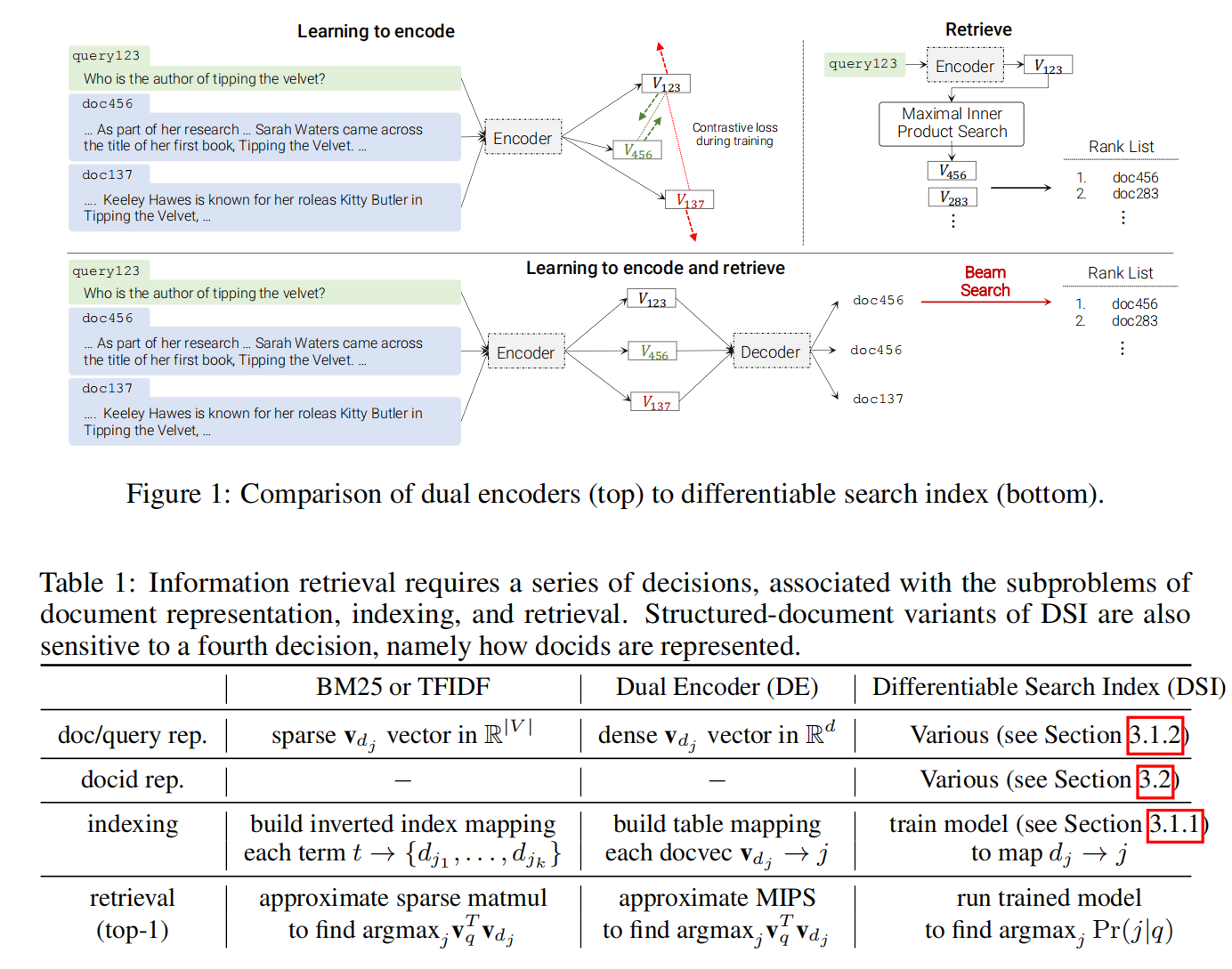
This paper addresses information retrieval with a Seq2Seq formulation, in contrast to prior dual-encoder models.
The most direct way to use Seq2Seq for retrieval is to take a query and use beam search to generate documents.
However, the setup is not a pure sequence-to-sequence mapping from query to documents.
Instead, the problem is split into two tasks: documents ↔ docids, and query → docids. The first task is called indexing: it establishes a one-to-one mapping between a document and a docid, where the docid can be viewed as a compressed summary of the document (itself a seq2seq task). The second task is retrieval: given a query, the model generates candidate docids (again a seq2seq task). Retrieval is therefore indirect: query → docids → documents.
The indexing task mainly teaches the model the relationship between docids and documents; retrieval is where search actually happens.
During training, indexing and retrieval share model parameters (otherwise the model may not learn what docids mean) and are optimized jointly via multi-task learning.
Differentiable Search Index
The core idea of a Differentiable Search Index (DSI) is to parameterize the traditional multi-stage retrieve-and-rerank pipeline with a single model. DSI supports two operations:
Indexing: A DSI model must learn to link document content to the corresponding document identifier (docid). This work uses a seq2seq model with document content as input and the identifier as output.
Retrieval: Given a query, a DSI model should return a ranked list of candidate docids via autoregressive generation (also seq2seq).
Semantically Structured Identifiers
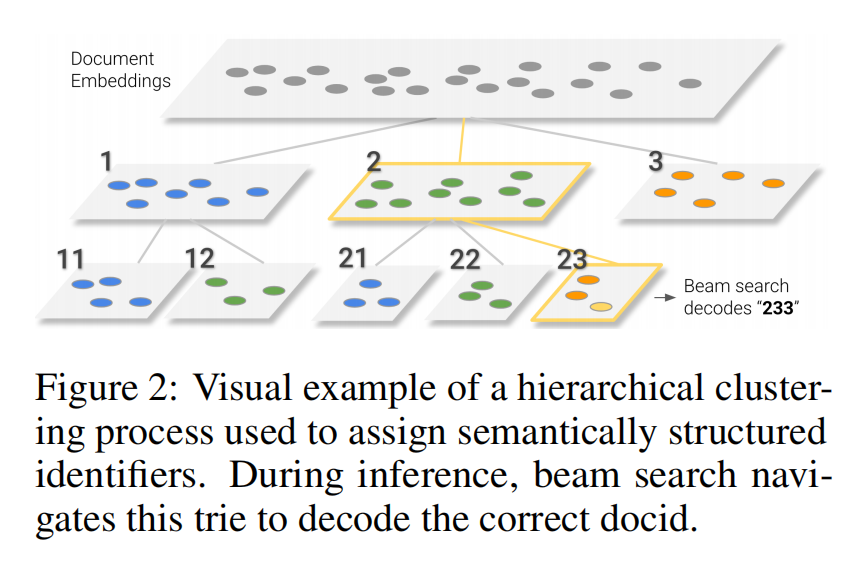
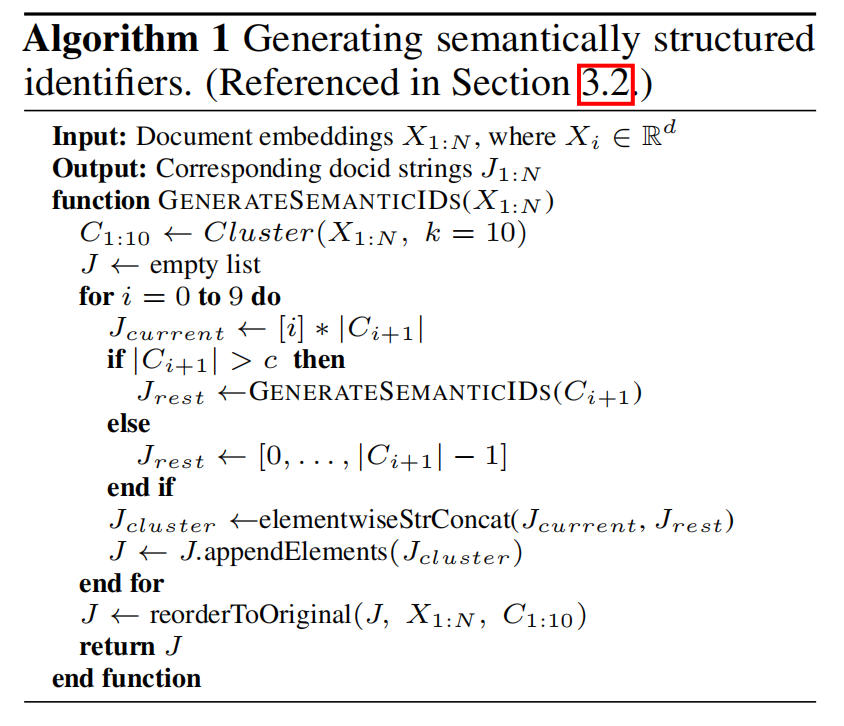
Instead of random integer identifiers, documents use structured integers—semantically structured identifiers. Concretely, given a corpus to index, all documents are clustered into 10 groups. Each document receives a digit from 0 to 9. Each cluster is processed recursively in the same way: split into up to 10 sub-clusters labeled 0–9. If a cluster has fewer than 10 documents (say, c documents), labels run from 0 to c-1. This yields a tree whose leaves are individual documents; a document’s final identifier is the concatenation of digits along the path from the root to that leaf.
Document clustering is unsupervised: BERT representations are extracted and k-means is applied.
Hyperparameters fix 10 clusters per split and a threshold c of 100; clustering continues while a group has more than 100 documents.
Experiments
<HR align=left color=#987cb9 SIZE=1>