
EMNLP-2021 CodeT5:Identifier-aware Unified Pre-trained Encoder-Decoder Models for Code Understanding and Generation
CodeT5: full Transformer, identifiers, and bimodal learning
Abstract
Most existing pre-training methods use encoder-only or decoder-only architectures. This work proposes CodeT5, a unified encoder–decoder Transformer that supports both code understanding and generation, together with an identifier-aware pre-training objective.
Introduction
Pre-trained models have succeeded widely on language tasks, yet most are either encoder-only (e.g., BERT) or decoder-only (e.g., GPT), which is suboptimal when both understanding and generation are required. For instance, CodeBERT needs an extra decoder for code summarization, and that decoder cannot leverage the pre-training stage.
Conventional NLP-style pipelines also treat source code as a token sequence much like natural language, largely overlooking the rich structured semantics of code.
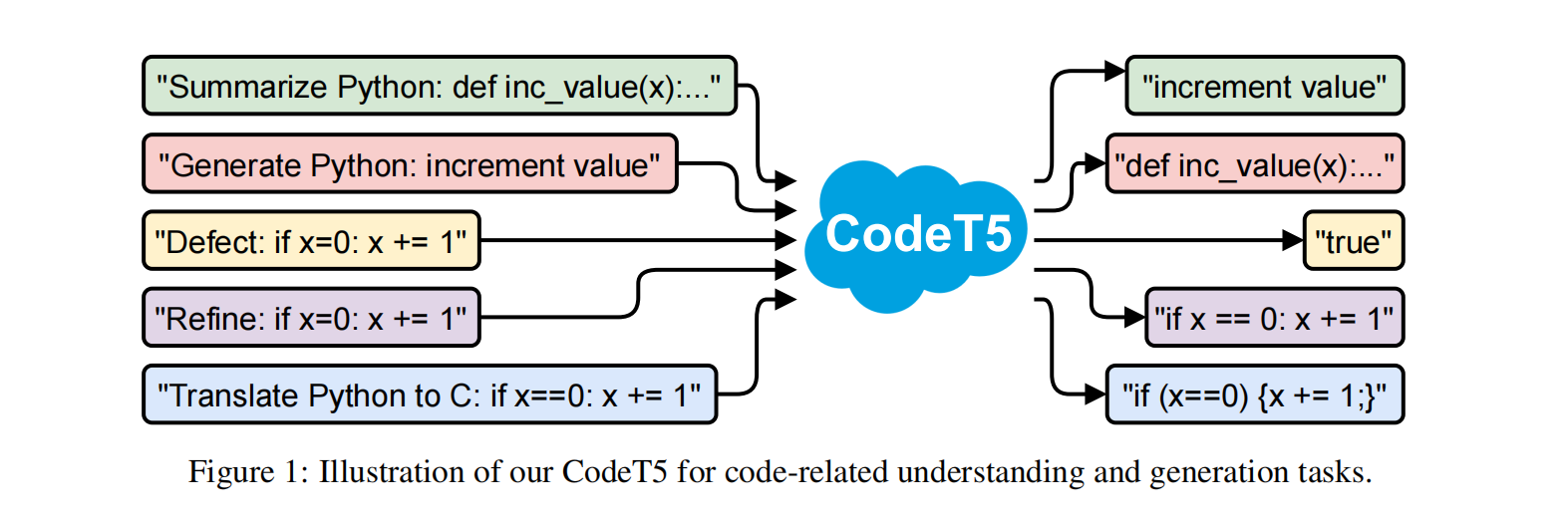
CodeT5 uses denoising seq2seq pre-training, exploits developer-assigned identifiers, learns stronger natural-language–programming-language (NL–PL) alignment from code and comments, and is pre-trained on CodeSearchNet.
CodeT5
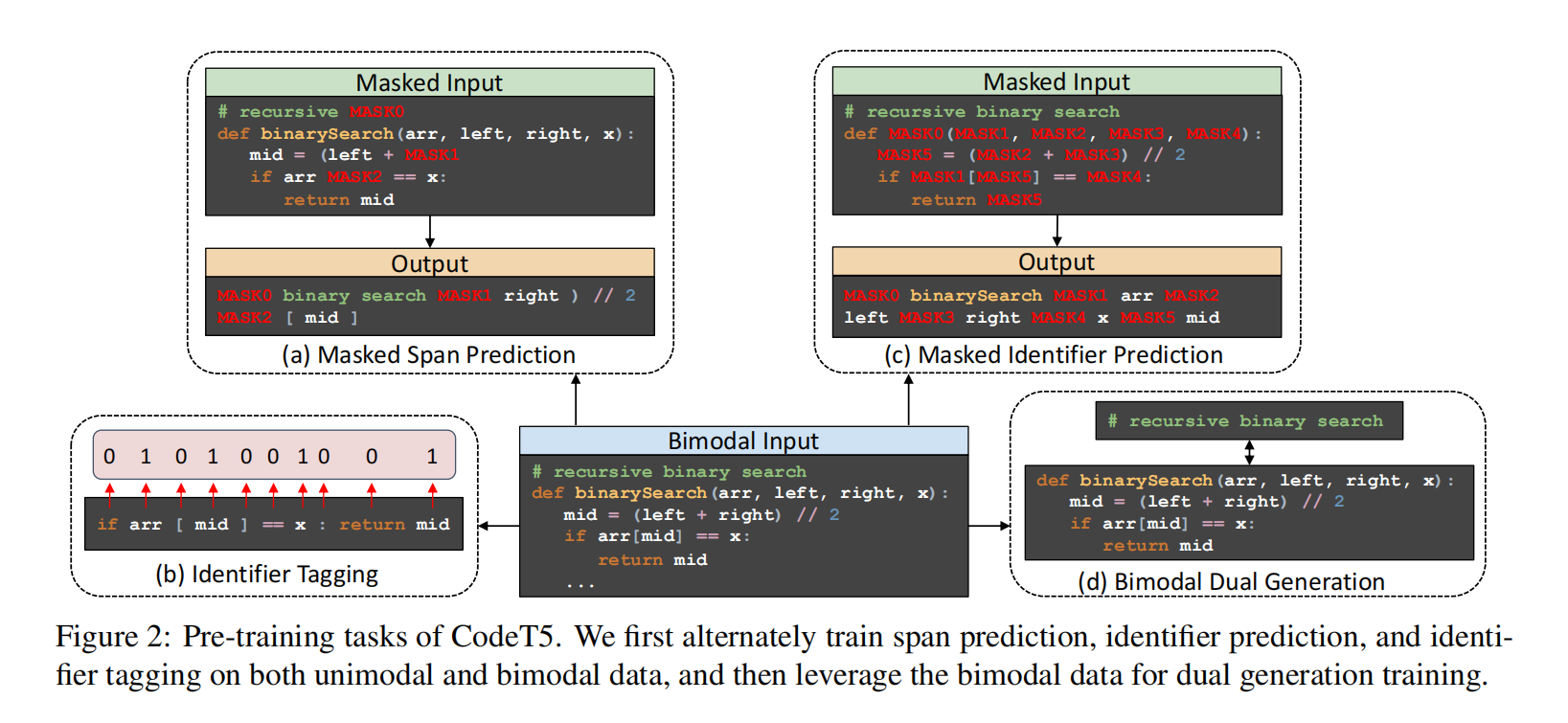
Pre-training Tasks
Identifier-aware Denoising Pre-training
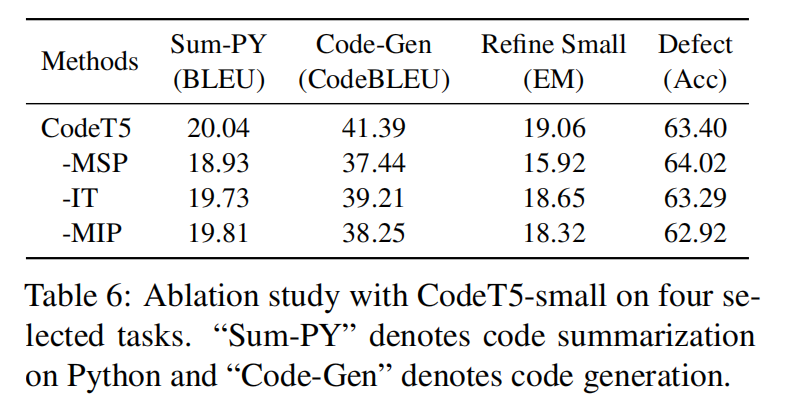
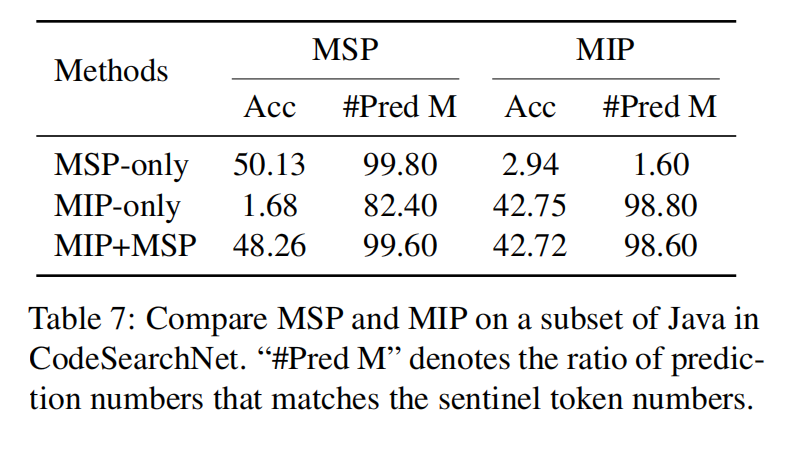
The source sequence is first corrupted with noise functions; the decoder then reconstructs the original text—this is masked span prediction (MSP).
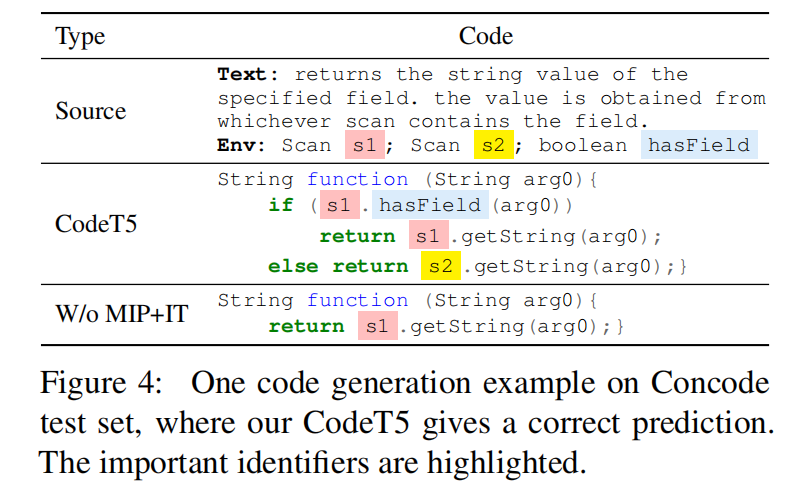
To incorporate more code-specific structure (identifier node types in the AST), two auxiliary tasks complement denoising pre-training: Identifier Tagging (IT) and Masked Identifier Prediction (MIP).
- Identifier Tagging (IT): indicates whether a token is an identifier.
- Masked Identifier Prediction (MIP): unlike masking a contiguous span, MIP masks all identifiers in a code fragment.
Bimodal Dual Generation
NL→PL and PL→NL generation are treated as two tasks; for each NL–PL pair, two training instances with opposite directions are constructed.
Experiment
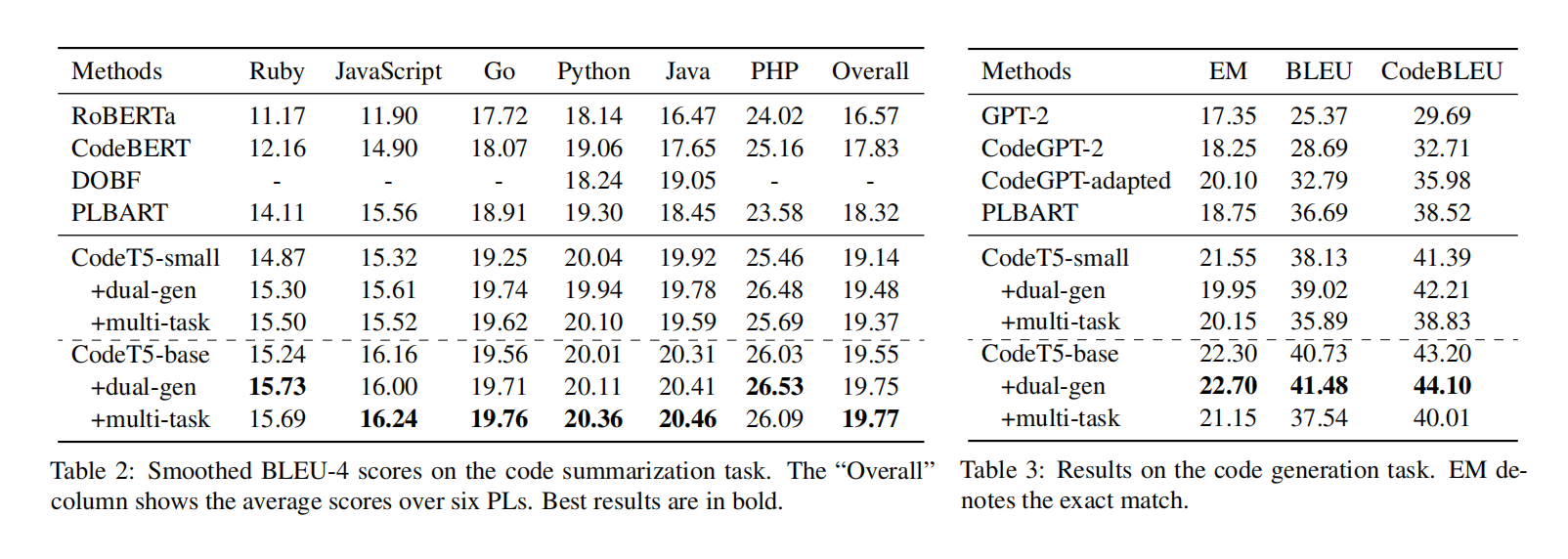
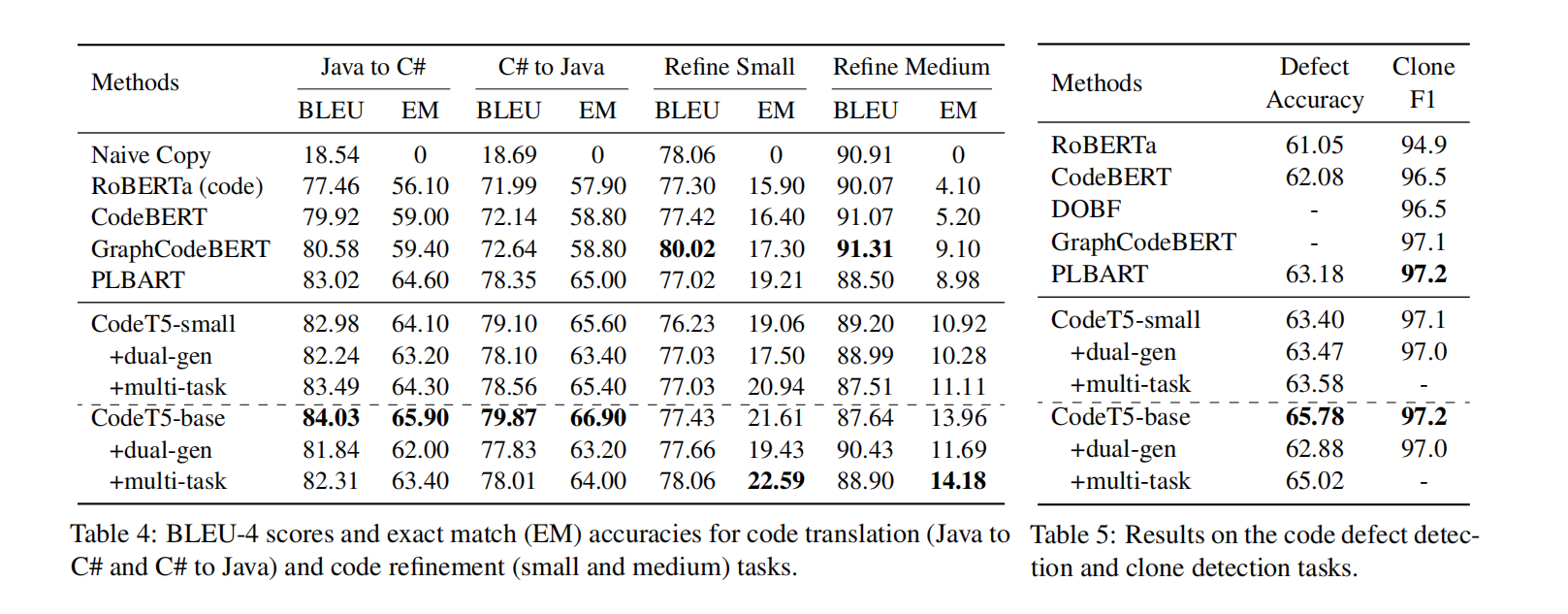
<HR align=left color=#987cb9 SIZE=1>