
ACL-2022 Impact of Evaluation Methodologies on Code Summarization
Paper: Impact of Evaluation Methodologies on Code Summarization
Code: https://github.com/EngineeringSoftware/time-segmented-evaluation
This paper reflects on evaluation methodology and dataset splitting; I find it highly instructive.
Time segmented: splitting datasets by timestamp
Abstract
How practitioners split datasets into training, validation, and test sets has received little systematic study. The authors propose time-segmented dataset splitting based on timestamps, compare it with common mixed-project and cross-project splits, and describe realistic deployment scenarios for this approach.
Introduction
Although data-driven deep learning has driven many new techniques, evaluation methodology remains understudied.
Time-based dataset design is meaningful in software engineering: newly written summaries are often influenced by older ones, yet prior work typically assumes data are independent and identically distributed (i.i.d.), which can inflate reported metrics or mislead practitioners when models are deployed.
Rather than evaluating generated comments without regard to when code was written (batch processing), a more realistic setting is continuous use: a model trained at one timestamp is evaluated on data from later timestamps (continuous processing).
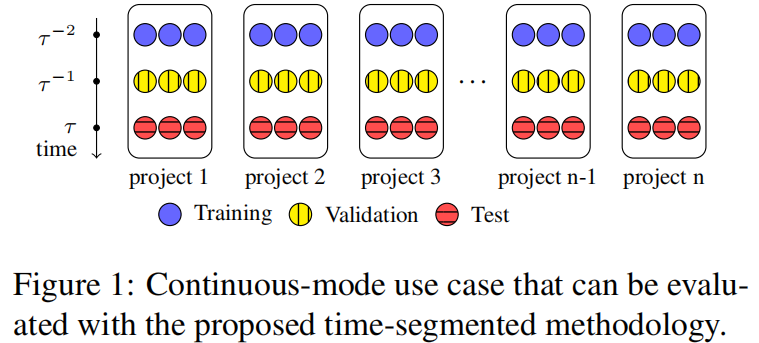
Time-segmented dataset split
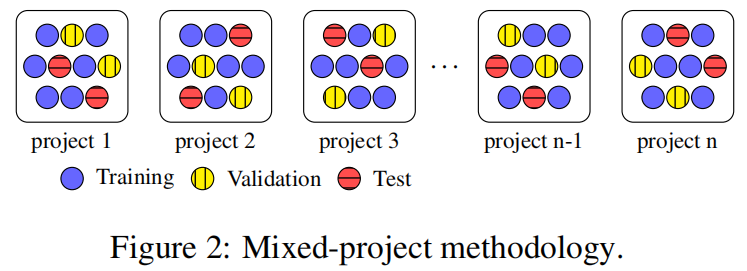
Mixed-project dataset split
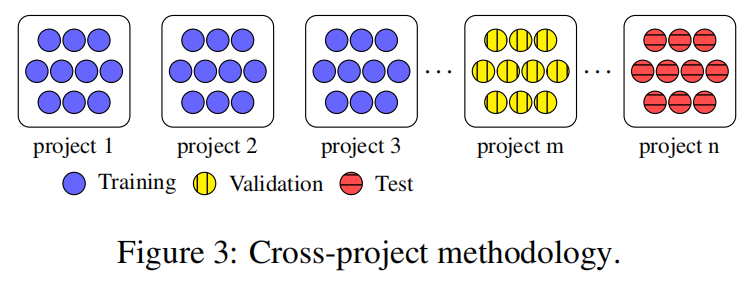
Cross-project dataset split
The authors argue that we need to choose evaluation methodologies more carefully when reporting ML results, aligning splits with the target task and intended use.
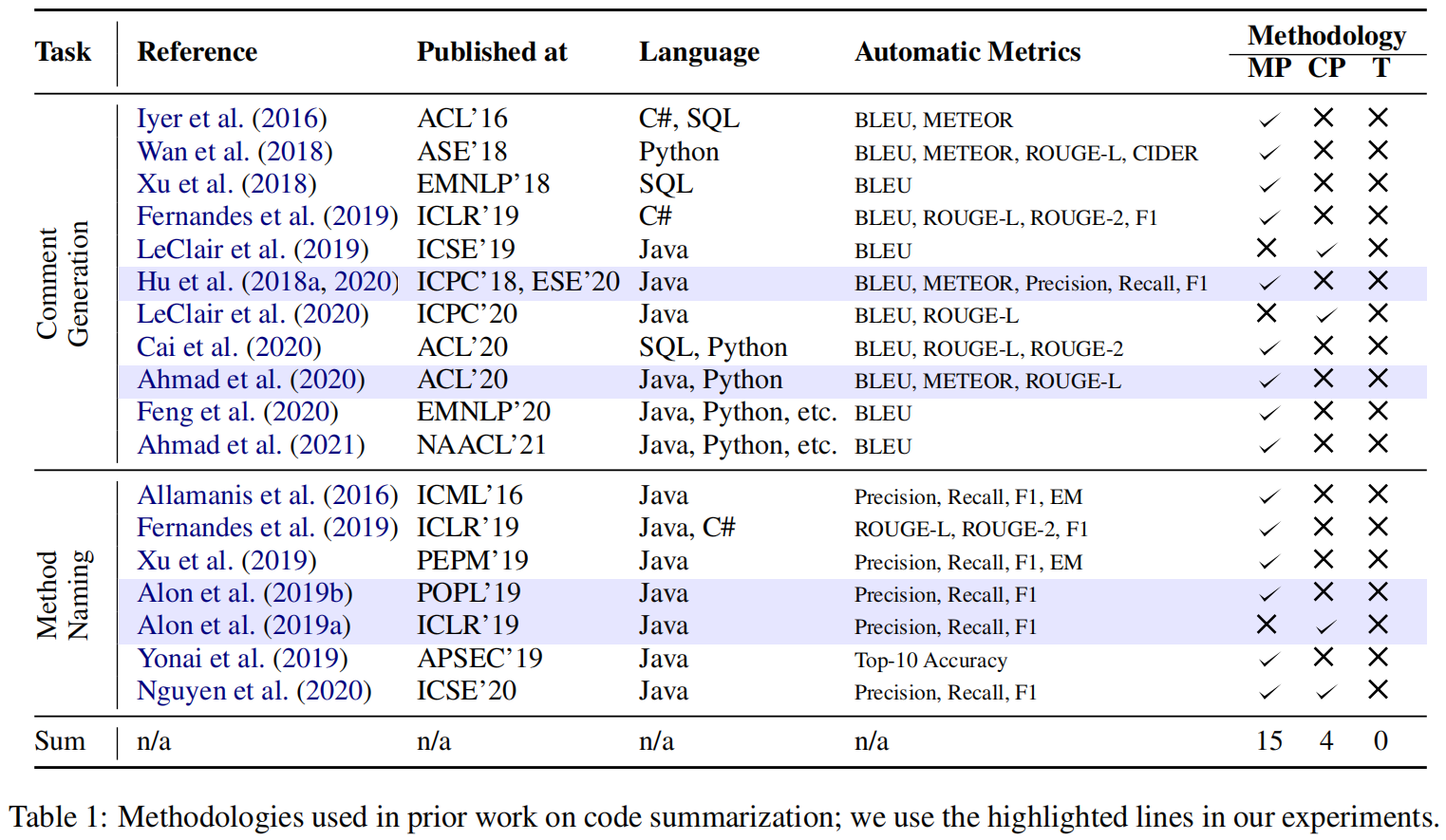
Use Cases
Earlier ML work focused on benchmarks without clearly describing real use cases. We should ask how developers will actually use these models. The authors sketch several hypothetical scenarios (acknowledged as illustrative rather than empirically validated).
Use mixed-project evaluation when developers have written some comments; use cross-project when they have written none; use time-segmented splitting when comments are written contemporaneously within the same timeline.
Application of Methodologies
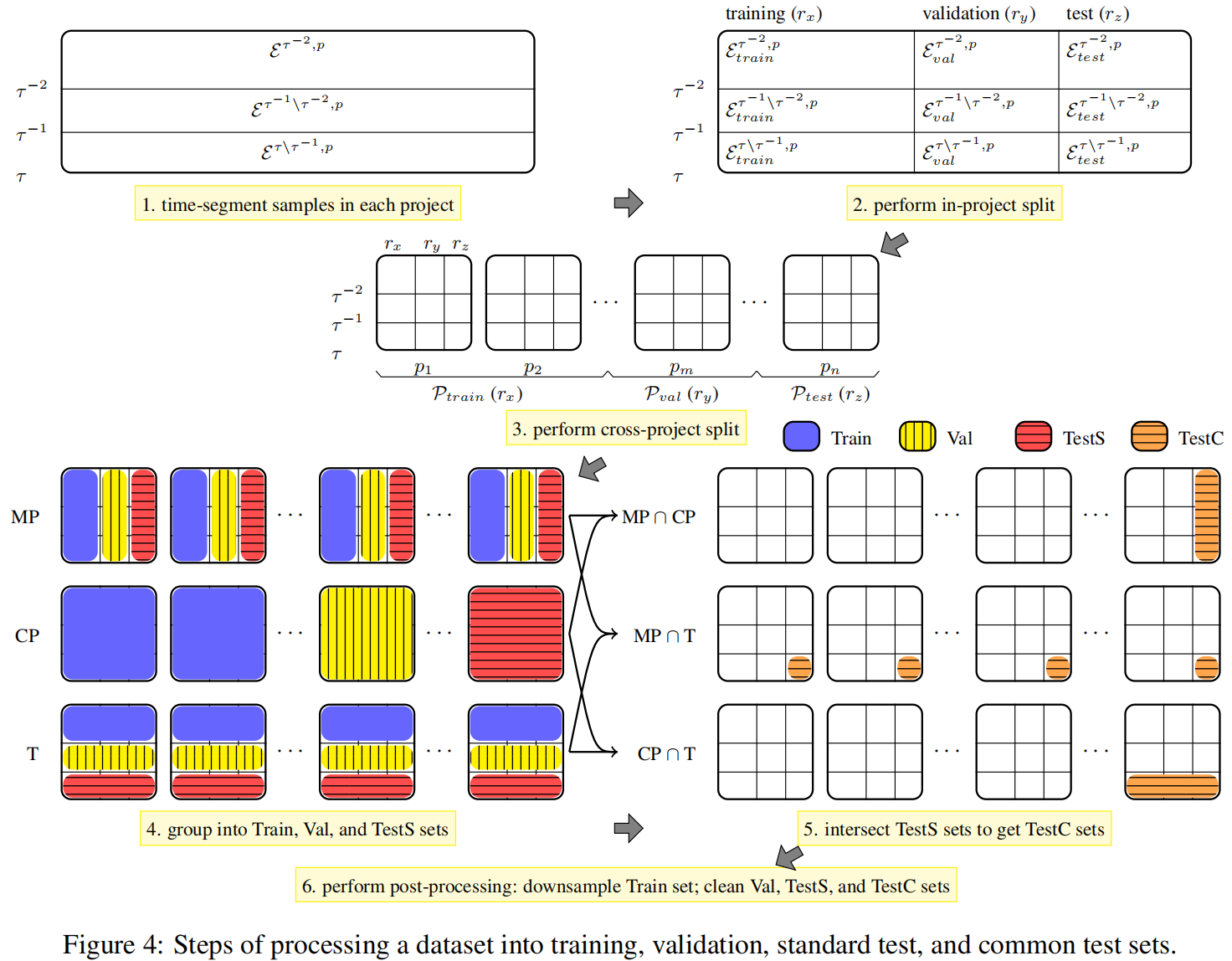
Experiment
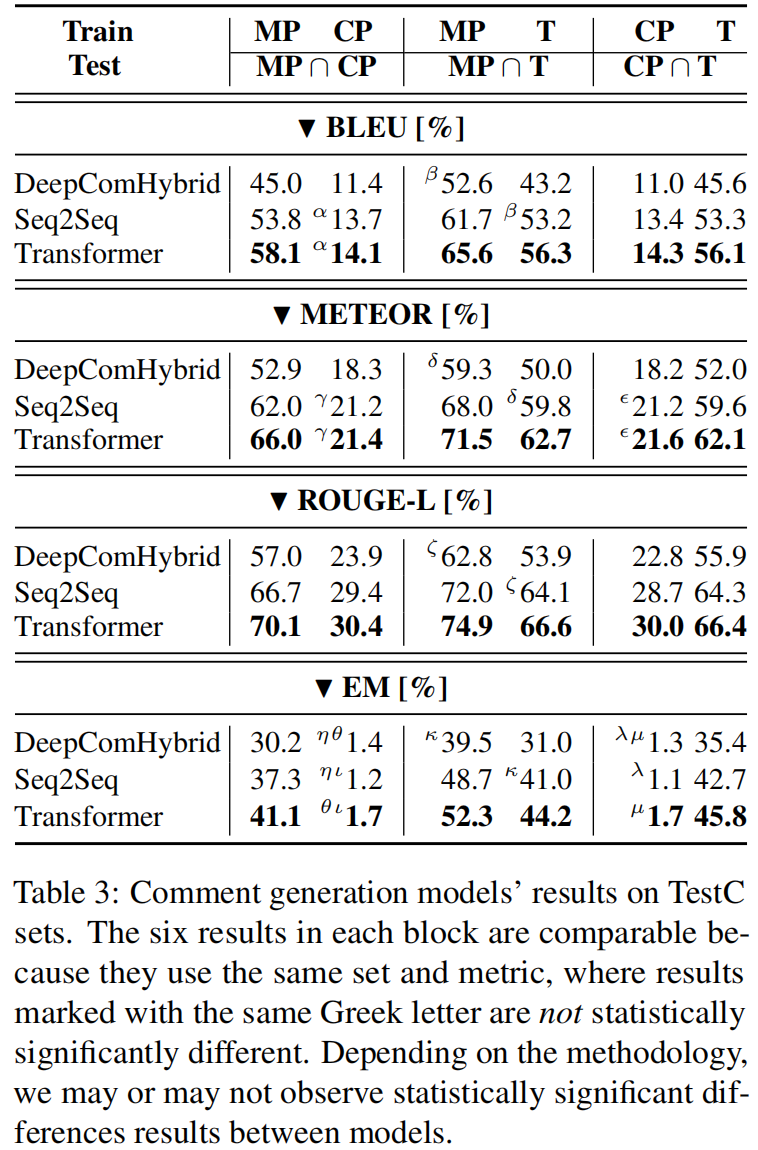
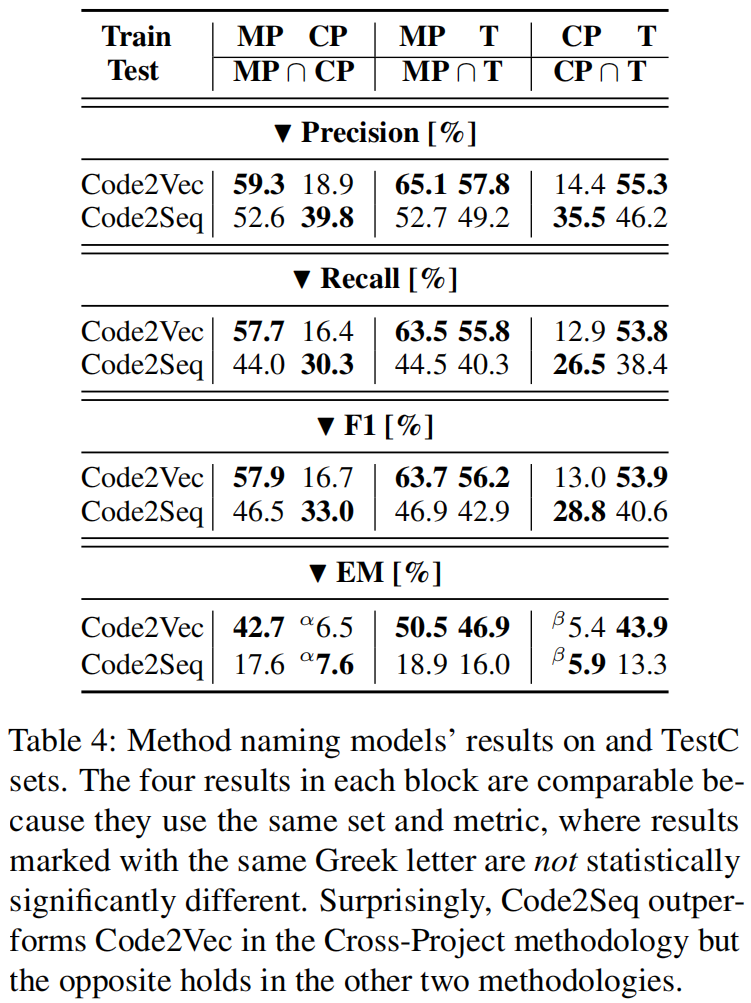
Future Work
Methodologies for Other SE Areas Using ML Models
Transferring this approach beyond code summarization mainly requires adapting inputs and outputs—for example, for commit-message generation, replace “(code, comment) pairs” with “(code change, commit message) pairs.”
Other Use Cases and Methodologies
Cross-project continuous use case: At time $\tau$, training does not use prior data from the same project but instead samples from other projects. This may be less practical but can better stress-test generalization.
Online continuous use case: At time $\tau$, training neither discards the model from time $t$ nor retrains from scratch; it uses online learning, updating with data between $\tau^{-1}$ and $\tau$.
<HR align=left color=#987cb9 SIZE=1>