
Journal of Cheminformatics 2024
PETA
A systematic study of how sub-word tokenization — BPE and Unigram versus per-amino-acid vocabularies — shapes protein pretraining and transfer to downstream applications.
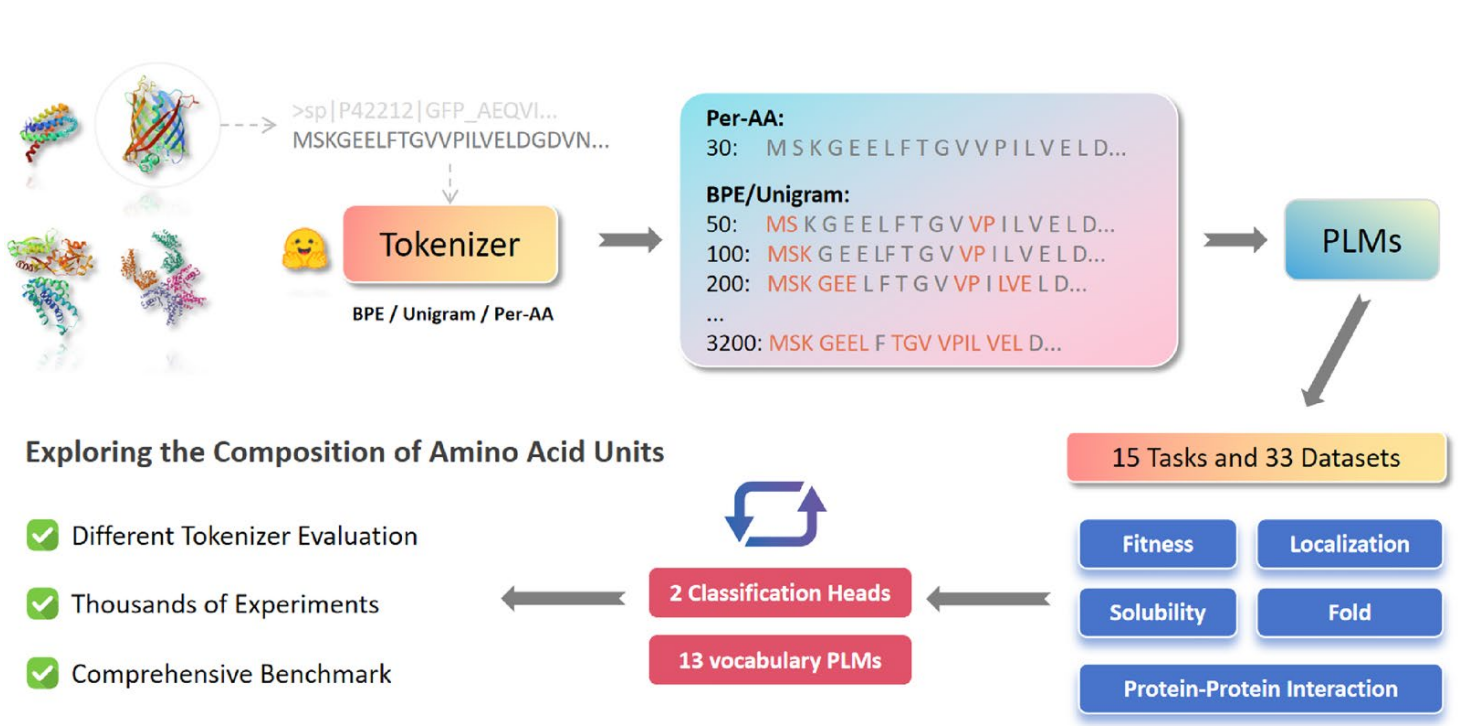
Why tokenization matters
Most protein language models tokenize sequences one amino acid at a time. That choice is simple and biologically natural, but it ignores a lesson from NLP: sub-word units can compress repetitive motifs, change context length, and alter what a Masked LM learns to represent.
PETA asks a practical question for transfer learning: when you hold architecture and pretraining budget roughly fixed, how do BPE / Unigram vocabularies of different sizes compare to a classic per-AA tokenizer on real downstream protein tasks?
What PETA provides
The project (also referred to as Venus-PETA in the codebase) releases a family of Masked LM checkpoints and tokenizers on Hugging Face under AI4Protein/deep_*, spanning:
- Per-AA baseline —
AI4Protein/deep_base(vocab size 33) - BPE — vocab sizes 50 → 3200 (
deep_bpe_*) - Unigram — vocab sizes 50 → 3200 (
deep_unigram_*)
Sub-word models merge frequent residue patterns into multi-letter tokens (e.g. SLG, AK, PF), shortening tokenized length relative to character-level encoding while keeping special start/end tokens for Transformer training.
from transformers import AutoTokenizer, AutoModelForMaskedLM

tokenizer = AutoTokenizer.from_pretrained("AI4Protein/deep_bpe_3200")
model = AutoModelForMaskedLM.from_pretrained("AI4Protein/deep_bpe_3200")

sequence = "MSLGAKPFGEKKFIEIKGRRM"
print(tokenizer.tokenize(sequence))
# ['M', 'SLG', 'AK', 'PF', 'GE', 'KK', 'FI', 'EI', 'KG', 'RR', 'M']
Downstream evaluation
Beyond releasing pretrained models, PETA packages a fine-tuning harness (peta/train.py) for transfer experiments: choose a dataset split, pooling head (e.g. attention1d), precision, and whether to fine-tune the full backbone or only the head.
Benchmark dataset archives and split definitions live with the
ProteinPretraining
repository.
The takeaway is evaluative rather than a single “best tokenizer forever”: sub-word schemes change sequence compression and inductive bias, and their effect on transfer depends on the task and vocabulary size — PETA supplies the controlled comparison to measure that trade-off.
Citation
If you use PETA, please cite:
@article{tan2024peta,
  title={PETA: evaluating the impact of protein transfer learning with sub-word tokenization on downstream applications},
  author={Tan, Yang and Li, Mingchen and Zhou, Ziyi and Tan, Pan and Yu, Huiqun and Fan, Guisheng and Hong, Liang},
  journal={Journal of Cheminformatics},
  volume={16},
  number={1},
  pages={92},
  year={2024},
  publisher={Springer},
  doi={10.1186/s13321-024-00884-3}
}