
ISMB/ECCB 2025 · Bioinformatics
VenusREM
Retrieval-enhanced fitness prediction that bridges high-throughput mutation evaluation and wet-lab directed evolution — combining structure/sequence protein language model signals with explicit MSA retrieval.
What the model does
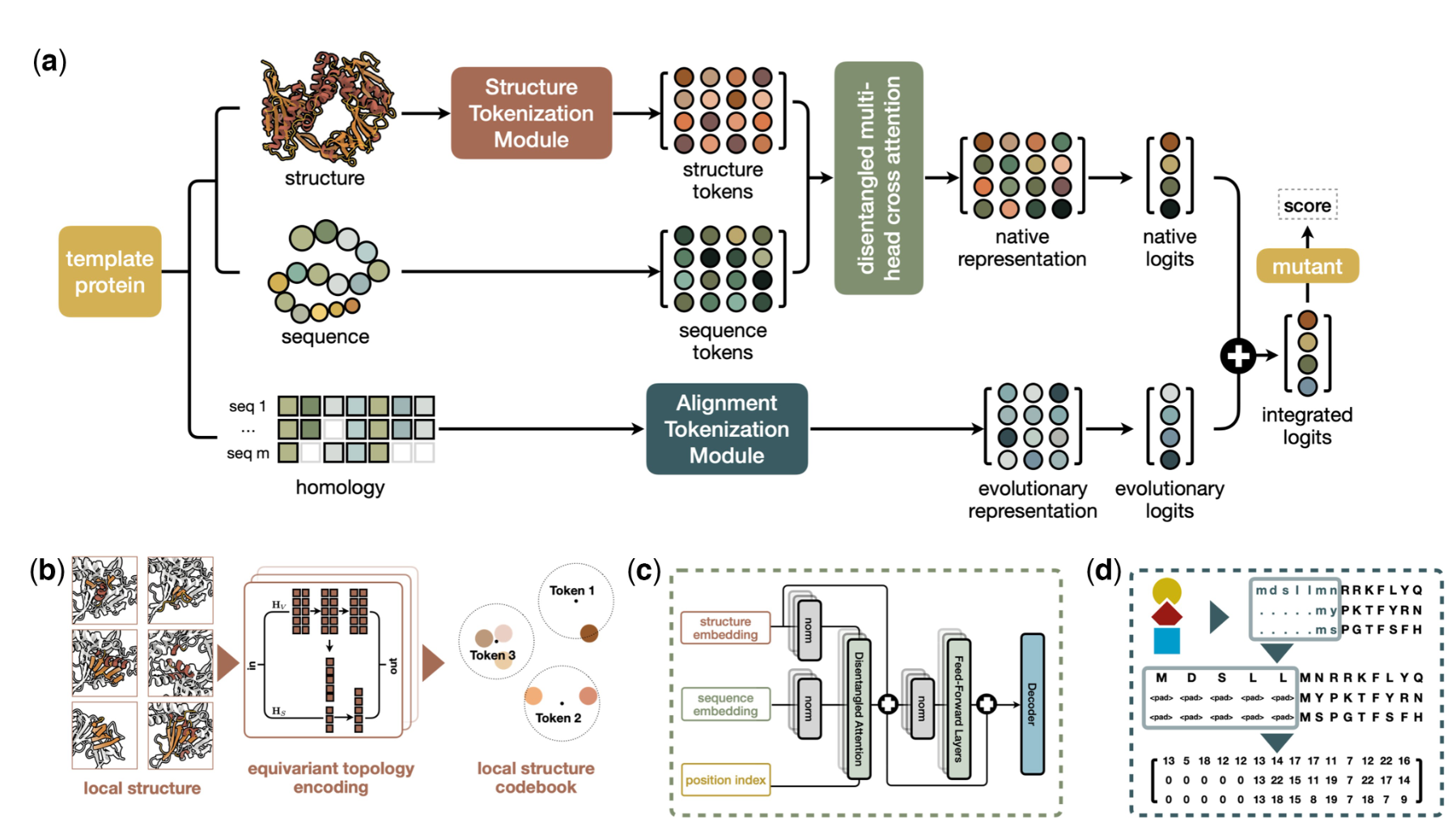
VenusREM performs zero-shot mutant scoring: given a wild-type sequence, structure, and optional substitution list, it estimates relative fitness without assay-specific fine-tuning.
Structure and sequence protein language model (PLM) signals are combined with MSA retrieval — homology alignments prepared as EVCouplings a2m or ColabFold a3m files, released with the VenusREM dataset on Hugging Face.
The same inference path supports ProteinGym-scale evaluation and single-protein wet-lab campaigns: prepare sequences, structures, structure tokens, and alignments, then run compute_fitness.py.
Why retrieval helps
VenusREM sits in a family of zero-shot predictors from the same line of work, each emphasizing a different structural or evolutionary cue:
- ProtSSN — geometrical encoding over amino-acid coordinates (no MSA required).
- ProSST — local structure tokens with disentangled sequence–structure attention.
- VenusREM — explicit MSA retrieval layered on structure-aware PLM scoring.
In practice the three are complementary: retrieval helps when deep, informative alignments are available; coordinate- or token-level structure models can be preferable when MSAs are shallow or costly to build.
Setting --alpha 0 in VenusREM’s fitness script recovers a ProSST-style score without MSA reweighting, easing head-to-head comparison.
Results highlight
Ranked 1st on the ProteinGym Substitution leaderboard (April 2025), with strong standing also reported on VenusMutHub and related mutation-effect suites. See the leaderboard page for a compact family comparison; official live rankings remain on ProteinGym.
Wet-lab oriented workflow
For a custom protein, the README pipeline mirrors a typical directed-evolution prep:
- Homology search — JackHMMER / EVCouplings against UniRef100; select an
a2m(or supply ColabFolda3m). - Structure — high-quality PDB from AlphaFold DB/Server, ESMFold, or experiment.
- Structure sequence —
get_struc_seq.pyover the PDB directory. - Mutant table — assay CSV or all single-site variants via
get_sav.py. - Score —
compute_fitness.py --base_dir … --out_scores_dir ….
Preprocessed ProteinGym v1 bundles (alignments, PDBs, structure sequences, substitutions) are available from the VenusREM dataset.
Integration
VenusREM is integrated into VenusFactory2 (venusfactory.bio); open-source stack on GitHub: ai4protein/VenusFactory2.
Citation
If you use VenusREM, please cite:
@article{tan2025venusrem,
    author = {Tan, Yang and Wang, Ruilin and Wu, Banghao and Hong, Liang and Zhou, Bingxin},
    title = {From high-throughput evaluation to wet-lab studies: advancing mutation effect prediction with a retrieval-enhanced model},
    journal = {Bioinformatics},
    volume = {41},
    number = {Supplement_1},
    pages = {i401-i409},
    year = {2025},
    doi = {10.1093/bioinformatics/btaf189}
}