
ICLR 2025
VenusVaccine
Immunogenicity prediction with dual attention enables vaccine target selection — multimodal sequence, structure, and physicochemical encoding for protective versus non-protective antigen classification.
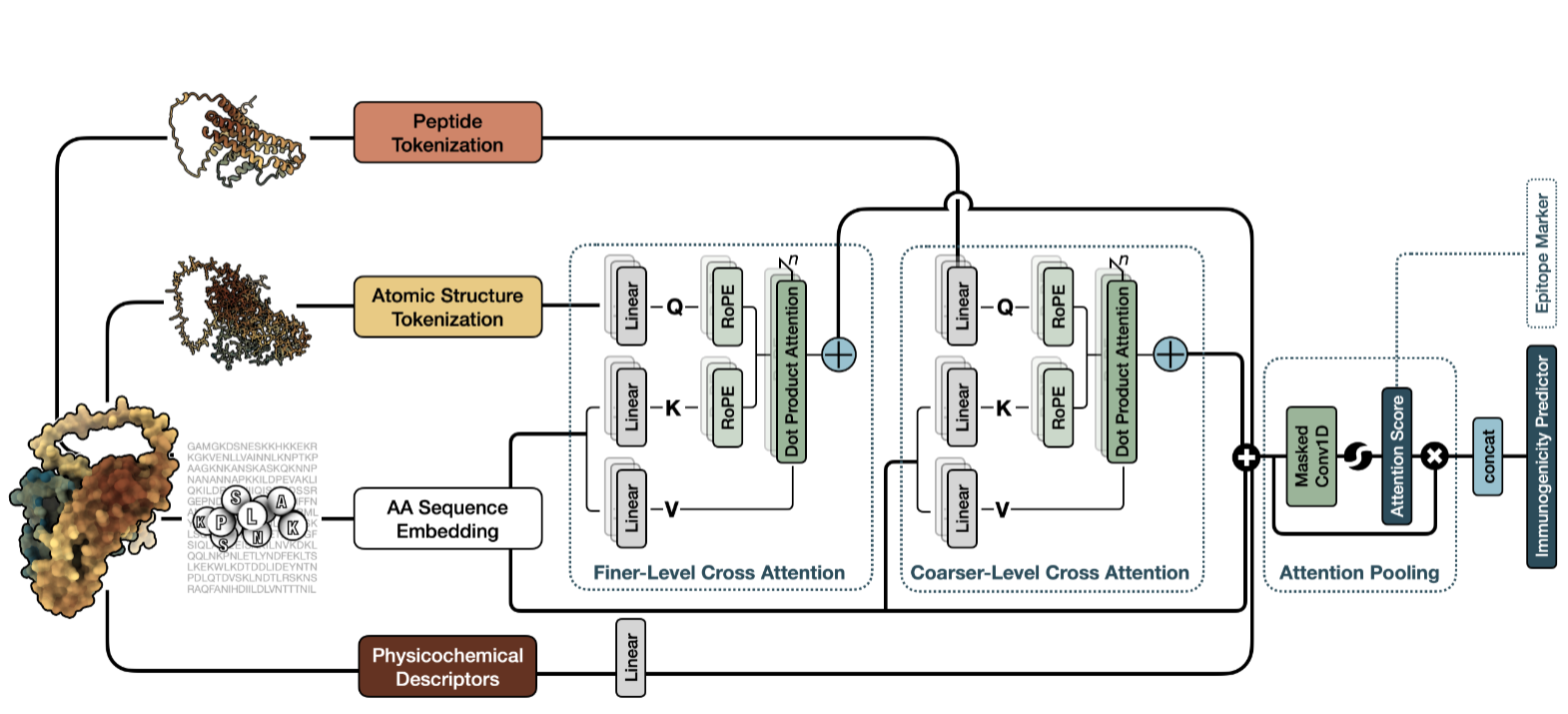
What the model does
VenusVaccine predicts whether an antigen is protective or non-protective, supporting vaccine target selection from protein antigens. Inputs combine amino-acid sequence, structure-derived tokens, and physicochemical descriptors in a single multimodal encoder with dual attention.
Released checkpoints cover three antigen settings — Bacteria, Virus, and Tumor — so the same inference path can be pointed at the matching pathogen type.
Multimodal encoding
Beyond the amino-acid sequence, VenusVaccine consumes structure and property streams that are extracted into a shared JSON feature format:
- Foldseek secondary-structure sequences for local backbone geometry.
- ESM3 structure-sequence encoding of 3D conformation.
- E-descriptors (5-D) and Z-descriptors (3-D) for physicochemical context.
Pretrained protein language models provide sequence backbone features through lightweight adapters, with support for ESM, Bert, and Ankh families among others.
Inference workflow
- Obtain a PDB (experimental or predicted, e.g. ESMFold / AlphaFold).
- Convert structures with
pdb2json.pyto assemble sequence, Foldseek, ESM3, and E/Z features. - Run
infer.py -i input.json -t Bacteria|Virus|Tumoragainst the matching checkpoint.
Outputs include a binary protective-antigen label and a probability score, suitable for ranking candidate vaccine targets before wet-lab follow-up.
Citation
If you use VenusVaccine, please cite:
@inproceedings{li2025immunogenicity,
title={Immunogenicity Prediction with Dual Attention Enables Vaccine Target Selection},
author={Song Li and Yang Tan and Song Ke and Liang Hong and Bingxin Zhou},
booktitle={The Thirteenth International Conference on Learning Representations},
year={2025},
url={https://openreview.net/forum?id=hWmwL9gizZ}
}