
ICLR 2026
VenusX
A large-scale benchmark for fine-grained protein functional annotation and pairing at residue, fragment, and domain levels.
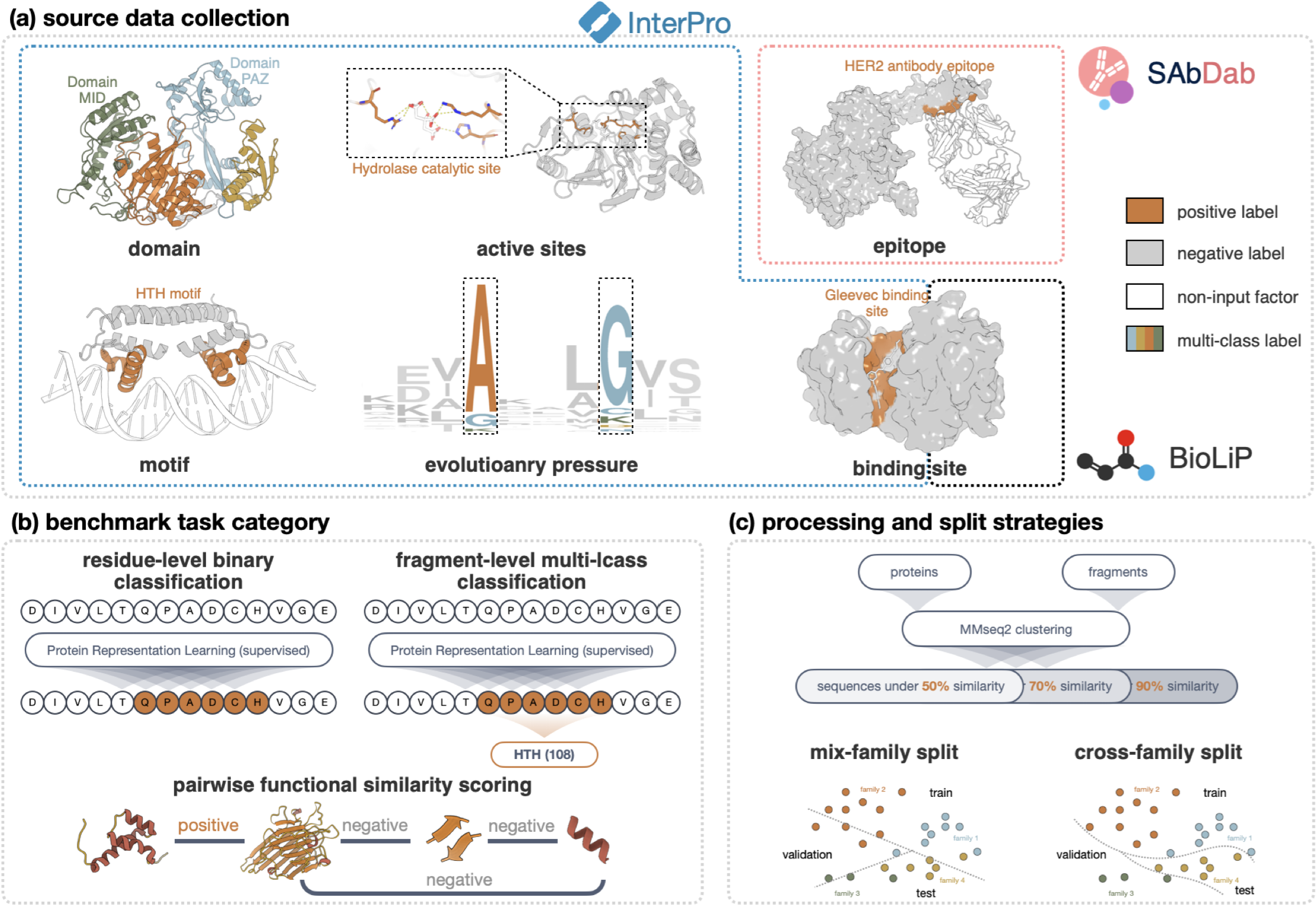
What VenusX evaluates
Global protein labels and whole-sequence embeddings tell only part of the story. VenusX asks models to resolve function where biology actually happens — at local sites, fragments, and matched substructures — through three complementary tasks:
- Residue-level binary classification — identify functionally important residues (active sites, binding sites, conserved sites, motifs, domains, and related annotations).
- Fragment-level multi-class classification — assign biological roles to sequence fragments under family-aware splits.
- Pairwise functional similarity scoring — match functionally related proteins or fragments without requiring explicit function labels at inference time.
Together these tasks stress local resolution, transfer across families, and unsupervised functional pairing — capabilities that sequence- and structure-aware protein models often claim but rarely measure jointly.
Why fine-grained understanding matters
Many protein benchmarks reward global competence: fold-level retrieval, whole-protein function prediction, or mutation effects aggregated over a sequence. Those signals are valuable, but they can mask weak local grounding. A model may retrieve the right family while missing catalytic residues, confuse motif boundaries, or fail to pair fragments that share a biochemical role.
VenusX makes that gap explicit. Cross-family residue tasks remain difficult even for strong pretrained baselines, while mixed-family settings and some fragment/pairwise regimes look much easier. The contrast argues for evaluation that separates in-distribution annotation from out-of-family local transfer — and for models that are more robust and interpretable at subprotein resolution.
Dataset & splits
Datasets are released as a Hugging Face collection:
AI4Protein/venusx-dataset.
Naming follows task × annotation × split (for example, VenusX_Res_Act_MF50 for residue-level active-site identification under a mixed-family, 50% fragment-similarity partition).
- Cross-family — out-of-distribution residue evaluation; train and test families are disjoint.
- Mixed-family — in-distribution residue evaluation with families shared across splits.
- MF50 — fragment multi-class splits clustered at 50% fragment similarity.
- F50 / P50 — pairwise functional similarity at fragment (F50) or protein (P50) level.
Annotations draw primarily from InterPro (and related sources such as BioLiP / SAbDab for selected binding and epitope settings). Structures support sequence–structure baselines where applicable.
Key findings
Structure-aware models (e.g. SaProt) often lead difficult cross-family residue and fragment MF50 settings, while strong sequence PLMs (Ankh, ESM2) can dominate easier mixed-family residue tasks. Pairwise F50 active-site matching is led by structure-aware / alignment methods such as ESM-IF and Foldseek. Full curated tables and tabs live on the leaderboard page; the interactive board remains at ai4protein.github.io/venusx.
Get started
- Clone ai4protein/VenusX and create the conda env from
environment.yaml(orrequirements.txt). - Download the relevant split from the VenusX dataset collection.
- Train residue token classifiers with
script/example/train/train_token_cls.sh. - Train fragment multi-class models with
script/example/train/train_fragment_cls.sh. - Compute embeddings / pairwise scores via scripts under
script/example/embedding.
VenusX is also integrated into VenusFactory2 (web playground).
Citation
If you use VenusX, please cite:
@inproceedings{tan2026venusx,
   title={{VenusX}: Unlocking Fine-Grained Functional Understanding of Proteins},
   author={Yang Tan and Wenrui Gou and Bozitao Zhong and Huiqun Yu and Liang Hong and Bingxin Zhou},
   booktitle={The Fourteenth International Conference on Learning Representations},
   year={2026},
   url={https://openreview.net/forum?id=zcmL592XRG}
}