ICLRw-2023 Enhancing Protein Language Models with Structure-based Encoder and Pre-training
Paper: Enhancing Protein Language Models with Structure-based Encoder and Pre-training
ESM-GearNet: Multi-view contrastive learning with ESM-1b + GearNet
Abstract
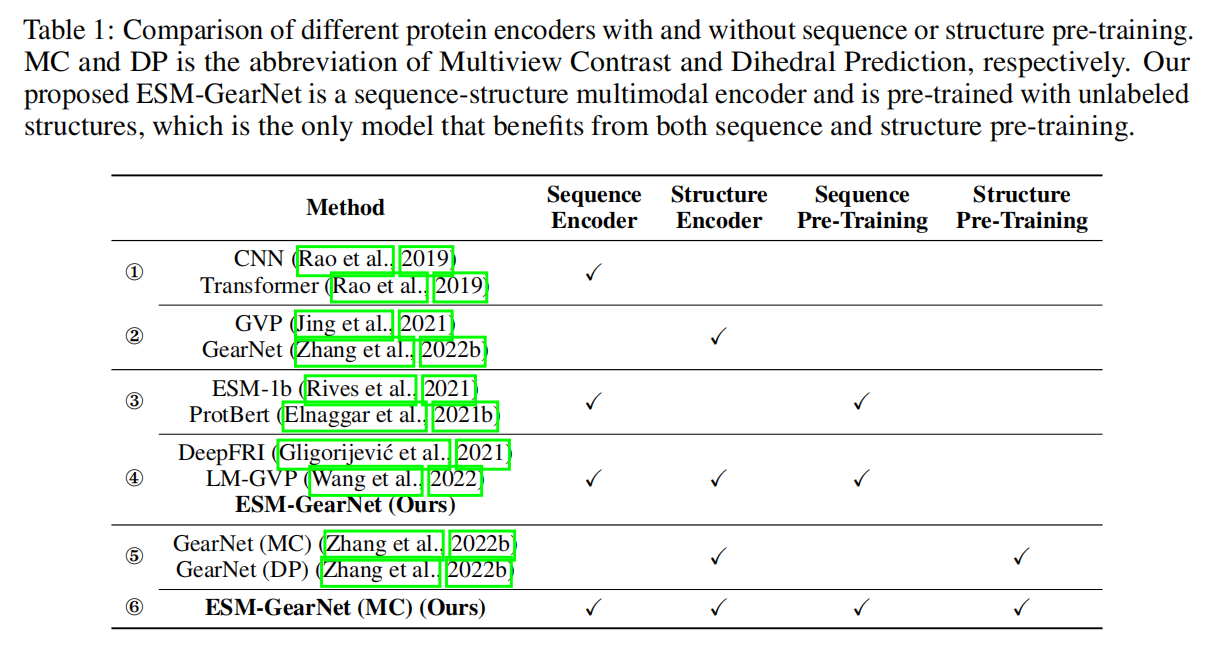
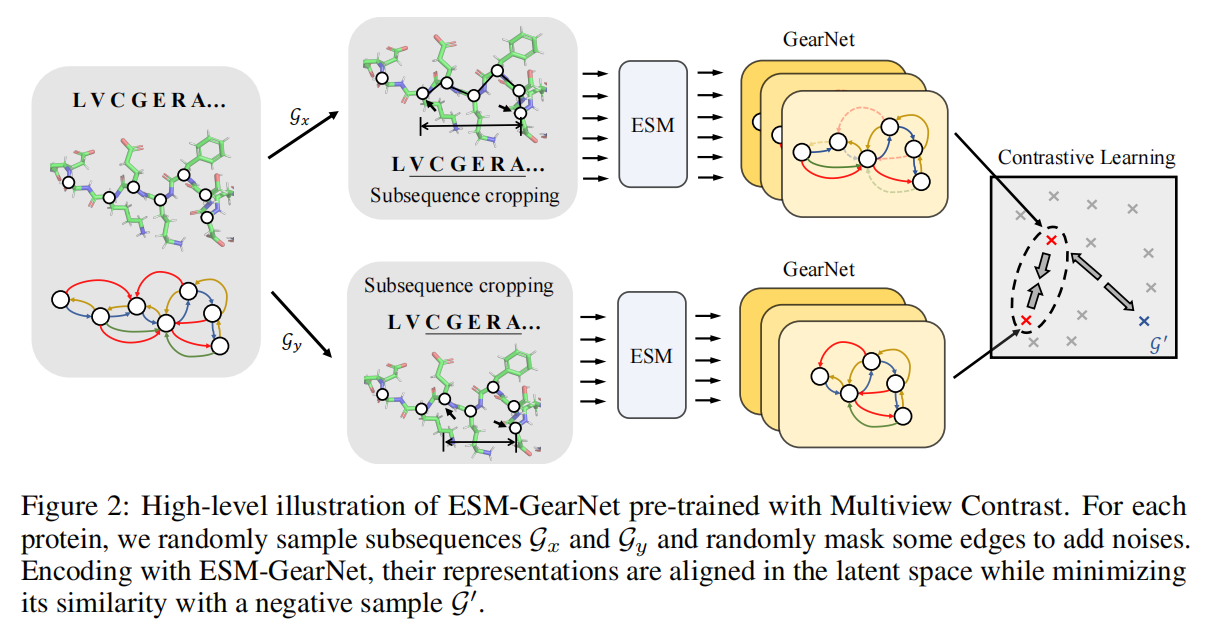
Pre-trained language models can capture intrinsic relationships among amino acids; adding structural information further strengthens PLM performance. This work explores different ways to combine structure encoders with PLM encoders, proposes ESM-GearNet, and pre-trains it with contrastive learning to align whole-protein structures with subsequence-level structure views.
Introduction
Trained with masked language modeling, existing PLMs capture co-evolution signals well and implicitly capture residue–residue contact information. Because they do not explicitly take protein structure as input, however, whether they capture fine-grained structural features remains an open question.
Methods
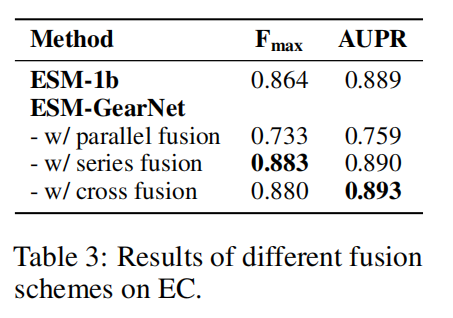
Enhancing Protein Language Models with Protein Structures
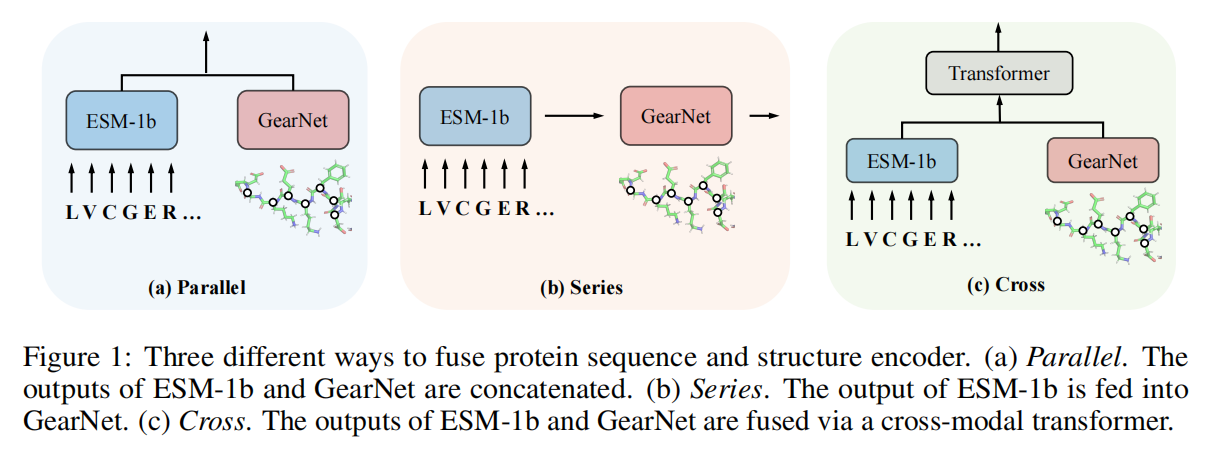
To avoid substantially changing the learned representations, the authors use smaller learning rates than those used for standalone ESM-1b and GearNet.
Pre-training ESM-GearNet with Unlabeled Protein Structures
Experiments
Experimental Setup
Pre-training dataset
AlphaFold Database v1 and v2: 365K proteome predictions and 440K Swiss-Prot predictions.
Downstream datasets
Enzyme Commission (EC) number prediction.
Gene Ontology (GO) term prediction: molecular function (MF), biological process (BP), and cellular component (CC).
Training
50 epochs on the AlphaFold Database; 200 epochs on EC and GO prediction.
Multi-view contrastive pre-training: cropped subsequence length 50, mask ratio 15%, InfoNCE temperature 0.07, batch size 256, learning rate 2e-4.
Downstream tasks: batch size 2, learning rate 1e-4, ReduceLROnPlateau scheduler with factor 0.6 and patience 5.
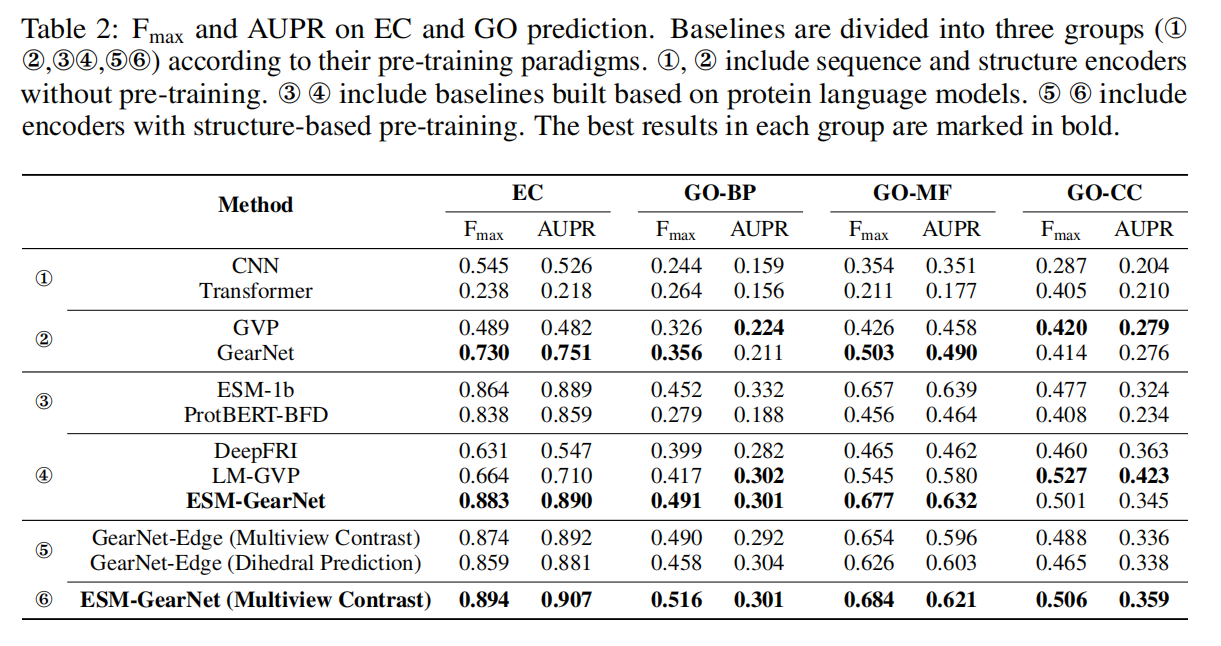
Results