
NeurIPS-2019 Evaluating Protein Transfer Learning with TAPE
Paper: Evaluating Protein Transfer Learning with TAPE
Code: https://github.com/songlab-cal/tape
Further reading: https://zhuanlan.zhihu.com/p/401130363
TAPE: Tasks for Evaluating Protein Embeddings
Abstract
Introduces five biologically motivated semi-supervised learning tasks to evaluate protein embeddings: Tasks Assessing Protein Embeddings (TAPE). The benchmark spans predictions related to protein structure, evolution, and protein engineering, and indicates that self-supervised learning models have substantial untapped potential in biology.
Background
- Protein representation: a protein of length $L$ is represented as an amino acid sequence over 25 letters: $(x_1, x_2, \ldots, x_L)$. The 25 symbols comprise 20 standard amino acids, 2 non-standard amino acids, 2 ambiguous amino acids, and 1 unknown amino acid.
- Protein 3D structure: primary structure (amino acid sequence), secondary structure (local features), tertiary structure (global features).
- Homologs: two proteins that share a common ancestor but may differ substantially in sequence because they diverged long ago.
- In this work, the authors primarily use sequence identity (amino acid sequence alignment) to quantify evolutionary relationships.
Dataset
Pre-training corpus: a large unlabeled sequence dataset, Pfam (a database of 31M protein domains).
Supervised datasets: task-specific, with between 8,000 and 50,000 training examples.
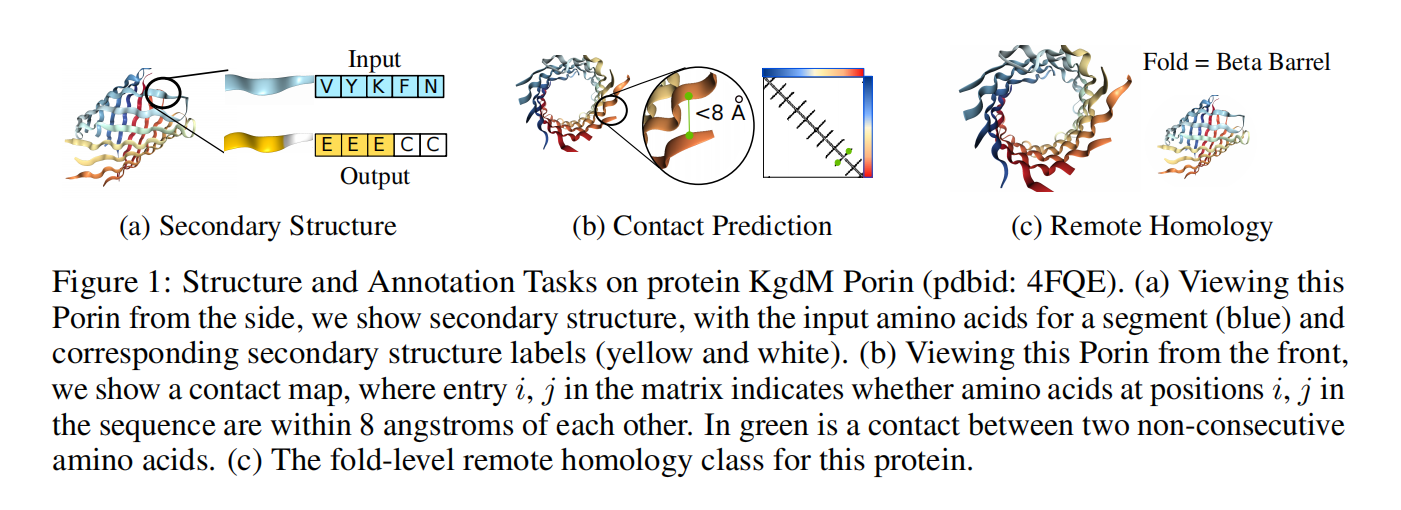
Task 1: Secondary Structure Prediction
Fig. 1a
Definition: a Seq2Seq task in which each input amino acid $x_i$ is mapped to a label $y_i \in {\mathrm{Helix\,(H)}, \mathrm{Strand\,(E)}, \mathrm{Other\,(C)}}$.
Impact: secondary structure is an important descriptor of protein structure; secondary structure predictors are also commonly used to provide richer input features for higher-level models.
Generalization: assesses how well models learn local structure.
Task 2: Contact Prediction
Fig. 1b
Definition: a pairwise prediction task in which amino acids $x_i$ and $x_j$ from a protein are mapped to a label $y_{ij} \in {0, 1}$, indicating whether they are in contact.
Impact: provides strong global information for robust modeling of full 3D protein structure.
Generalization: probes understanding of the overall protein context.
Task 3: Remote Homology Detection
Fig. 1c
Definition: a sequence classification task in which each sequence $x$ is assigned a label $y \in {1, \ldots, 1195}$ corresponding to a possible fold.
Impact: relevant to microbiology and medicine, e.g., detecting newly emerging antibiotic resistance genes.
Generalization: tests the ability to recognize structural similarity on distantly related inputs.
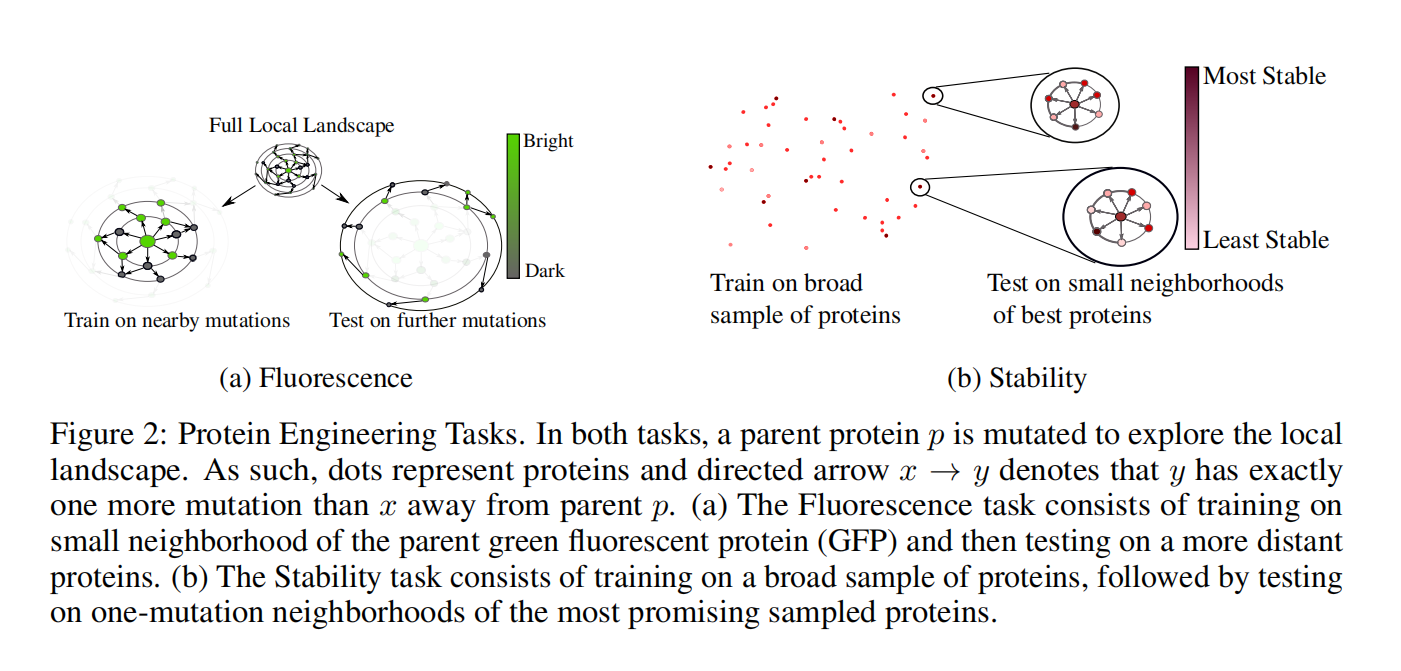
Task 4: Fluorescence Landscape Prediction (Protein Engineering Task)
Fig. 2a
Definition: a regression task in which each input protein $x$ is associated with a label $y \in \mathbb{R}$ reflecting the log-fluorescence intensity of $x$.
Impact: enables more efficient exploration of the fitness landscape.
Generalization: tests discrimination among very similar inputs and generalization to unseen mutation combinations.
Task 5: Stability Landscape Prediction
Fig. 2b
Definition: a regression task in which each input protein $x$ is associated with a label $y \in \mathbb{R}$ representing folding stability.
Impact: helps identify better candidates for costly protein engineering experiments.
Generalization: tests generalization from broad sequence samples and localization of information in neighborhoods of a few sequences.
Model and Experimental Setup
Models:
The authors evaluate three NLP-inspired architectures: Transformer, residual network, and LSTM.
Baselines: CNN/LSTM (Bepler, Tristan, and Bonnie Berger), LSTM (Alley, Ethan C., et al.), one-hot baseline, and alignment-based baselines.
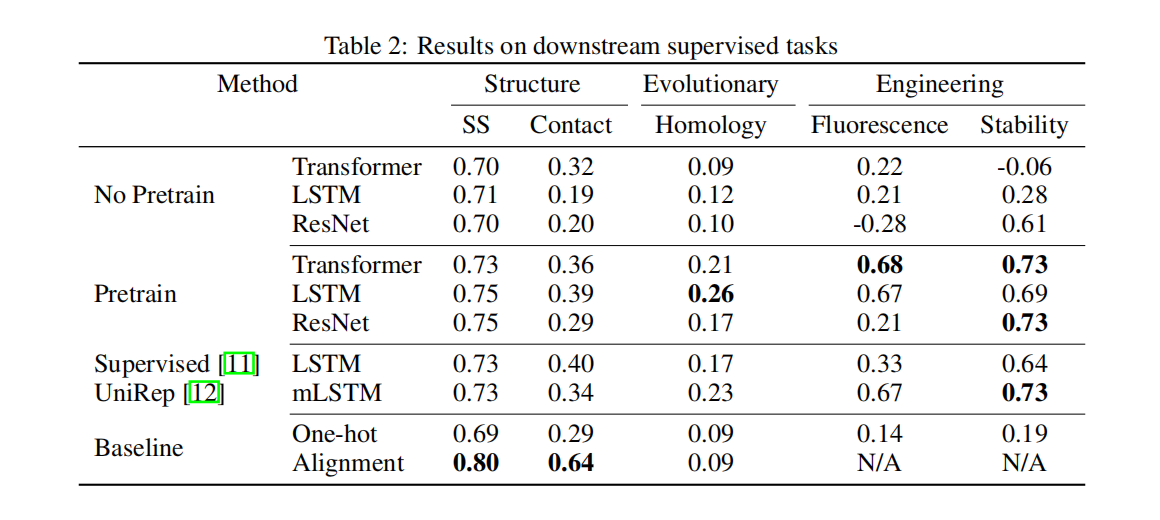
Results:
- Self-supervised pre-training almost always improves performance.
- For structure-related tasks, NLP-inspired models underperform alignment-based baselines.
<HR align=left color=#987cb9 SIZE=1>