
Journal of Chemical Information and Modeling-2024 TM-search:An Efficient and Effective Tool for Protein Structure Database Search
Paper: TM-search:An Efficient and Effective Tool for Protein Structure Database Search
TM-search: fast structural alignment
Abstract
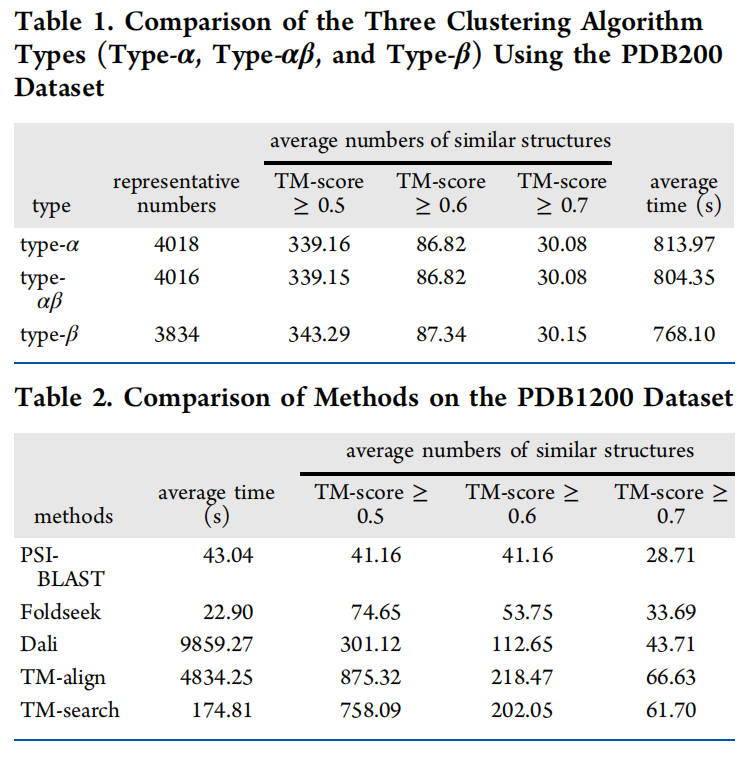
Existing protein structure search algorithms incur substantial computational cost. This work introduces TM-search, a program built on TM-align with a new iterative clustering algorithm. Benchmarks show it runs about 27× faster than TM-score while retaining ~90% hit rate, and 2–10× faster than other current tools such as Foldseek, Dali, and PSI-BLAST.
Introduction
By 2020 the PDB contained roughly 178,000 structures and ~400,000 protein chains—too large for exhaustive TM-align search, which averages ~0.5 s per protein pair.
Two mainstream strategies accelerate structure database retrieval:
- Map 3D structures to 1D structural identifiers (e.g., Foldseek). This discards much structurally critical information and can reduce sensitivity to remote homolog detection.
- Use clustering to cut redundant computation, performing pairwise alignment only between the query and representative structures. Methods such as MMseq2 or CD-HIT cluster by sequence similarity rather than structure.
TM-search builds a hierarchical database from a structure-similarity matrix.

Materials and Methods
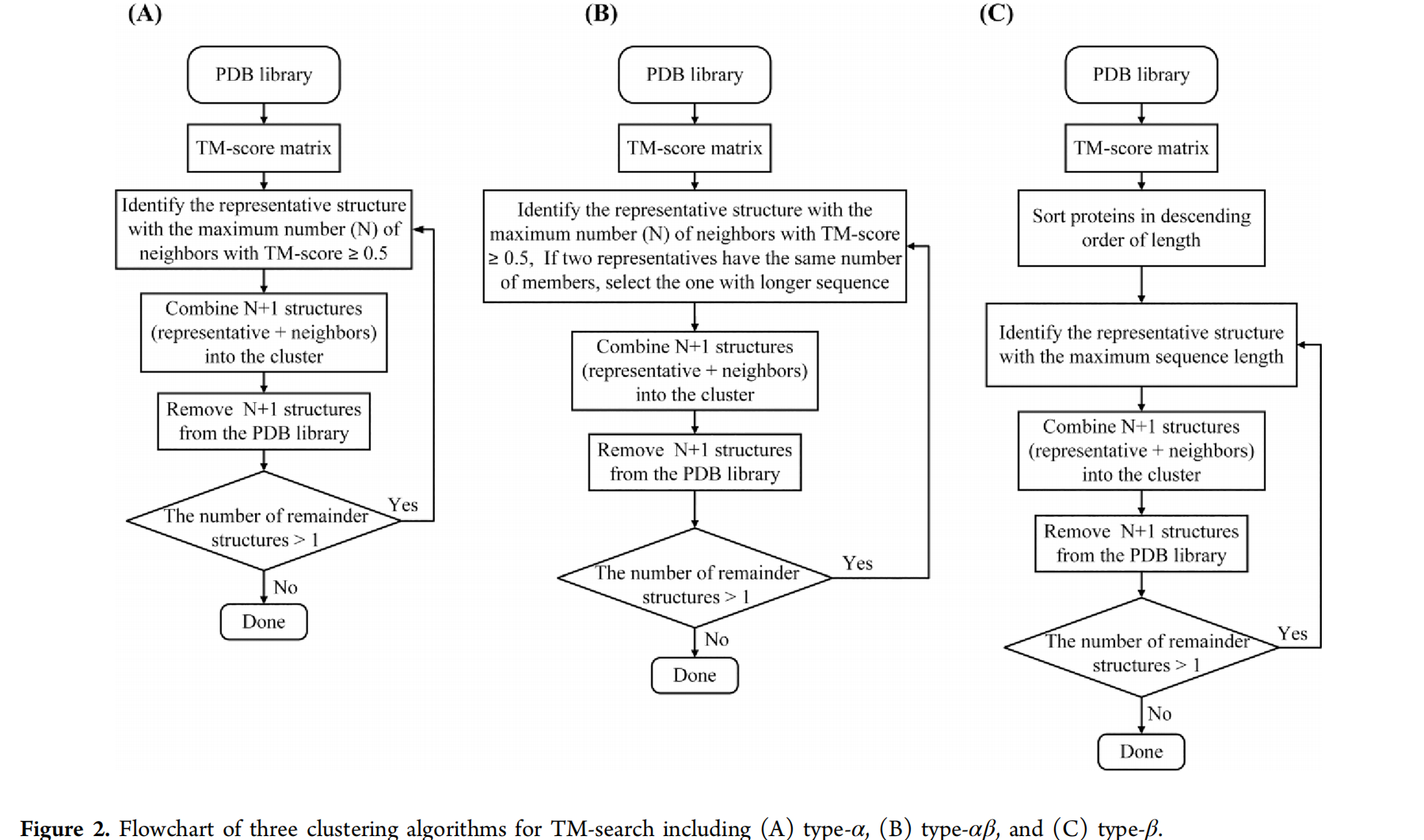
Preparation of the TM-search Database
Build a hierarchical structure database.
- Split each structure in the database into domains; use SCOPe domain definitions when available, otherwise Protein Domain Parser.
- After excluding structures shorter than 30 amino acids, ~470,000 structures form the initial database (PDBall).
- CD-HIT clusters at 70% sequence identity; the largest structure in each cluster serves as the representative, yielding 71,115 non-redundant entries (PDB70).
Next, compute pairwise TM-scores for PDB70.
Choosing cluster representatives is key to accuracy and speed; three strategies are used:
- type-α: the representative is the structure with the most neighbors in the cluster with TM-score > 0.5.
- type-αβ: same as type-α, but if several proteins tie for the largest neighbor count, pick the longest.
- type-β: the longest protein not already assigned to an existing cluster becomes the representative.
Evaluation Metric
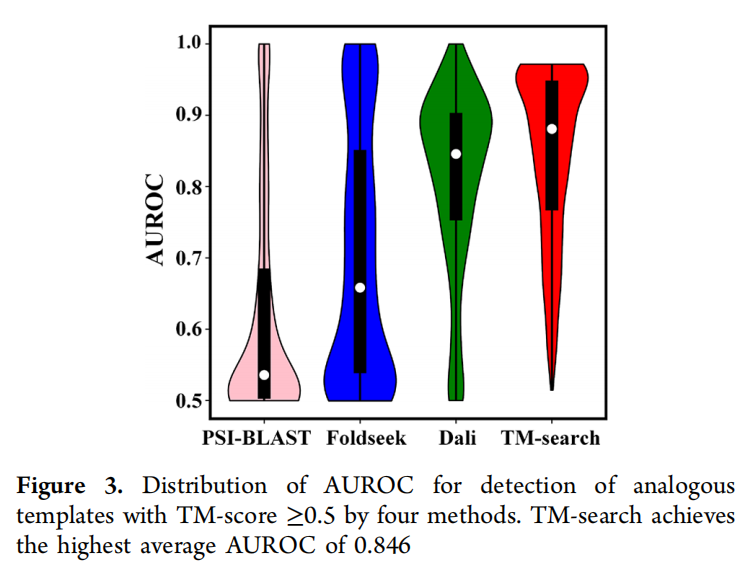
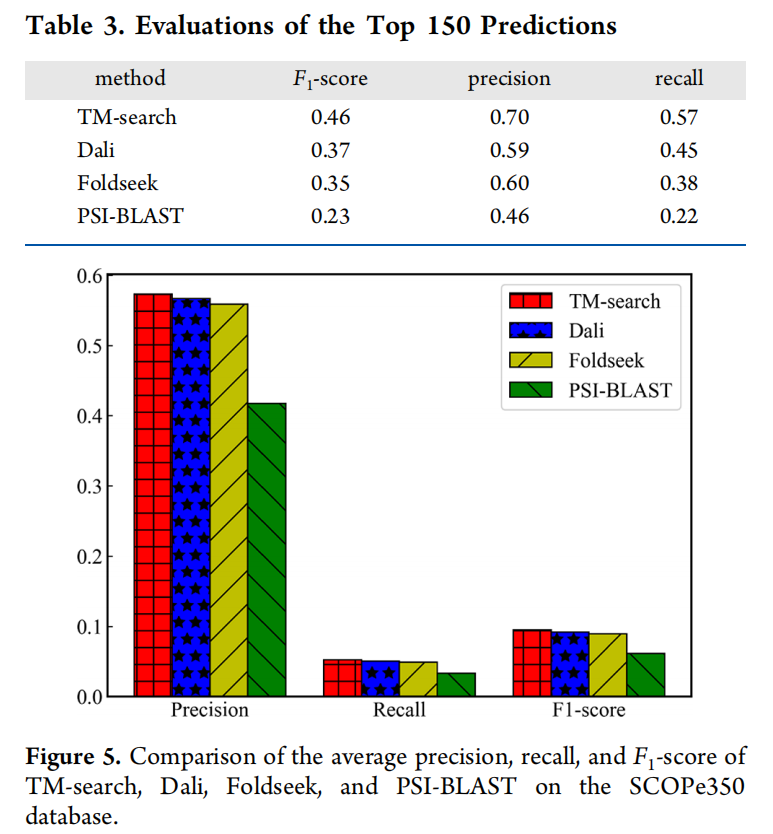
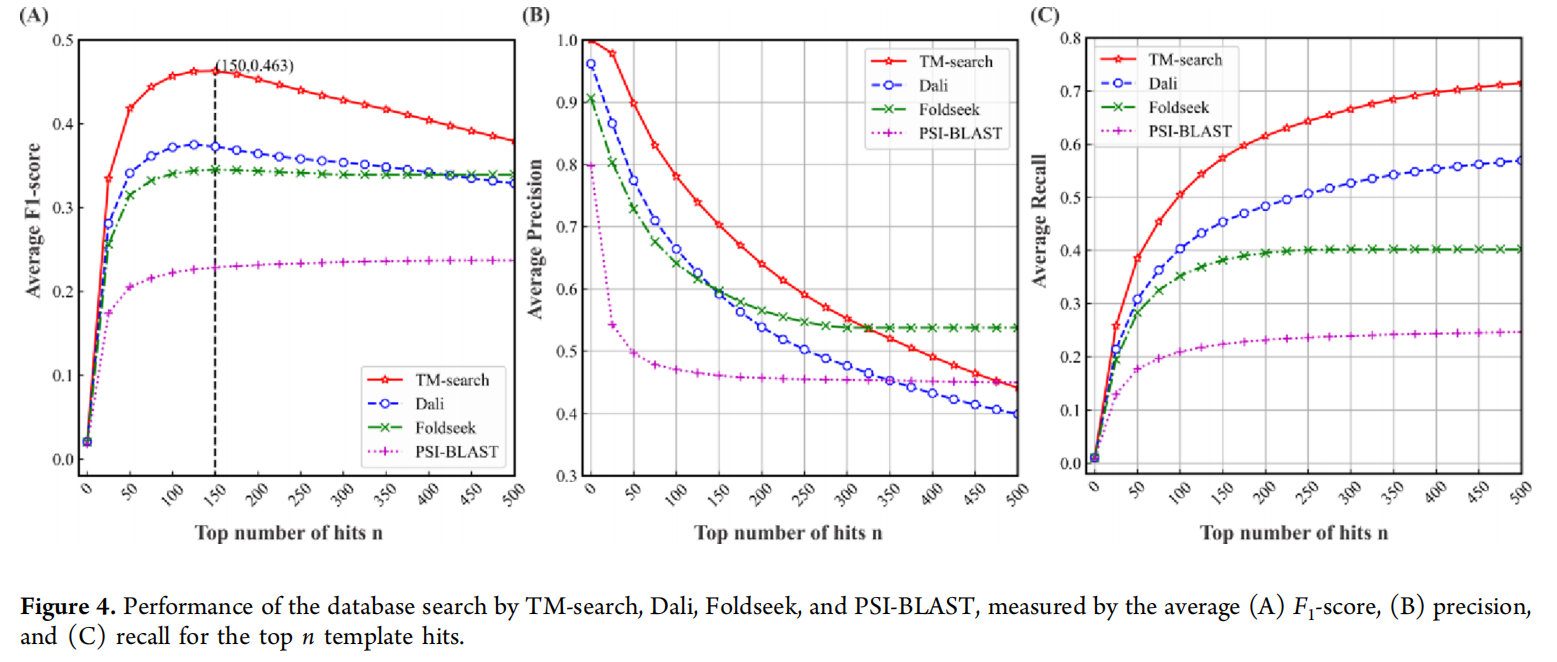
AUROC, F-score, recall, precision
Algorithm for Database Search


TM-score
Results and Discussion
<HR align=left color=#987cb9 SIZE=1>