
ACL Demo-2024 LlamaFactory:Unified Efficient Fine-Tuning of 100+ Language Models
Paper: LlamaFactory:Unified Efficient Fine-Tuning of 100+ Language Models
LlamaFactory: A Framework for Efficient Fine-Tuning of LLMs
Abstract
Efficient fine-tuning of large models on downstream tasks is critically important. The authors present LlamaFactory, which enables easy fine-tuning of 100+ LLMs through a built-in web UI with little or no coding.
Introduction
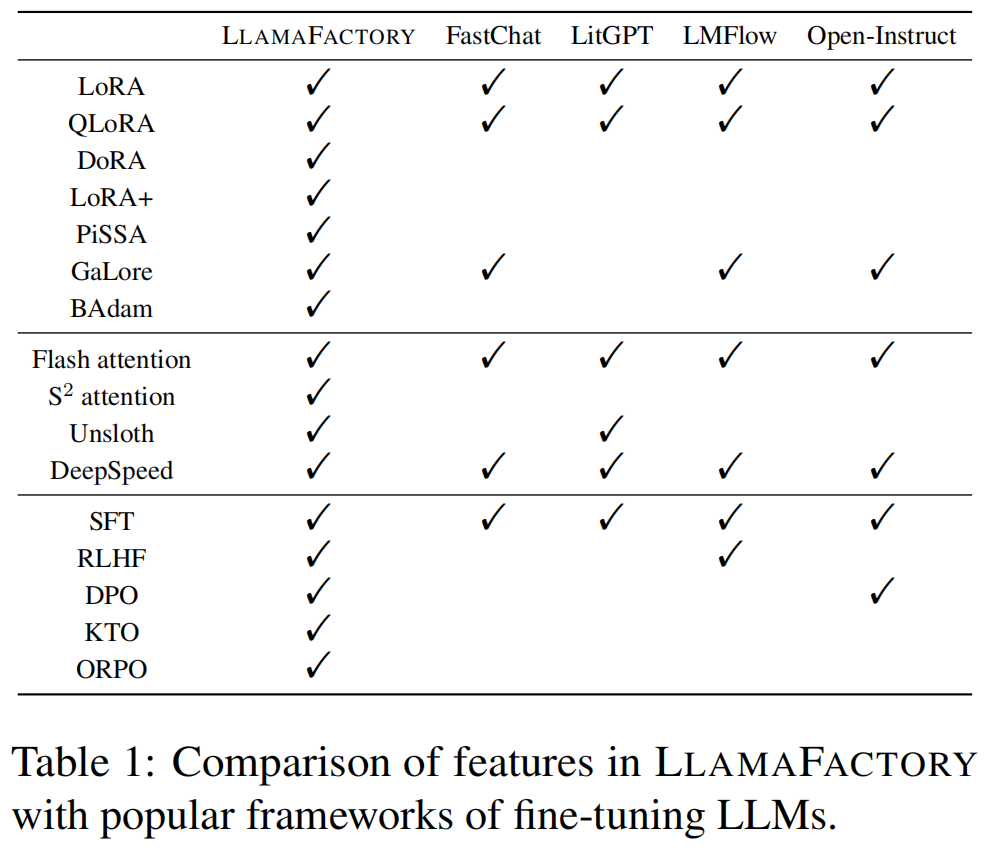
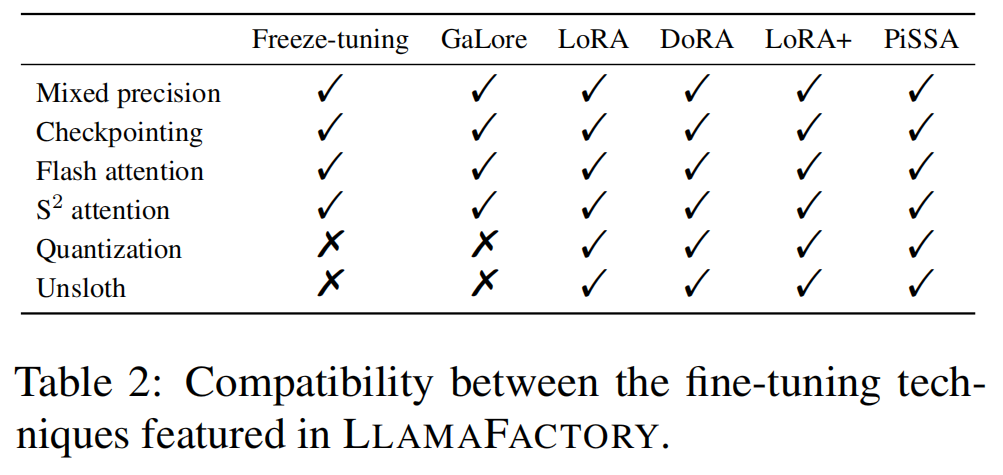
Large language models (LLMs) excel at reasoning and a wide range of tasks such as question answering, machine translation, and information extraction. In recent years, LLMs have flourished in the open-source community; for example, Hugging Face’s LLM leaderboard lists more than 5,000 models, making it easier for users to leverage LLM capabilities.
To adapt LLMs to downstream tasks, fine-tuning is required, but updating parameters at extreme scale demands substantial compute, which becomes a key bottleneck. Parameter-efficient fine-tuning techniques (e.g., LoRA, QLoRA) reduce training cost, yet the community offers many disparate methods and lacks a unified framework to support broad adoption and customization.
LLAMAFACTORY framework:
- The authors propose LLAMAFACTORY, a unified framework for efficiently fine-tuning more than 100 LLMs.
- The framework integrates state-of-the-art efficient fine-tuning methods and can fine-tune models with minimal resources and high throughput.
- It offers two user-friendly modes—command line and a graphical interface (LLAMABOARD)—so users can flexibly customize and fine-tune LLMs with almost no code.
LLAMAFACTORY comprises three core modules:
- Model Loader: loads and manages pretrained models.
- Data Worker: processes and aligns datasets in diverse formats.
- Trainer: applies efficient fine-tuning methods.
Implementation:
- The framework is built on PyTorch and several open-source libraries (e.g., Transformers and PEFT), providing high-level, out-of-the-box tooling.
- LLAMABOARD, implemented with Gradio, lets users fine-tune LLMs without writing code.
Efficient Fine-Tuning Techniques
Efficient Optimization
Overview
Efficient optimization techniques aim to adapt LLM parameters at minimal resource cost. They reduce computational complexity by freezing part of the parameters or introducing low-dimensional adapters.
Technical details
-
Freeze-tuning:
- Only a small subset of parameters is updated while most layers remain frozen.
- Typically only a few parameters in decoder layers—often the last few layers—are trained.
- Fewer trainable parameters lowers resource consumption.
-
Gradient Low-Rank Projection (GaLore):
- Projects gradients into a low-dimensional subspace, enabling full-parameter learning while substantially saving memory.
- Suited to large-model training: maintains performance with lower memory overhead.
-
BAdam:
- A Block Coordinate Descent (BCD)-based method that partitions parameters into blocks to improve training efficiency.
- Can optimize large parameter sets efficiently.
-
Low-Rank Adaptation (LoRA):
- Freezes all pretrained weights and adds a pair of low-rank matrices to selected layers as trainable adapters.
- Combined with quantization (e.g., QLoRA), memory use can be reduced further.
-
QLoRA:
- Applies LoRA fine-tuning on quantized weights.
- Uses 4-bit quantization and double quantization (e.g., LLM.int8), greatly reducing memory consumption.
-
DoRA:
- Decomposes pretrained weights into magnitude and direction components and updates only the direction part to improve performance.
- More effective than LoRA alone in complex fine-tuning settings.
-
LoRA+:
- An optimization for LoRA that addresses suboptimal low-rank factorization and further improves performance.
-
PiSSA (Principal Singular Values and Singular Vectors Adaptation):
- Initializes adapters from principal components of pretrained weights for faster convergence.
Efficient Computation
Overview
Efficient computation techniques reduce time or memory during LLM training through hardware-aware optimizations and algorithmic improvements.
Technical details
-
Mixed Precision Training:
- Trains with mixed precision (e.g., float16 and bfloat16) to lower memory footprint.
- Improves compute efficiency with limited impact on model accuracy.
-
Activation Checkpointing:
- Stores only some intermediate activations during the forward pass and recomputes the rest in the backward pass to save memory.
-
Flash Attention:
- A hardware-friendly attention implementation that cuts I/O overhead in attention layers and speeds up computation.
-
S2Attention (Shifted Sparse Attention):
- For long-context LLMs, uses sparse attention to reduce memory use.
-
Quantization:
- Represents weights in lower precision (e.g., 4-bit or 8-bit) to shrink memory requirements.
- Supports multiple post-training quantization methods such as GPTQ, AWQ, and AQLM.
-
Unsloth:
- Implements LoRA backward passes with the Triton library, reducing FLOPs and accelerating gradient descent.
- Improves the efficiency of LoRA fine-tuning.
LLAMAFACTORY integrates the above optimization and computation techniques seamlessly, substantially improving the efficiency of LLM fine-tuning.
LlamaFactory Framework
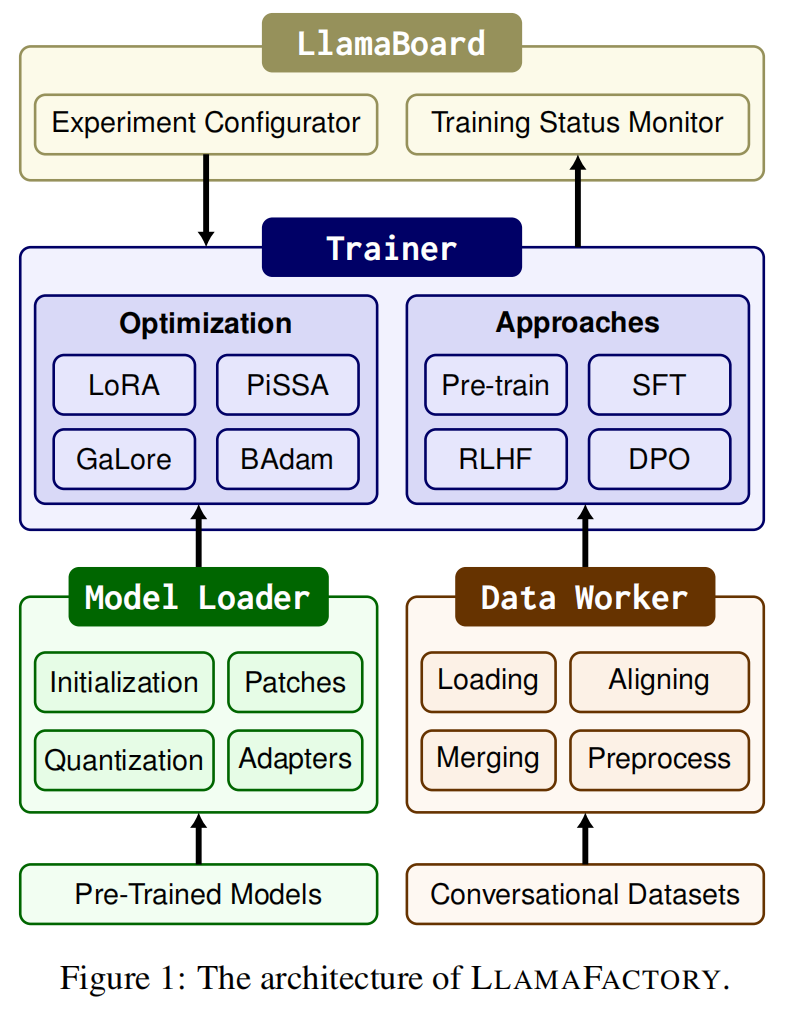
Model Loader
The Model Loader manages model initialization and fine-tuning setup, including:
-
Model Initialization:
- Loads pretrained models and tokenizers via Transformers Auto classes (e.g.,
AutoModelForCausalLMandAutoTokenizer). - Supports automatic resizing of embedding layers and initialization of new parameters.
- Extends context length using scaling factors for RoPE (rotary position embeddings).
- Loads pretrained models and tokenizers via Transformers Auto classes (e.g.,
-
Model Patching:
- Uses monkey patching to add capabilities such as S²Attention.
- Natively supports Flash Attention for better compute efficiency.
- Optimizes mixture-of-experts (MoE) models under DeepSpeed ZeRO stage-3 to avoid excessive partitioning of dynamic layers.
-
Model Quantization:
- Supports 4-bit or 8-bit dynamic quantization (e.g., LLM.int8 and QLoRA double quantization).
- Compatible with multiple quantization methods (GPTQ, AWQ, AQLM); fine-tuning of quantized weights is limited to adapter-based methods.
-
Adapter Attaching:
- Automatically detects where to insert adapters (e.g., all linear layers) for better convergence.
- Supports multiple adapter methods (LoRA, DoRA, PiSSA, etc.).
- Can replace the backward pass with Unsloth to speed up training.
-
Precision Adaptation:
- Adjusts floating-point precision (e.g., bfloat16 or float16) according to hardware capability.
- Keeps all trainable parameters in float32 during mixed-precision training for stability.
Data Worker
The Data Worker provides a full data-processing pipeline so task-specific data can be normalized into a unified format.
-
Dataset Loading:
- Loads local or remote datasets via the Datasets library.
- Uses the Arrow format to reduce memory overhead and supports streaming to avoid downloading entire datasets.
-
Dataset Aligning:
- Provides a data specification that standardizes diverse formats (e.g., Alpaca, ShareGPT) into a common structure.
-
Dataset Merging:
-
Offers efficient merging strategies:
- Direct concatenation in non-streaming mode.
- Interleaved reads in streaming mode to preserve randomness.
-
-
Dataset Preprocessing:
- Supplies multiple chat templates for different models.
- By default, loss is computed only on the generation segment; sequence packing reduces training time.
Trainer
The Trainer is a core module that integrates efficient fine-tuning methods and training mechanics.
-
Efficient Training:
- Supports recent efficient fine-tuning methods (LoRA+, GaLore, BAdam, etc.).
- Modular design lets different tasks apply these methods flexibly.
- Uses trainers from Transformers and TRL for pretraining, instruction tuning, preference optimization, and related objectives.
-
Model-Sharing RLHF:
- Proposes an approach so RLHF (reinforcement learning from human feedback) can run on consumer hardware.
- By dynamically switching adapters, a single pretrained backbone can serve as policy, value, reference, and reward models.
-
Distributed Training:
- Combines DeepSpeed for data parallelism and uses the ZeRO optimizer to reduce memory consumption.
Utilities
-
Model Inference:
- Supports streaming decoding with Transformers and vLLM for high-throughput inference.
- Provides an OpenAI-style API for easy integration into applications.
-
Model Evaluation:
- Supports automatic evaluation on multiple benchmarks (e.g., MMLU, CMMLU, and BLEU).
- Includes text similarity metrics and human evaluation utilities.
LLAMABOARD: A Unified Interface for LLAMAFACTORY
LLAMABOARD is the graphical front end for LLAMAFACTORY, allowing users to customize fine-tuning and evaluation workflows through a web UI without code.
-
Easy Configuration:
- Sensible default hyperparameters; users can preview and validate datasets in the UI.
-
Monitorable Training:
- Real-time training logs and loss curves for monitoring progress.
-
Flexible Evaluation:
- Supports automatic and human evaluation to measure model capability.
-
Multilingual Support:
- Localized UI; currently English, Russian, and Chinese.
Empirical Study
Training Efficiency
Experimental setup
- Dataset: PubMed, with roughly 36 million biomedical records; about 400k tokens were sampled to build the training corpus.
- Settings: learning rate $10^{-5}$, token batch size 512, 8-bit AdamW optimizer, bfloat16 precision, activation checkpointing to reduce memory, Freeze-tuning: only the last 3 decoder layers, GaLore: rank 128 and scale factor 2.0, LoRA/QLoRA: adapters on all linear layers with rank 128 and alpha 256, hardware: single NVIDIA A100 40GB GPU, Flash Attention enabled in all runs; Unsloth additionally enabled for LoRA and QLoRA.

- On Gemma-2B, QLoRA used 5.21 GB memory, throughput 3158.59 tokens/s, and PPL 10.46.
- On Llama2-13B, GaLore achieved PPL 5.72, better than LoRA and QLoRA, at higher memory cost.
Fine-Tuning on Downstream Tasks
Experimental setup
-
Tasks:
- CNN/DM: summarization
- XSum: extreme summarization
- AdGen: advertisement text generation
-
Data split:
- 2,000 training and 1,000 test examples per task.
- Training and test sets are disjoint.
-
Metrics:
- ROUGE (ROUGE-1, ROUGE-2, ROUGE-L) for generation quality.
-
Settings:
- Learning rate $10^{-5}$, batch size 4, max input length 2048, 8-bit AdamW optimizer, NVIDIA A100 40GB GPU; LoRA and QLoRA adapter settings match the training-efficiency experiment.
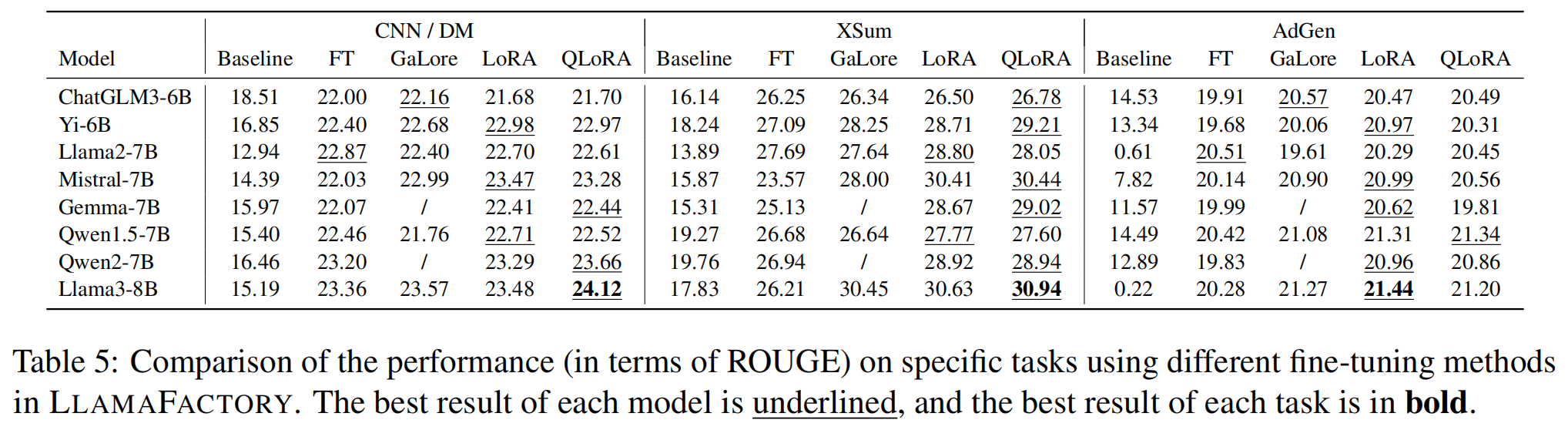
-
Best fine-tuning methods:
- LoRA and QLoRA perform best on most tasks and models.
- For example, on XSum and AdGen, Llama3-8B with QLoRA achieves the highest ROUGE scores.
-
Model comparison:
- Llama3-8B is the strongest overall across tasks.
- Yi-6B and Mistral-7B are competitive among models of similar size.
-
Task relevance:
- QLoRA is stable on generation tasks, especially under tight resource constraints.
Summary
-
Training efficiency:
- QLoRA and LoRA offer much better memory efficiency and throughput than full fine-tuning.
- On large models, GaLore achieves lower PPL through gradient optimization.
-
Downstream adaptation:
- LoRA and QLoRA adapt strongly, especially for smaller models and resource-limited settings.
- Task-specific performance varies; Llama3-8B leads on many benchmarks.
-
Effectiveness of LLAMAFACTORY:
- The framework’s efficient fine-tuning methods improve training efficiency and transfer well to downstream tasks, validating its practicality across scenarios.