
ICML-2021 Is Space-Time Attention All You Need for Video Understanding
Paper: Is Space-Time Attention All You Need for Video Understanding
Timesformer: Detailed Experiments on Adapting ViT to Video Understanding
Abstract
Adapt the vision transformer to video understanding.
Method
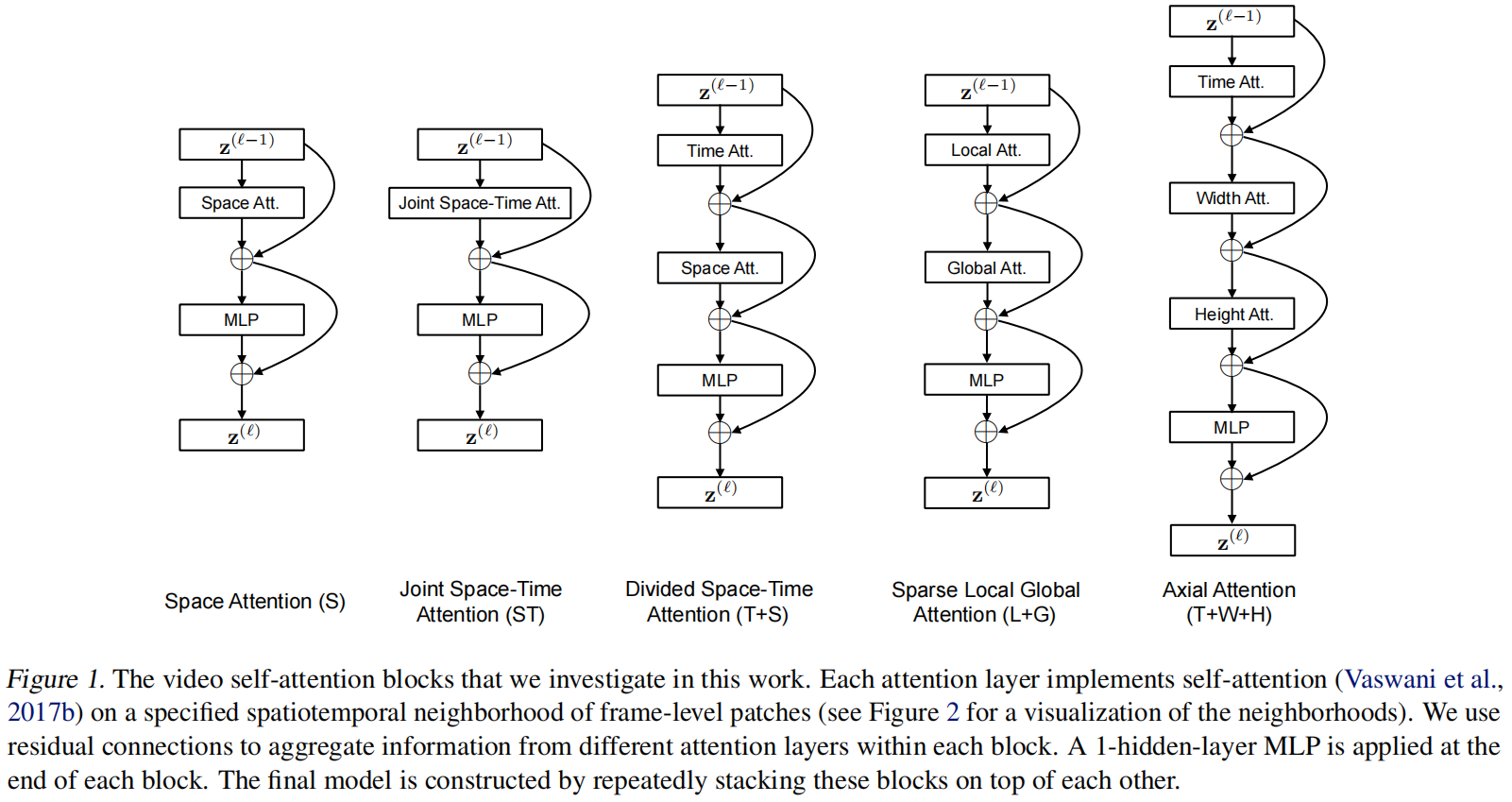
The authors evaluated the five architectures above.
- S
- Self-attention on spatial feature maps only—the same self-attention used in the image Vision Transformer.
- ST
- A brute-force variant: self-attention jointly over all three video dimensions, but the representation is too large to fit in GPU memory.
- T+S
- The main method in this paper: factorize 3D attention by applying temporal self-attention first, then spatial.
- L+G
- Local attention in small windows first, then global attention, reducing complexity.
- T+W+H
- Self-attention only along specific axes, decomposing the 3D volume into 1+1+1, which also lowers complexity.
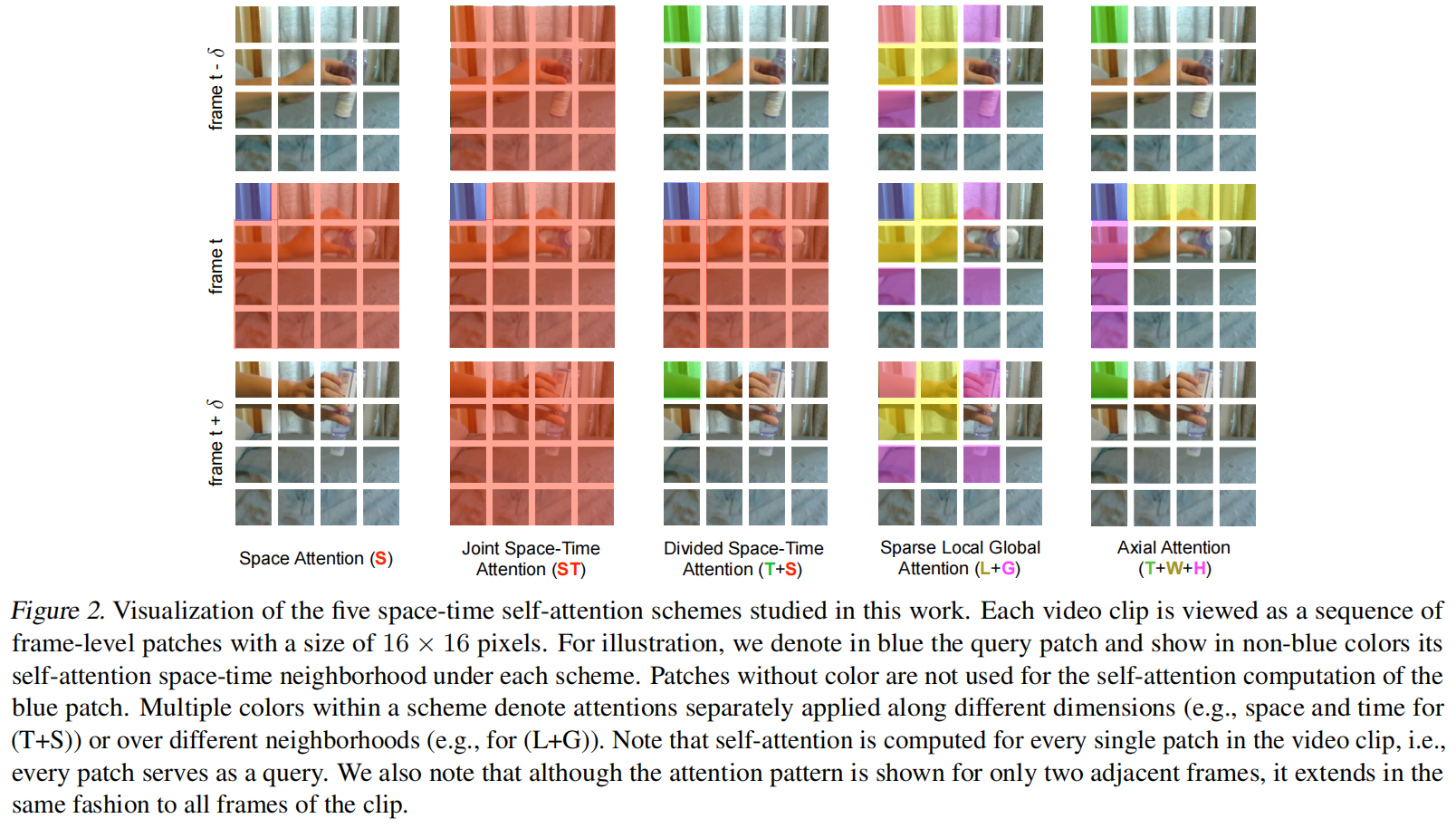
The diagram is very clear: blue patches are the baseline and attend to other patches; green denotes temporal attention; yellow marks local and axis-wise attention; purple marks global and axis-wise attention.
Experiment
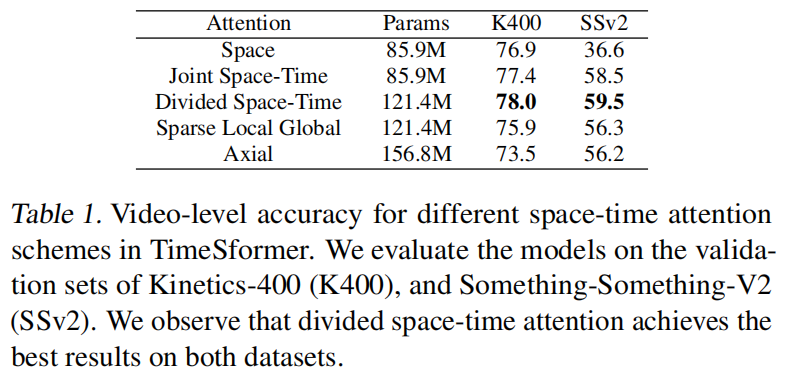
Using 2D-only attention performs relatively well on Kinetics-400 because the dataset is biased toward static content; on Something-Something V2 the results are worse, so the temporal dimension must be modeled.
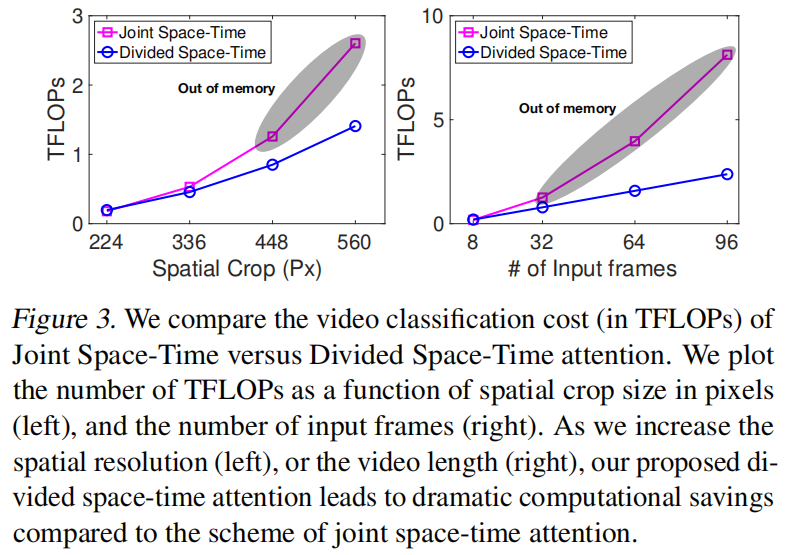
Joint space–time attention is strong, but cost grows sharply as the number of frames increases; gray entries indicate out-of-memory failures—training is infeasible.
Training time is shorter and inference is faster, though accuracy is not strictly the best; SlowFast with ResNet-101 can exceed 80 on K400.
Scaling up Timesformer also reaches SOTA.
Conclusion
Four advantages:
- Simple idea
- SOTA on several action recognition benchmarks
- Low training and inference cost
- Can process videos longer than one minute
<HR align=left color=#987cb9 SIZE=1>