
ICML-2021 ViLT:Vision-and-Language Transformer Without Convolution or Region Supervision
Paper: ViLT:Vision-and-Language Transformer Without Convolution or Region Supervision
Code: https://github.com/dandelin/ViLT
Does not use object-detection region features; the pipeline is simplified. Training is expensive and performance drops slightly, but inference time is greatly reduced.
ViLT: Extending ViT to Multimodal Learning
Abstract
Vision-and-language pretraining (VLP) brings large gains on downstream vision-and-language tasks. Methods often invest more compute on the visual side for better results, so most VLP approaches rely heavily on feature extraction—or treat the problem as object detection plus a ResNet-style convolutional backbone. Two main issues: (1) feature extraction dominates time compared with multimodal fusion; (2) expressiveness is limited by embeddings and a fixed visual vocabulary. ViLT is proposed as a minimal design.
Introduction
Multimodal VLP has progressed quickly with pretrain-then-fine-tune. Models are typically pretrained on image–text pairs with image–text matching and MLM objectives (nearly universal), then fine-tuned on downstream bimodal tasks.
Pixels cannot be fed directly into VLP; pixels and tokens must be embedded into discrete high-level semantic features before the transformer. Hence most work depends on object detectors (because (1) detected regions are naturally discrete, semantic representations; (2) in tasks such as VQA, objects are often tightly coupled to the question). More object categories generally help image–text alignment.
Object-detection feature extraction is costly, so some work reduces that cost—e.g., Pixel-BERT uses an ImageNet-pretrained ResNet to produce feature maps as a discrete sequence, so compute is only the backbone without a detection head.
Even then an image encoding stage remains and is slow; ViT-inspired patchification is one way to extract features.
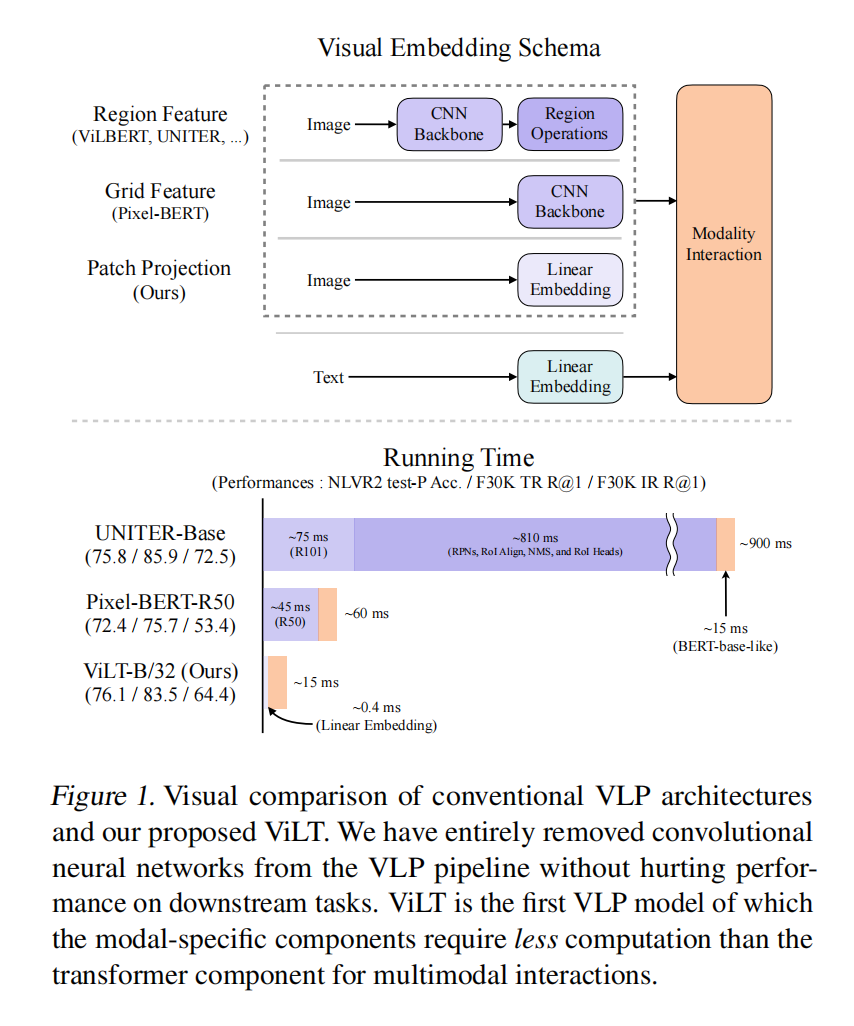
Earlier top-performing models used region features (object-centric representations). Grid features drop the detection stage; ViLT is like ViT with the backbone replaced by a learnable linear projection—very fast with competitive results.
Main contributions:
- ViLT is the simplest architecture to date, with large speedups and fewer parameters
- Performance drop without region features or ResNet backbones is small
- First use of image augmentation in VLP
Background
Taxonomy of Vision-and-Language Models
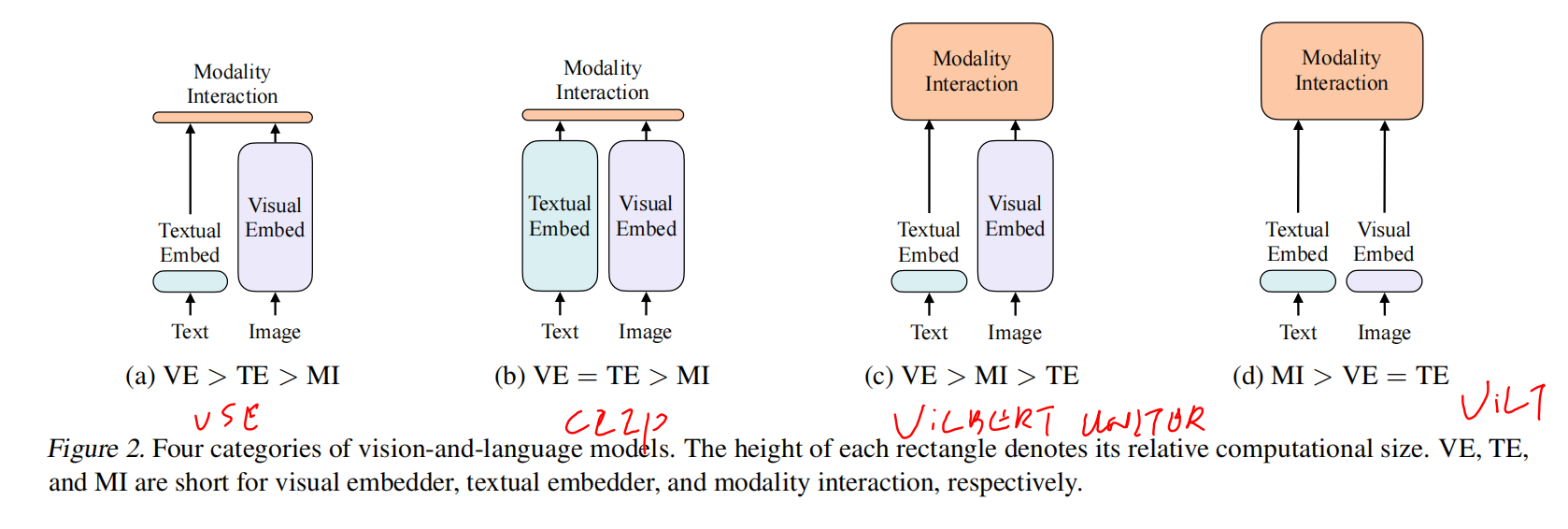
Four categories by (1) relative capacity for image vs. text and parameter balance; (2) how modalities are fused.
Modality Interaction Schema
Single-stream: concatenate the two sequences and learn cross-modal interaction. Dual-stream: process each modality first, then fuse.
Dual-stream often works better but adds more parameters.
Visual Embedding Schema
Region Feature
Given an image: backbone, NMS, and RoI head.
Grid Feature
Cheaper to use, but still relatively costly and performance drops more.
Patch Projection
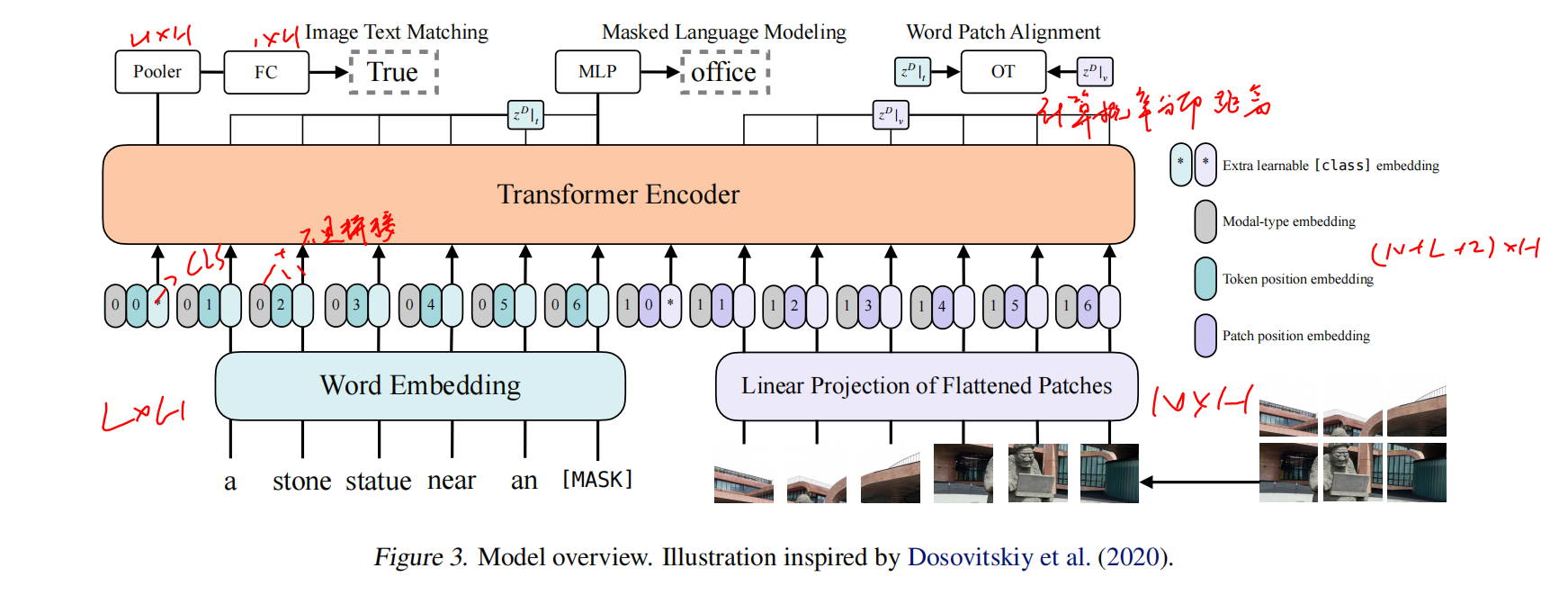
Patchify the image as in ViT.
Vision-and-Language Transformer
Whole Word Masking
WordPiece may split “giraffe” into [gi, ##raf, ##fe]. Masking only the middle subword is too easy—the model can guess from gi and fe without using the image. Masking the whole word forces reconstruction from visual context (e.g., “giraffe”).
Image Augmentation
Prior multimodal methods could not use augmentation because features were precomputed and stored on disk; augmentation would require re-extraction.
The authors use RandAugment but omit color jitter and cropping, since those changes would alter the semantics of the paired text.
Experiment
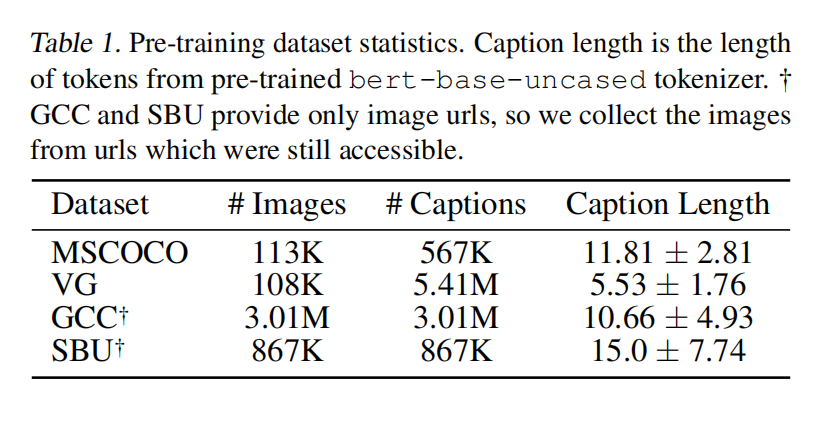
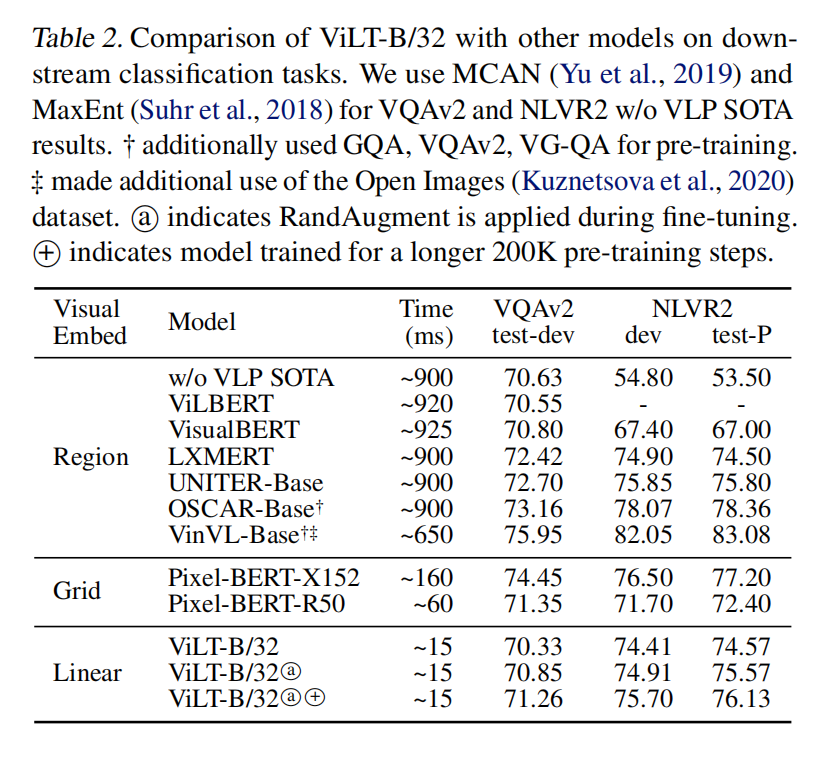
Region-feature models still score best, but ViLT trades accuracy for speed.
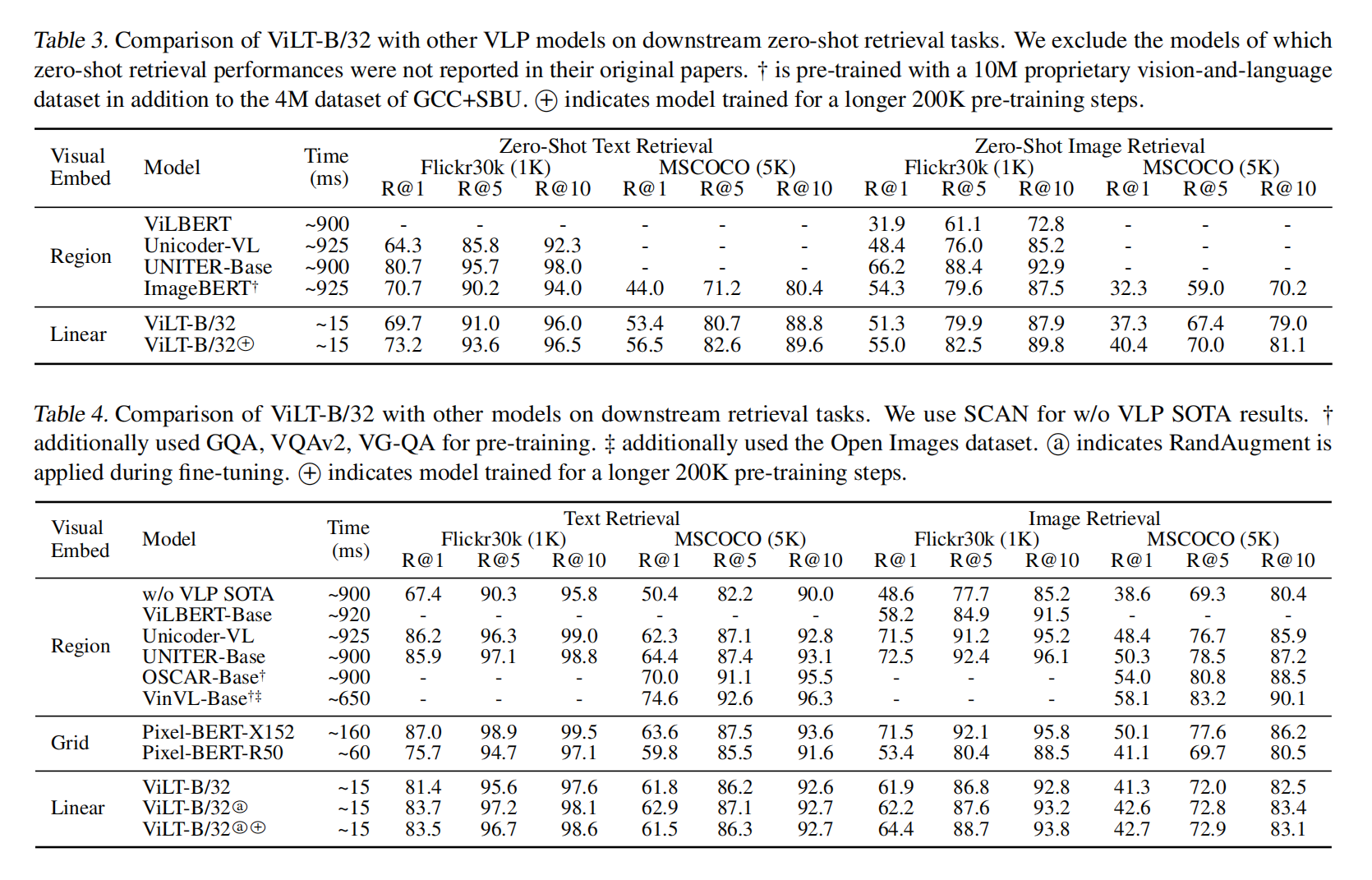
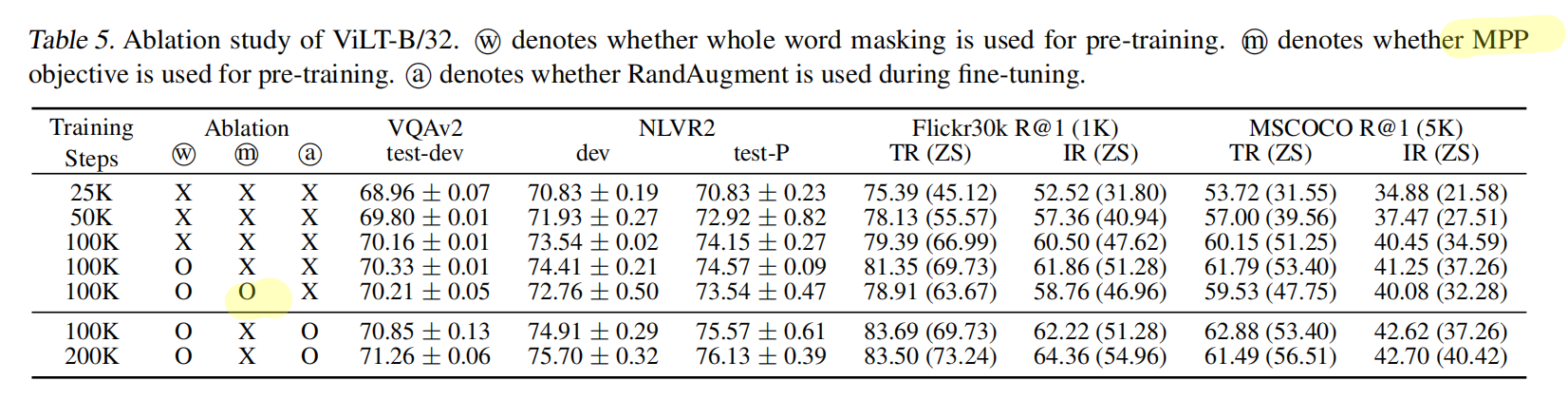
The authors try image masking (MPP) with little benefit here; later work shows tricks that make the idea useful.
Conclusion and Future Work
Scalability: larger models help; Masked Modeling for Visual Inputs: image reconstruction; Augmentation Strategies: large gains.
<HR align=left color=#987cb9 SIZE=1>