
arXiv-2024 Movie Gen:A Cast of Media Foundation Models
Paper: Movie Gen:A Cast of Media Foundation Models
Implementation: https://go.fb.me/MovieGenResearchVideos
Movie Gen: Meta video generation
Abstract
Movie Gen is a family of generative foundation models that can produce 1080p high-definition video, instruction-based video editing, or video generation conditioned on user images. The largest model has 30B parameters; the maximum context length is 73K tokens, corresponding to roughly 16 seconds at 16 frames per second.
3 Joint Image and Video Generation
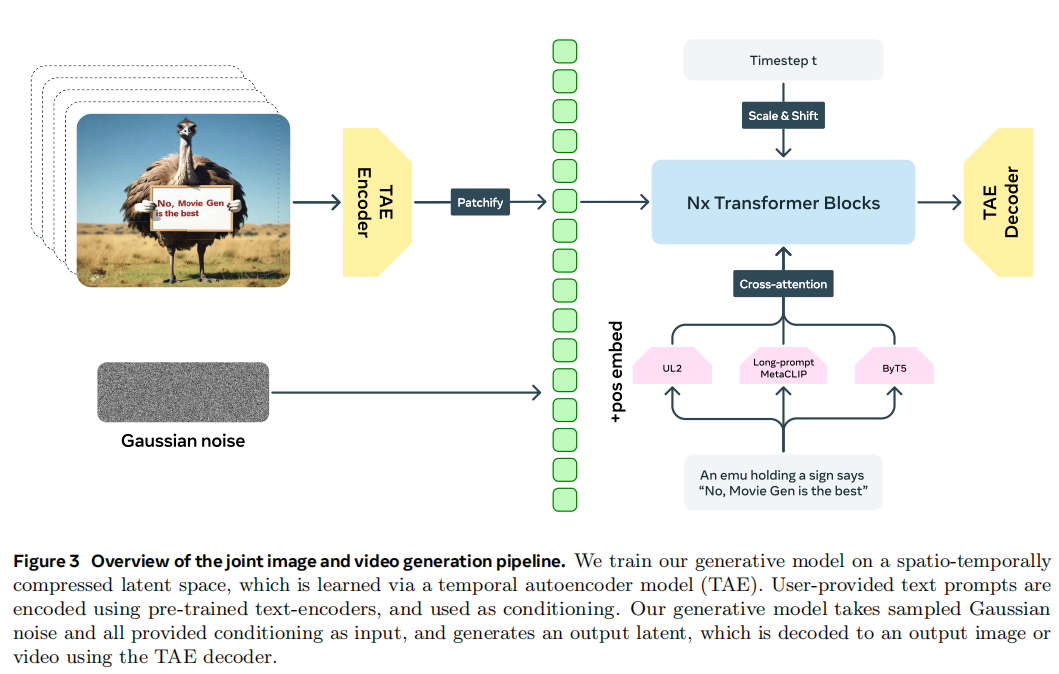
3.1 Image and Video Foundation Model
Because video resolution and frame rate are far larger than for images, RGB pixel-space video is compressed into a latent space for efficiency; stronger compression is preferred when possible.
3.1.1 Temporal Autoencoder (TAE)
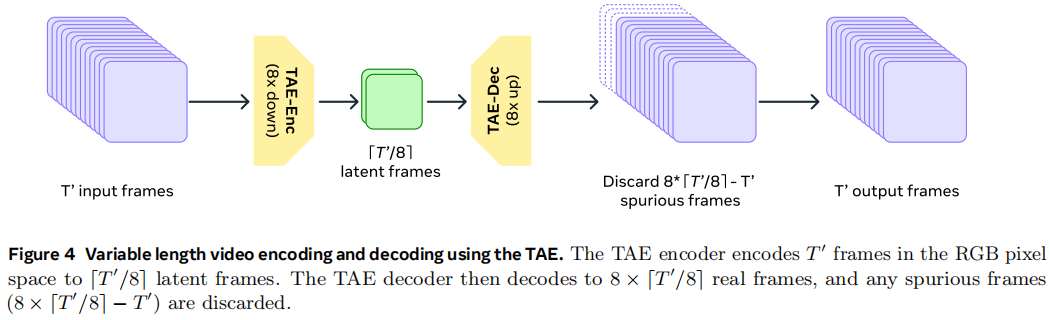
Compression is applied by a factor of 1/8 along time, length, and height.
TAE architecture. A 1D temporal convolution is added on top of each 2D block to handle video; strided convolutions with stride 2 downsample along time. The TAE starts from a pre-trained image autoencoder, then adds the temporal dimension to inflate the model.
3.1.2 Training Objective for Video and Image Generation
Training uses flow matching. Given a video sample’s latent $X_1$, a time step $t \in [0,1]$, and noise $X_0 \sim \mathcal{N}(0,1)$, the model is trained on constructed samples $X_t$ to predict the velocity $V_t = \frac{dX_t}{dt}$—i.e., to learn a direct transport from $X_t$ to the data sample $X_1$ along an optimal transport (OT) path.

where $\sigma_{min}=10^{-5}$

The final loss is

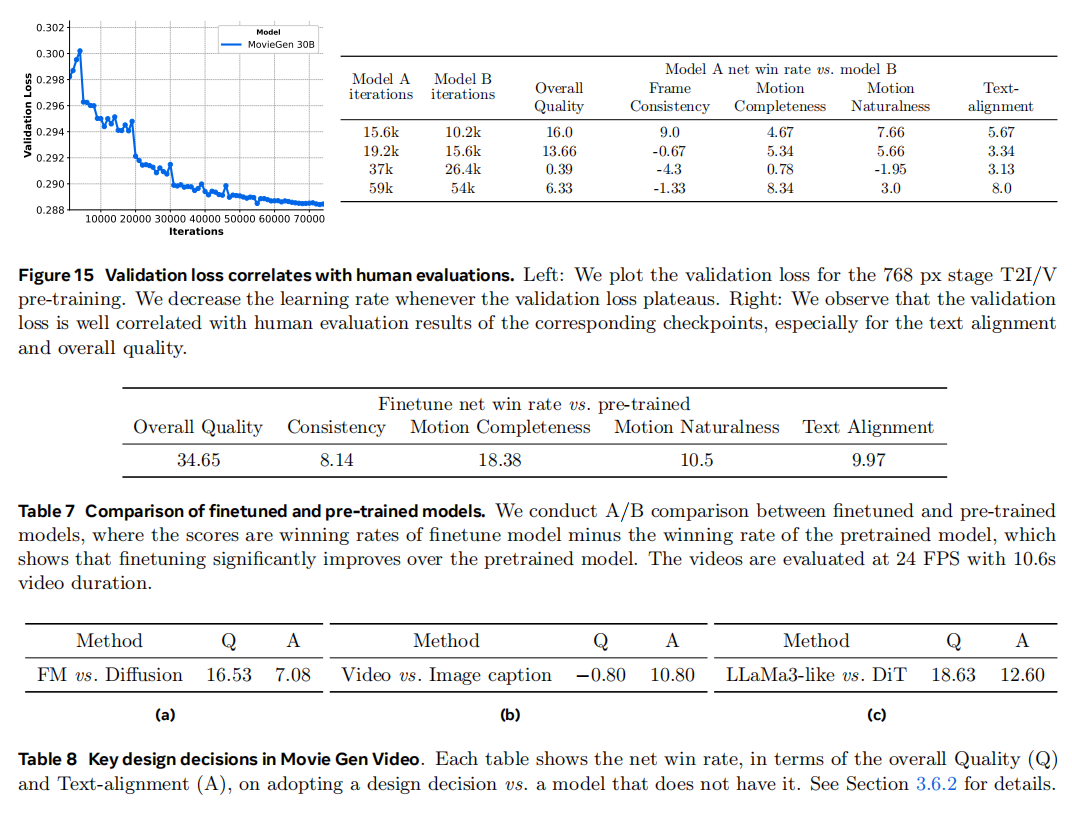
Table 8 compares whether flow matching or diffusion-style training works better.
3.1.3 Joint Image and Video Generation Backbone Architecture
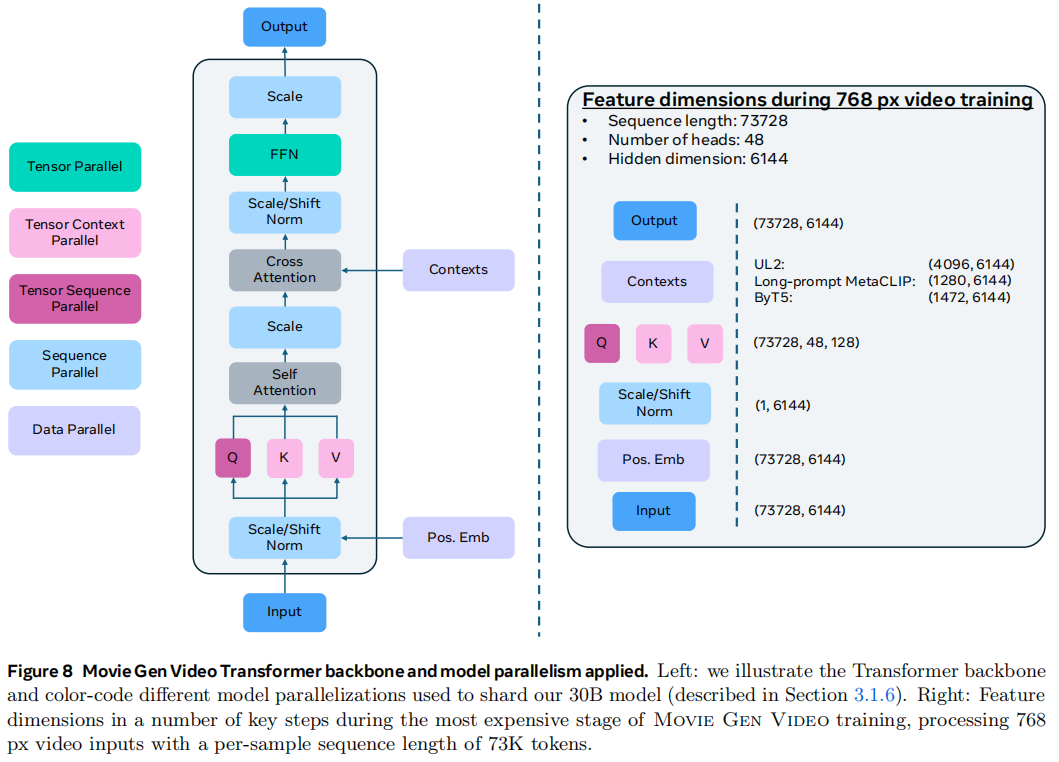
The pipeline still patchifies inputs: 3D convolutions turn latent embeddings into a sequence of tokens that are flattened into a 1D sequence.
Factorized learnable positional embeddings allow transformer inputs at arbitrary resolution and duration. Each spatial or temporal dimension (height $H$, width $W$, time $T$) is mapped into $[0, \mathrm{max_len}]$; arbitrary values are interpolated within that range. These positional embeddings are added inside every transformer layer, which helps reduce video distortion.
The backbone follows LLaMa3 with three main changes:
- Text embeddings are injected via cross-attention at every layer; because different text encoders emphasize different signals, embeddings are concatenated rather than summed.
- Adaptive layer norm blocks incorporate time-step information more effectively.
- Bidirectional attention is used instead of causal attention.
The backbone is kept as close as possible to LLaMa3 so that language-model training experience transfers directly.
3.1.4 Rich Text Embeddings and Visual-text Generation
Text encoders include UL2, ByT5, and Long-prompt MetaCLIP:
- MetaCLIP provides visual and text towers, which suits visual-prompt tasks with a more global view.
- Character-level ByT5 captures local text structure.
- UL2 supplies prompt-level embeddings.
3.2 Pre-training
3.2.1 Pre-training Data
Pre-training uses on the order of $10^8$ video–text pairs and $10^9$ image–text pairs, with diverse subjects such as people, nature, and animals.
After CLIP-style prompting, each video is roughly 4–16 seconds, with captions focused on a single object or concept when possible—favorable for training—with short videos averaging about 100 words of summary.
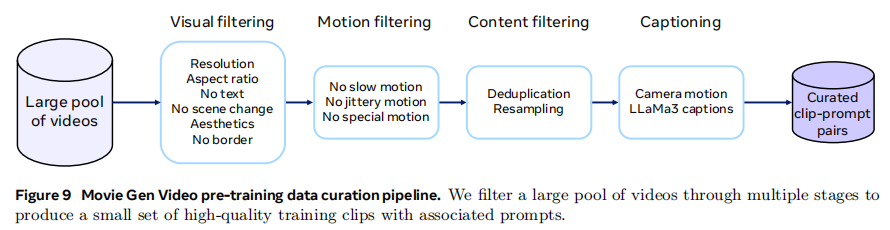
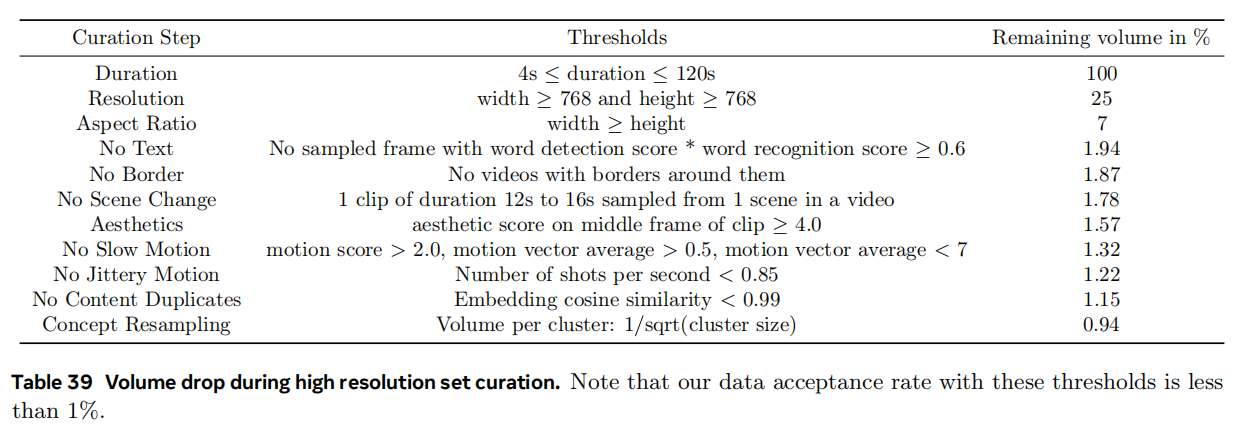
Six filters are applied in total; many rely on model-based filtering rather than coarse heuristics alone.
- Visual filtering. Landscape videos are generally preferred; portrait short clips often have unstable motion, weaker aesthetics, and lower quality. Reading-style footage is removed, as are clips with frequent scene changes (scene boundary detection). Aesthetic filters also remove letterboxing and similar artifacts.
- Motion filtering. An in-house static detector drops videos with no motion; VMAF motion scores and motion vectors score motion to keep “reasonable” clips. Jittery camera motion is flagged via shot boundary detection—if a 1-second clip splits into many segments, camera shake is assumed. Special cases such as slide decks are excluded.
- Content filtering. Embeddings are extracted and clustered; samples are drawn from each cluster with probability proportional to the inverse square root of cluster size to limit bias.
- Captioning. Given video clips, LLaMa3-Video fine-tuned for captioning annotates the full corpus; 8B (70%) and 70B (30%) models are mixed at inference because of cost and diversity needs. Sixteen camera transforms (e.g., zoom-in, zoom-out) are also predicted to recognize common camera motion for better camera control.
- Multi-stage data curation. Filtering proceeds in three stages from easy to hard; training moves from low to high resolution, with 80% landscape and 20% portrait, 60% of clips containing people.
3.2.2 Training
The 30B model is trained in multiple stages with three broad steps:
- Warm up with text-to-image (T2I), then text-to-video (T2V).
- Scale from 256p low resolution to 768p high resolution.
- Iterative dataset cleaning and hyperparameter tuning.
Training details are in Table 3. A strictly held-out validation set is maintained, and human evaluation is often the final judge.
3.3 Finetuning
Fine-tuning further improves final quality; these datasets are built with substantial human involvement.
- Finetuning Video Data. High-quality data should have good motion, realism, aesthetics, and diversity. Curation runs in four sequential steps:
- Stricter thresholds on aesthetics and motion; object-detection models remove clips with very small subjects. This retains on the order of a few million videos but with an uneven concept distribution.
- Human curation yields seed videos; text and video k-NN retrieve conceptually similar clips.
- Humans select visually strong, trainable clips—high-quality fine-tuning data is hard to capture automatically because criteria such as angle, saturation, color, and lighting are subjective. The best segment within each video is chosen manually.
- Models draft video captions that humans revise, covering camera control, objects, background, action, and lighting.
- The final set is 50% at 16 s; the remainder spans 10.6–16 s.
- Model Averaging. Data mixing ratios are sensitive, so one hyperparameter set rarely excels everywhere; multiple checkpoints are averaged into the final model.
3.6 Results
3.6.1 Comparisons to Prior Work
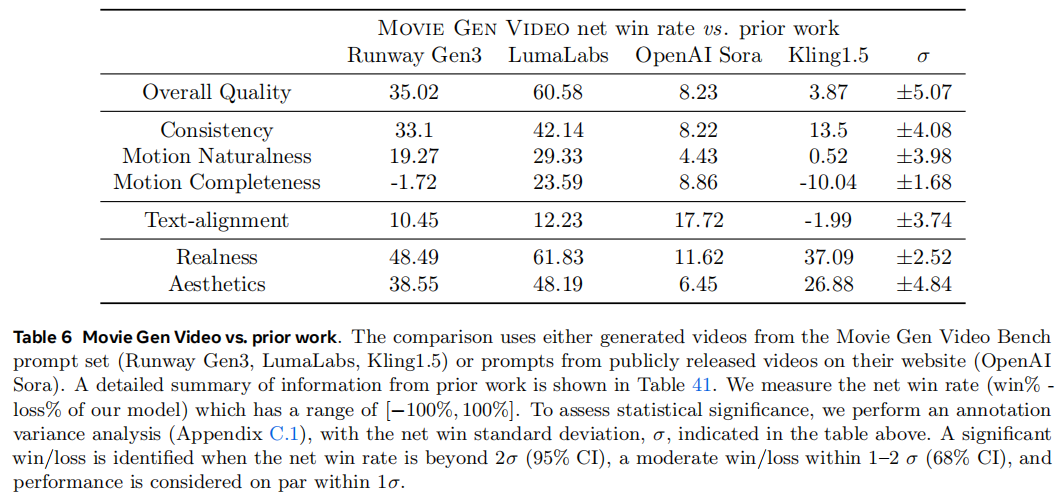
Comparison against proprietary and open models uses net win rate—the fraction of pairwise comparisons won.
3.6.4 TAE Ablations
Metrics include reconstructed peak signal-to-noise ratio (PSNR), structural similarity (SSIM), and Fréchet Inception distance (FID).
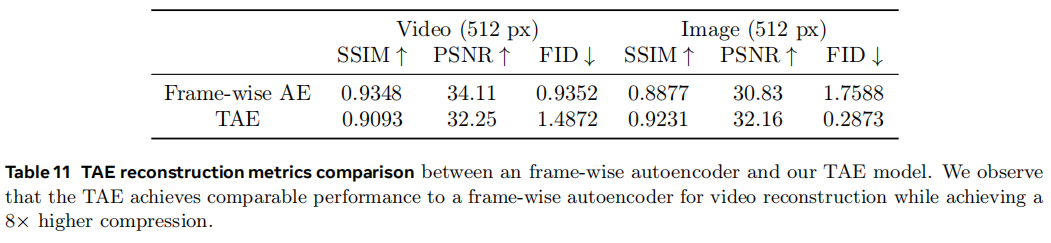
Table 11 shows that compressing along the frame axis hurts reconstruction quality.
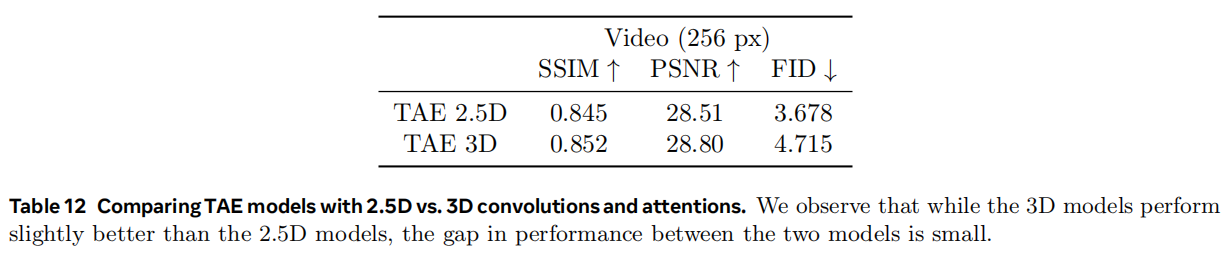
Table 12 indicates TAE 3D still outperforms TAE 2.5D, but the gain is modest whereas 2.5D is much more efficient.