
Automated Software Engineering-2021 Automating just-in-time comment updating
CUP: A New Tokenizer and Separate Encoders
Abstract
The task of helping developers update comment text when code changes is termed Just-in-Time (JIT) Comment Updating; the authors propose CUP for this setting.
They introduce several tailored enhancements: a specialized tokenizer and a joint attention mechanism.
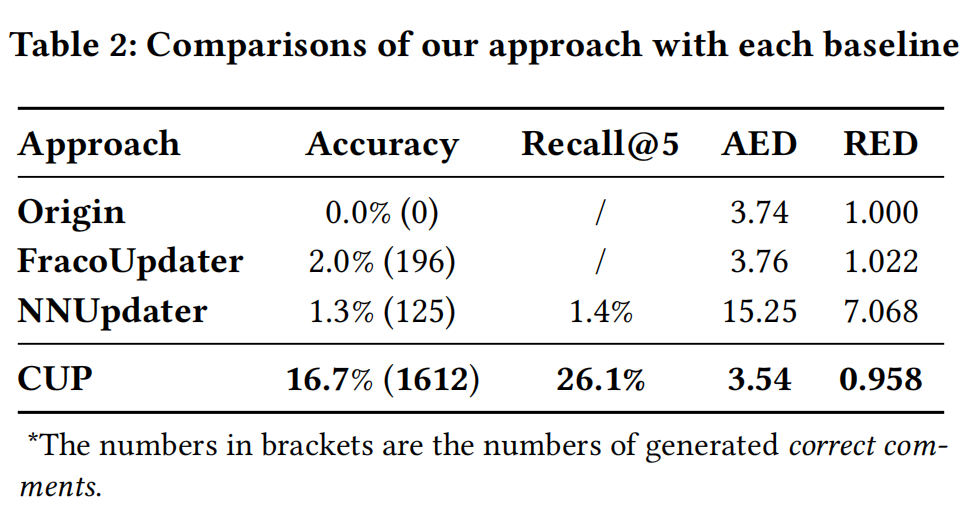
The method outperforms the previous best baseline by 7×.
Introduction
- Poorly updated comment text can mislead developers and is often useless.
-
This approach does not regenerate comments from scratch, so two aspects matter: (1) maintain consistency between old and new comments; (2) the old comment is the basis for the update, so an end-to-end model must learn both the code edit and a representation of the prior code.
- A new tokenizer and copy mechanism
- Two encoders—one for the code change and one for the old comment
- A joint code–comment vocabulary with word embeddings from a pretrained fastText model
- A joint attention mechanism
- Data: 1,496 Java projects on GitHub, yielding 108K samples pairing code comments with their modifications
Model
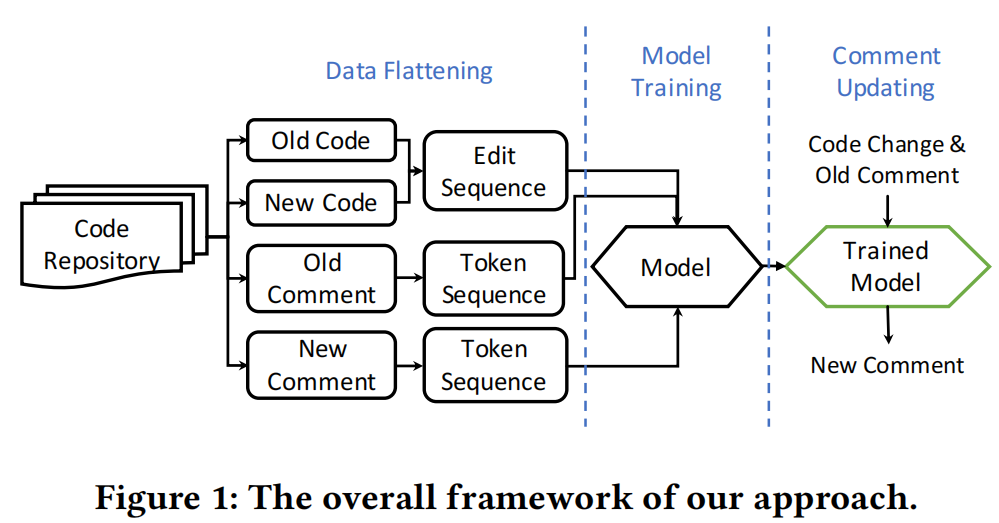
Data Flattening
-
Tokenization
- Remove spaces, retain punctuation, and split compound identifiers; when two adjacent tokens are not separated by whitespace, insert a
<con>marker. - Three common tokenization strategies: leave compound words intact; split them directly; or append a special symbol
</t>(e.g.,"inputBufer" -> "inputBufer</t>"). The first fails to remove OOV words, the second loses formatting, and the third cannot handle cases where sub-tokens of a compound word are predicted as independent tokens.
- Remove spaces, retain punctuation, and split compound identifiers; when two adjacent tokens are not separated by whitespace, insert a
-
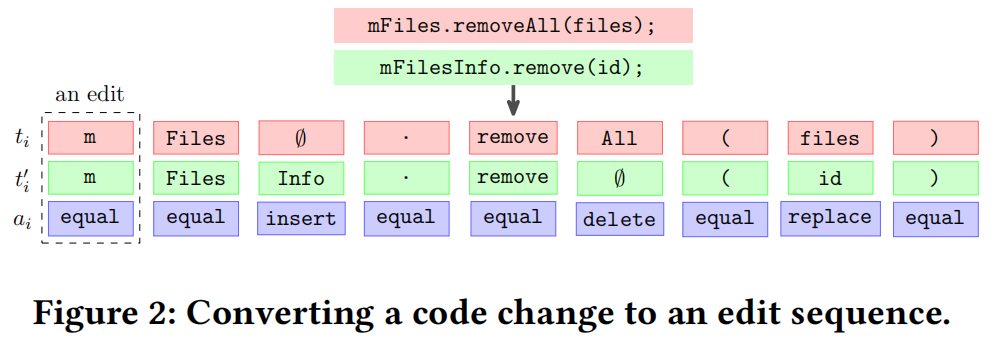
Code-change representation
- Each edit comprises three segments.
-
Seq2Seq Model
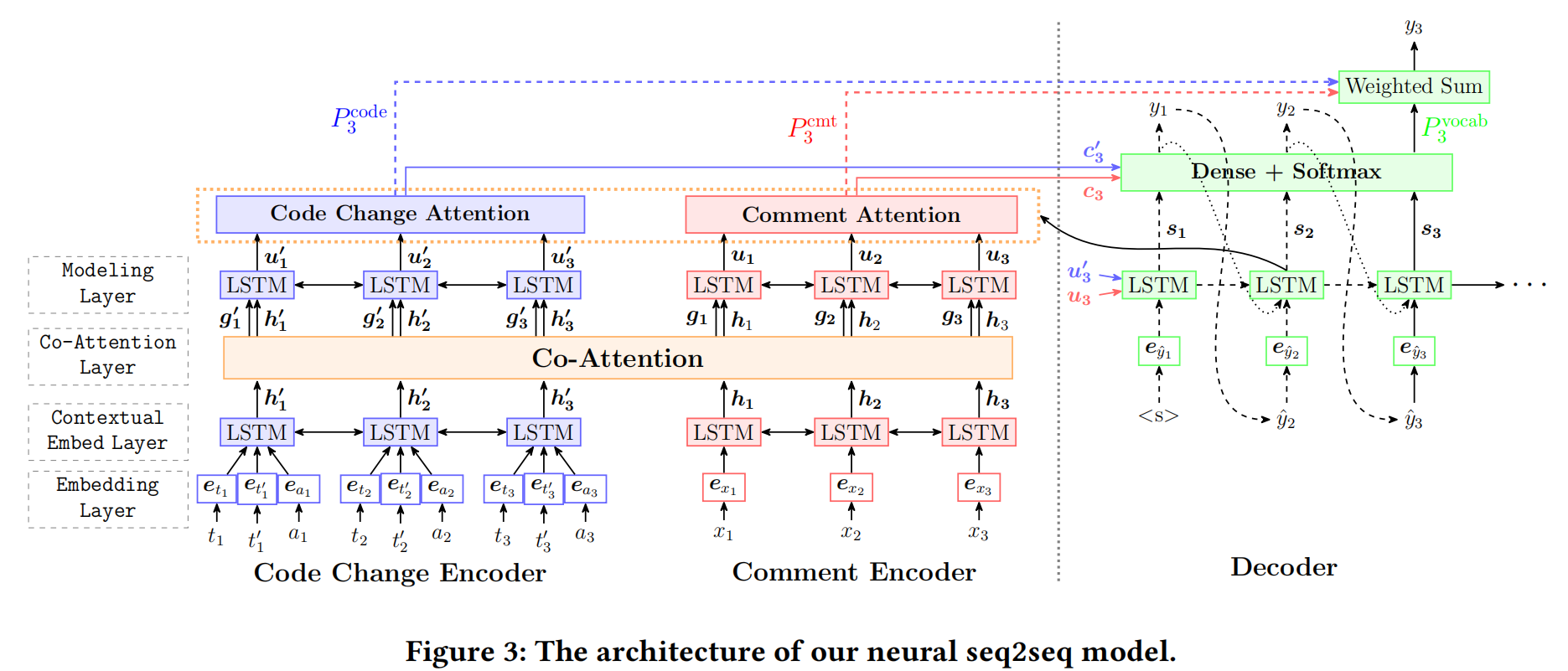
- Each encoder stacks four layers: embedding, contextual embedding, joint attention, and model layers.
- Embedding layer: shared vocabulary; embeddings initialized from fastText pretraining.
Data
- 1,496 repositories with at least 500 commits each.
- Method-level edits: GumTree is used to derive method-level change structure between two revisions.
- Data-processing details are lengthy; consult the original paper when implementing.
Experiment
<HR align=left color=#987cb9 SIZE=1>