
OpenAI-2021 Evaluating Large Language Models Trained on Code
Paper: Evaluating Large Language Models Trained on Code
Codex from the OpenAI team assists programmers in generating code.
Codex: GPT-based code tasks—innovation in application rather than algorithms
Abstract
The OpenAI team introduced Codex, a GPT-based model fine-tuned on GitHub code. The contribution lies in application rather than a new modeling algorithm; the work focuses on Python and solves 28.8% of problems. With repeated sampling—e.g., drawing 100 completions and counting success if any one passes—the effective solve rate rises to 70.2%.
Introduction
GPT-3 can generate simple code but struggles on harder tasks, so the authors retrained a dedicated model.
They target Python docstrings (comments preceding functions) and verify generated code with unit tests. They built a benchmark, HumanEval, with straightforward math and programming-interview-style problems.
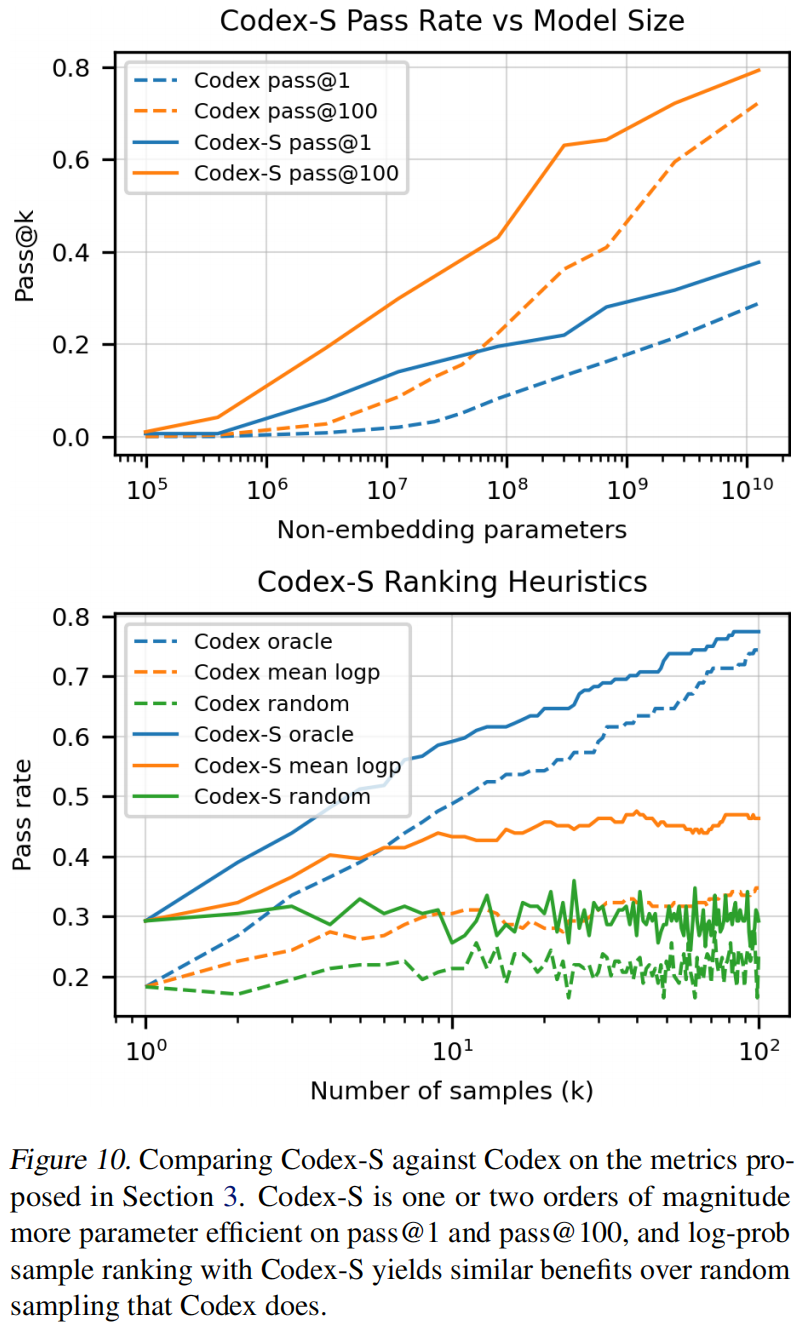
They generate multiple solutions and check whether any passes the unit tests. A 12B-parameter model reaches 28.8% accuracy; a 300M-parameter model reaches 13.2%; GPT-J at 6B reaches 11.4%; other GPT baselines are essentially 0%.
To further highlight model quality, they collected another dataset. The fine-tuned variant is Codex-S; even one in-context example lifts accuracy to 37.7%. With 100 samples, the probability that at least one is correct reaches 77.5%.
That setting is not realistic—you cannot give users 100 candidates and ask them to pick—so with a ranking procedure over candidates, the best single submission reaches 44.5% pass rate.
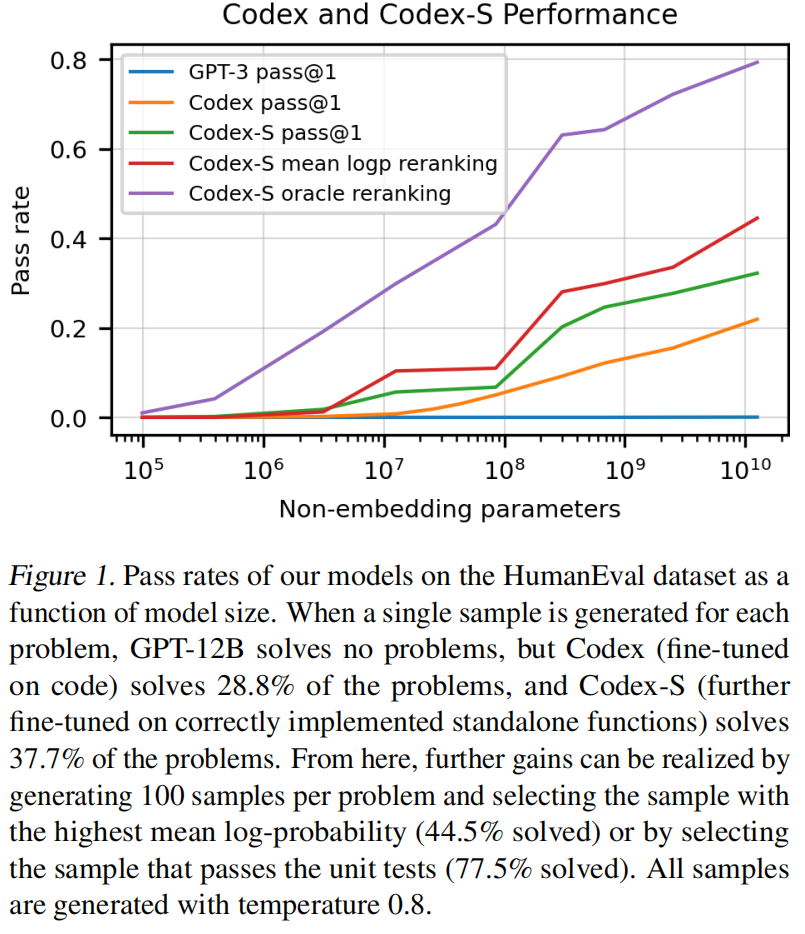
Performance still trends upward; larger data and models may help further.
Evaluation Framework
Metrics
They evaluate with pass@k: draw k samples; success if at least one passes. Very large k overstates model quality. In production, generated code should come with confidence scores and ranking; oversized k makes the metric overly optimistic.
Estimation
Estimating pass@k by generating exactly k answers per problem is unstable, so experiments are repeated. The authors draw n samples with n > k, then subsample k of them; let c denote the number of correct samples:
\[pass@k:=\mathbb{E}_{Problems}\left[ 1-\frac{ C_{n-c}^k}{ C_n^k}\right ]\]Validation set
Hand-written problems avoid web scraping, which often leaks training-set overlap.
Model
Data collection
They collected 179 GB of Python files without license filtering, which drew criticism over legal and ethical conflicts.
Method
Fine-tuning: Initializing from GPT-3 weights was expected to help but did not improve final quality; training still converged faster—fine-tuning may or may not help accuracy but typically speeds convergence.
Tokenization: Runs of whitespace collapse into special tokens so the model need not consume one token per space, cutting token count by about 30%.
Stopping: \nclass, \ndef, \n#, \nif, or \nprint.
Decoding: Next-token prediction uses nucleus (top-p) sampling, not greedy argmax or beam search.
- At each step, sort candidate tokens by probability, accumulate mass from highest to lowest until the total reaches at least 0.95, sample one token from that nucleus, and continue.
- This yields diverse runs across executions while suppressing low-probability junk.
Result
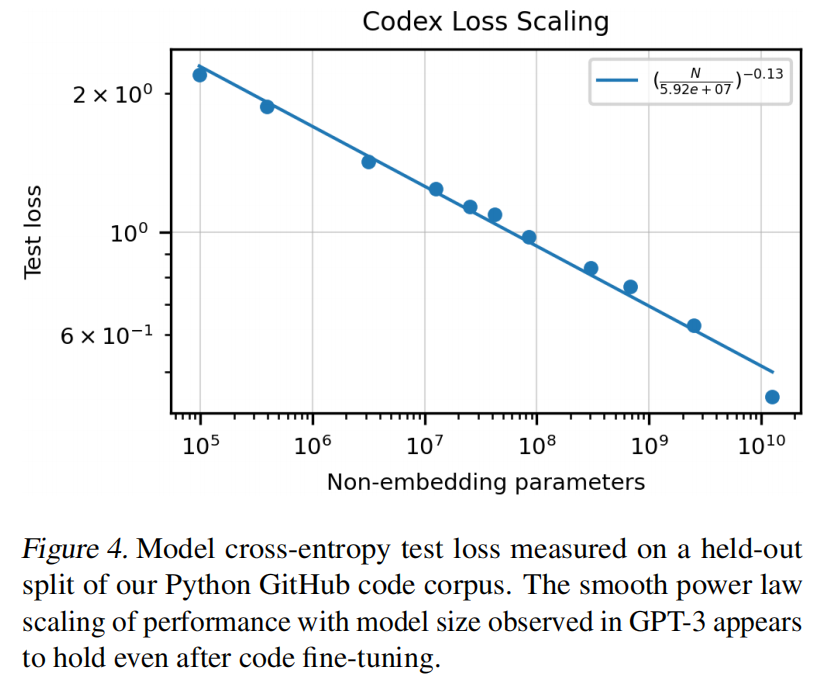
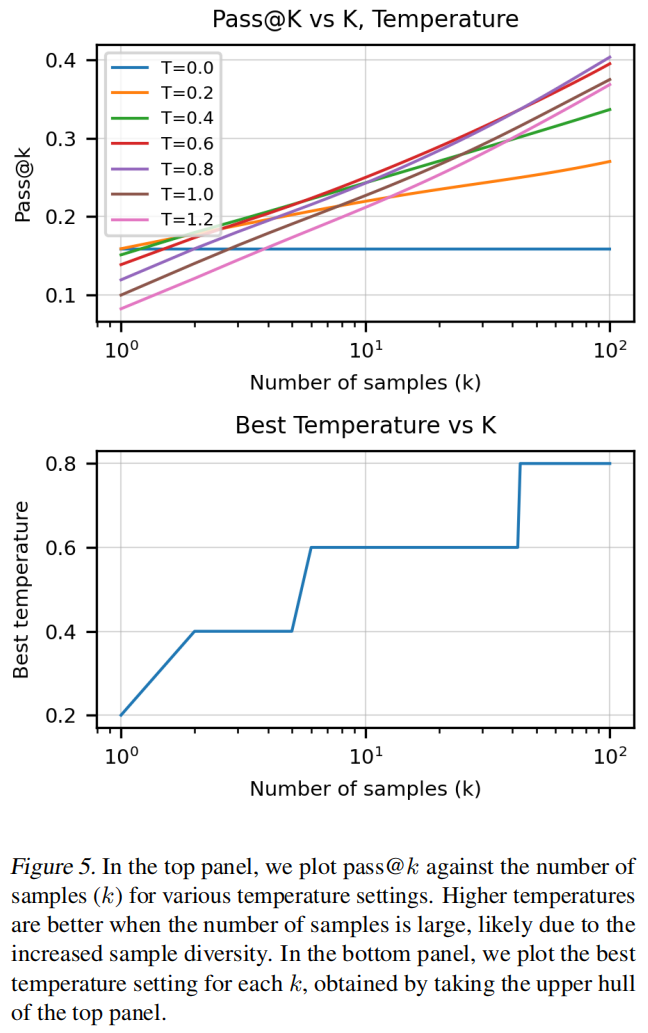
Dividing softmax logits by a higher temperature flattens the distribution; lower temperature sharpens it. Low temperature concentrates mass on top tokens; high temperature makes sampling more uniform.
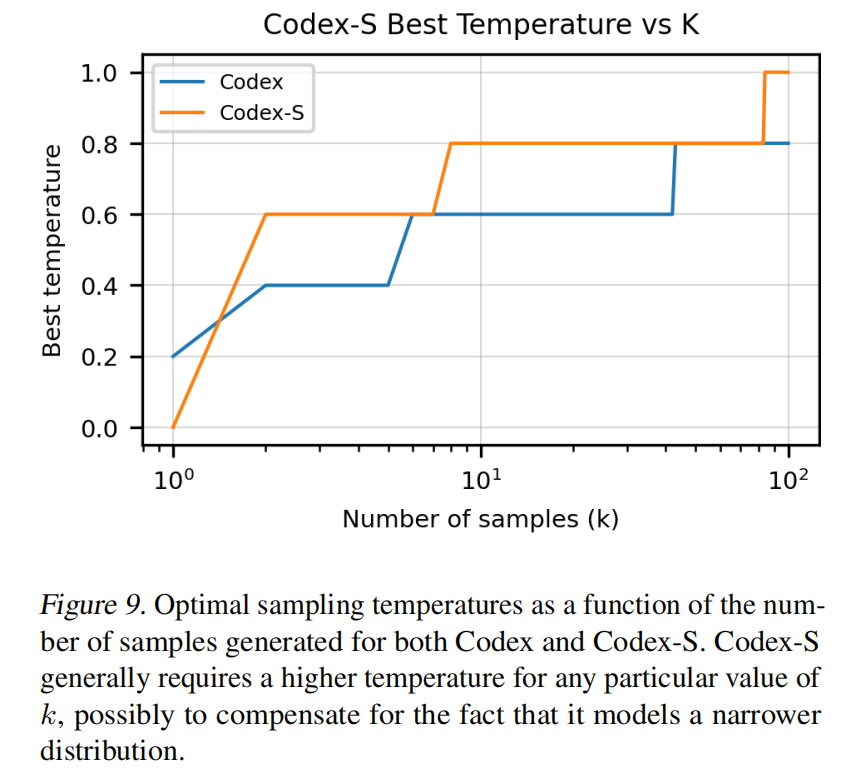
When more samples are allowed, temperature should increase accordingly.
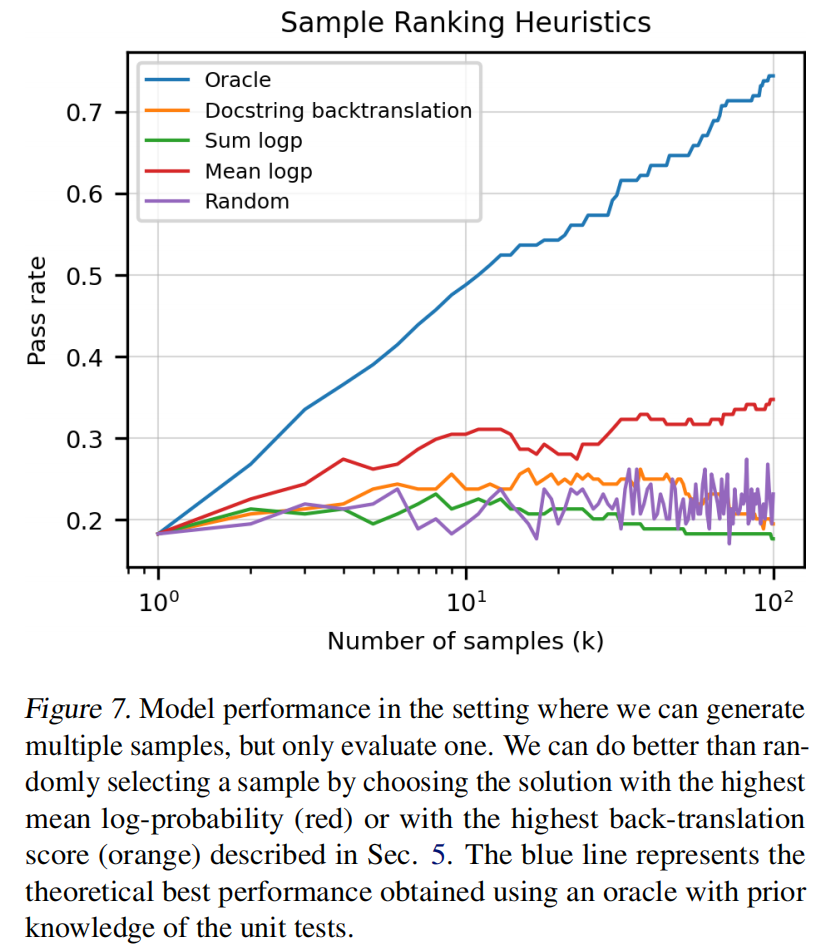
For ranking candidates, a strong heuristic averages log softmax probabilities per token; the highest-mean completion is selected.
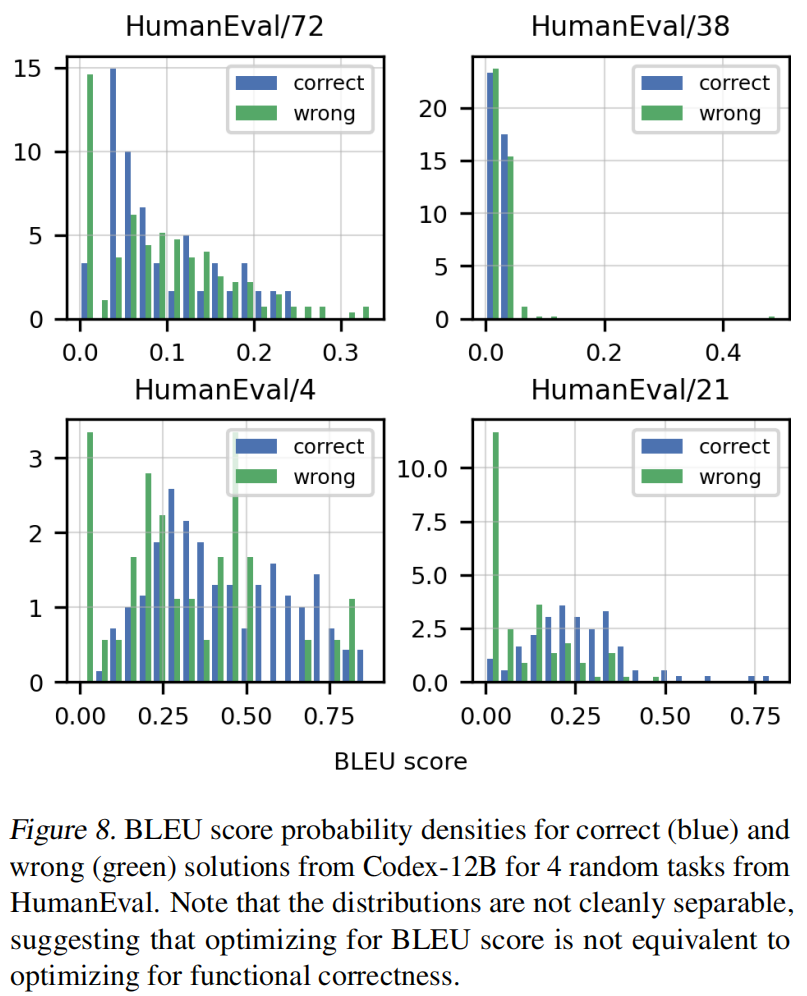
BLEU correlates poorly with functional correctness and does not guarantee semantic equivalence of code.
Supervised Fine-Tuning
They prepared an additional dataset with reference solutions—distinct from HumanEval—so overlap with the eval set might yield further gains.
- ~10,000 problems from programming contests
- Continuous integration (CI) runs unit tests on every commit in agile workflows; CI logs expose which tasks run—roughly 40,000 examples sourced this way
After collection, they filtered with the largest model: generate 100 completions per problem and keep it only if at least one passes unit tests; failures suggest an ill-posed problem or bad tests and little training value.
Docstring Generation
In Python, docstrings sit between the signature and the body—hard for left-to-right GPT-style models to fill “in the middle.” They rebuilt a dataset with docstrings moved to the end.
That variant is Codex-D.
Evaluation:
- Human inspection
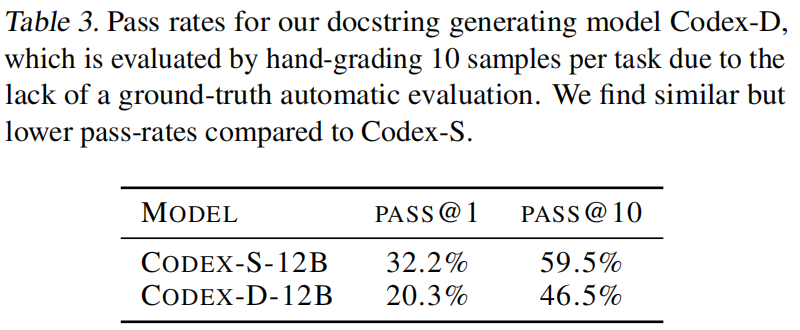
- Generate a docstring with Codex-D, implement the function from the docstring and signature, then run unit tests
Limitation
- Sample efficiency is limited; models may need to see substantial code volume.
- How should docstring prompts be written? Longer docstrings degrade generated code quality.
- They compose 13 building blocks, each a string operation (lowercase, uppercase, reorder, etc.); blocks chain arbitrarily and the model must apply them in sequence.
- More chained blocks correlate with lower accuracy.
- Weak at math and precise, complex operations.
- Developers may over-rely on model-generated code.
- Models may satisfy the literal request but not the intended use—e.g., when asked to generate comments, outputs may mimic training-data style rather than user needs.
<HR align=left color=#987cb9 SIZE=1>