
ICSE-2022 Cross-Domain Deep Code Search with Few-Shot Meta Learning
Paper: Cross-Domain Deep Code Search with Few-Shot Meta Learning
CDCS: meta-learning with random task splits for code search and extensive experiments
Abstract
Pre-trained models such as CodeBERT have advanced code search considerably in recent years, but fine-tuning them to align semantic distributions typically requires large corpora, which limits practicality in domain-specific settings. The authors propose CDCS: pre-train on common corpora such as Python or Java, transfer to other languages such as SQL, and use a MAML-based few-shot meta-learning algorithm to obtain a strong parameter initialization.
Introduction
Data for domain-specific languages is scarce, so practitioners often train a large multilingual model first and then fine-tune on task-specific datasets. The challenge is how to transfer prior knowledge: languages differ in features and representations, which can yield conflicting shared representations—especially for domain-specific code search, where target-language examples are sparse in the training data.
CDCS combines CodeBERT with a meta-learning procedure to find an initialization that adapts well to new tasks with small training sets.
Approach
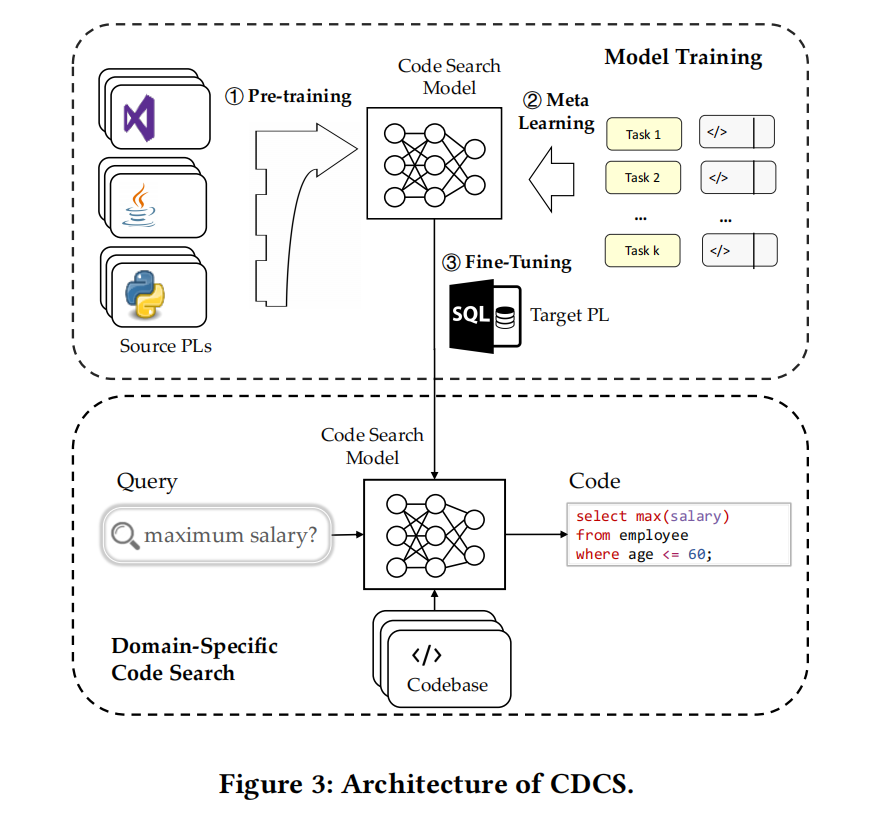
Pre-training
Similar to CodeBERT, MLM is used for pre-training; RTD is omitted because it did not help.
Each input is a <NL, PL> pair: [CLS], w…, [SEP], c…, [EOS], with natural language first and program language second.
Meta Learning
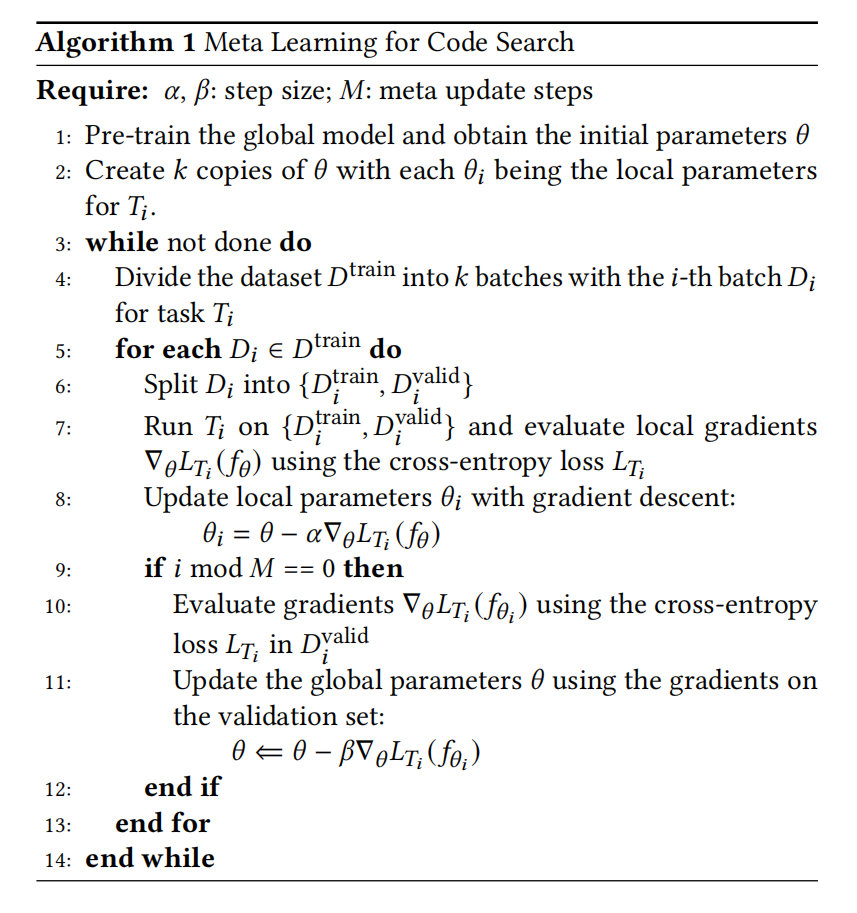
Training data are split into $k$ batches ${D_1,…,D_k}$; each $D_i$ is treated as a local task $T_i$, further divided into support and validation sets for inner updates, followed by an outer (global) update every $M$ steps.
Fine-Tuning
For code-search fine-tuning, retrieval is cast as binary classification: 1 for relevant and 0 for irrelevant. [CLS] serves as the pooled sequence representation; a fully connected head predicts whether a given <NL, PL> pair is relevant.
Domain-Specific Code Search
Given a query Q, code segments in the database form <NL, PL> pairs with the query; the trained model scores and ranks them.
Experiment
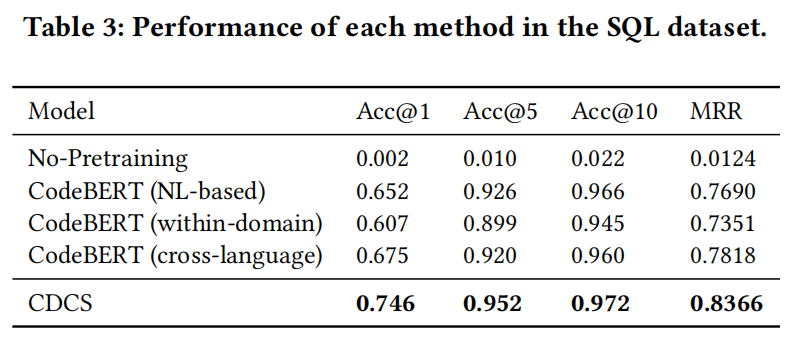
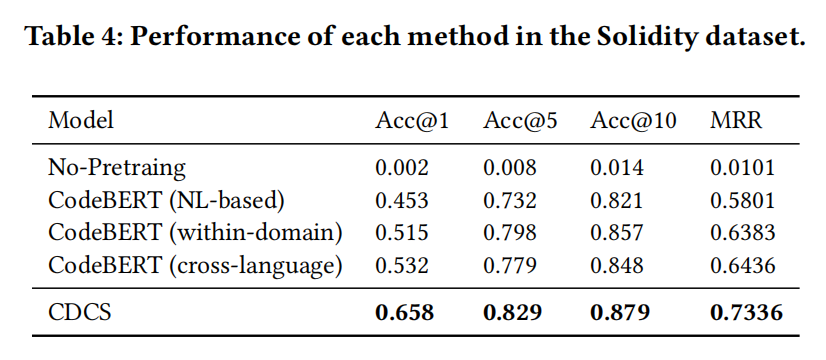
RQ1: How effective is CDCS for cross-domain code search?
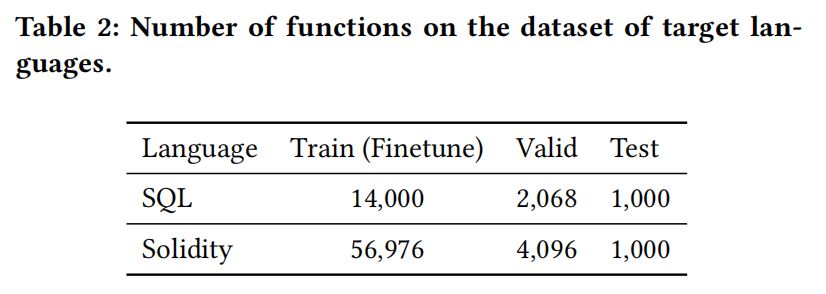
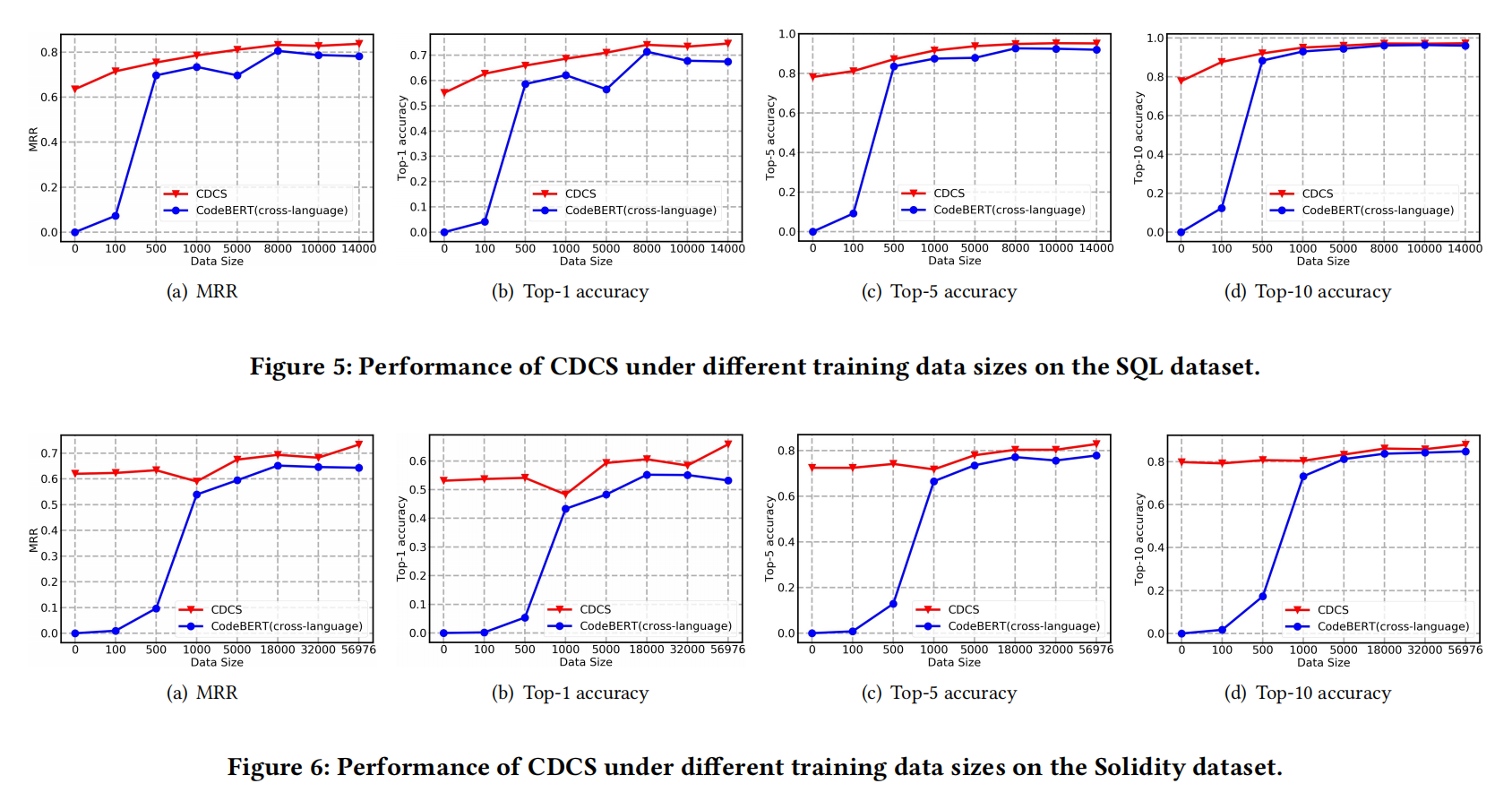
RQ2: Performance under different training set sizes
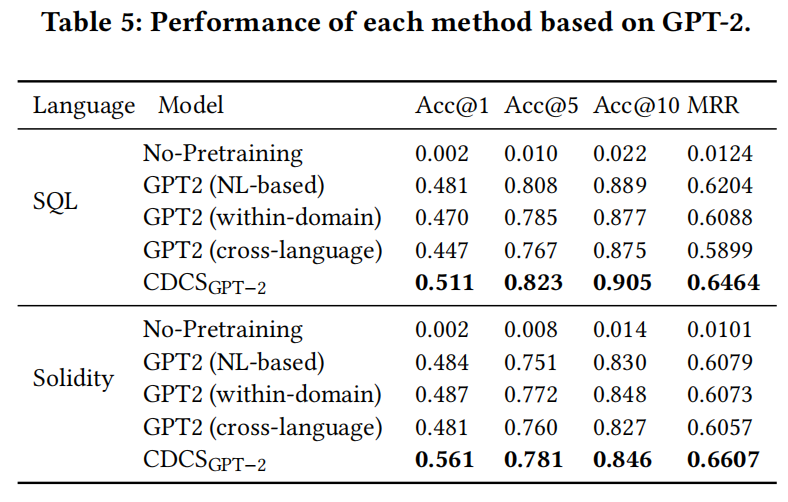
RQ3: Results with other pre-trained models
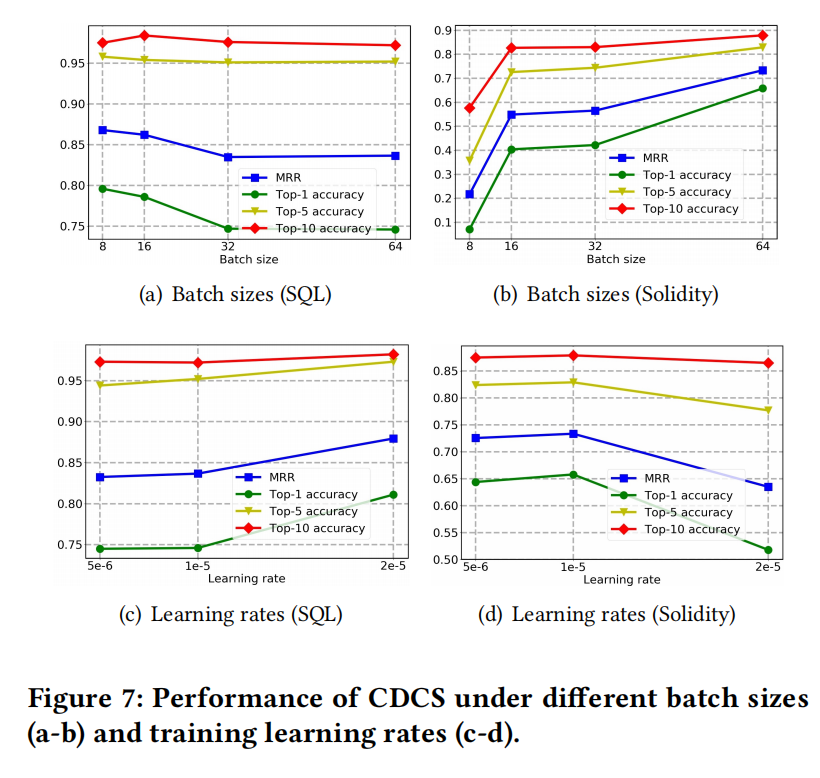
RQ4: Effect of hyperparameters
Notably, in Fig. 7a accuracy drops as batch size increases; the authors do not explain this behavior.
<HR align=left color=#987cb9 SIZE=1>