
EMNLP-2020 CodeBERT:A Pre-Trained Model for Programming and Natural Languages
Paper: CodeBERT: A Pre-Trained Model for Programming and Natural Languages
Code: https://github.com/microsoft/CodeBERT
Further reading: https://zhuanlan.zhihu.com/p/476950957
CodeBERT: A Pre-Trained Model for Programming Languages
Abstract
The authors propose CodeBERT, a bimodal pre-trained model for programming languages (PL) and natural language (NL) that learns general-purpose representations for downstream tasks.
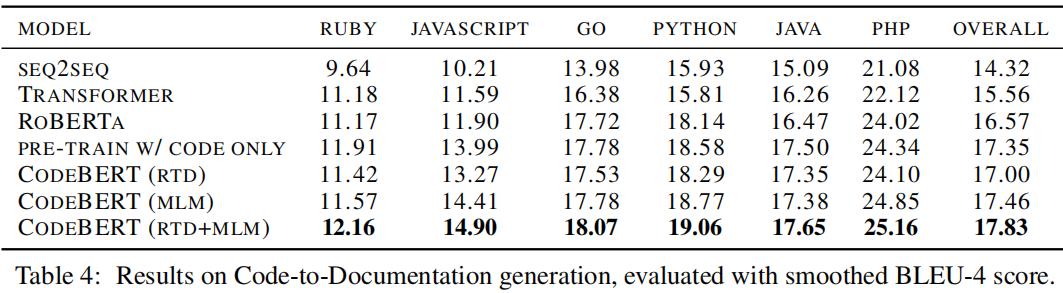
It achieves state-of-the-art results on code search and code documentation generation, though the primary focus remains code search.
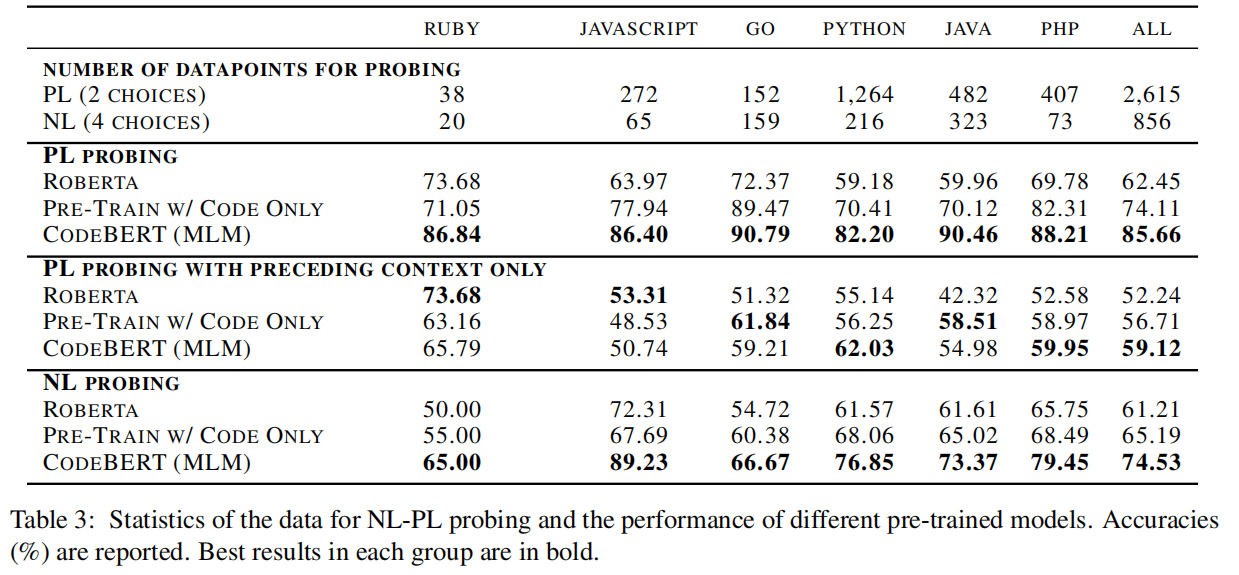
They also collect an NL–PL probing dataset.
Introduction
Large-scale pre-trained models such as ELMo, GPT, BERT, XLNet, and RoBERTa have substantially improved nearly all NLP tasks, and have motivated many bimodal approaches—e.g., ViLBERT and VideoBERT—for self-supervised learning from images/video and text.
Two pre-training objectives are used:
- Standard masked language modeling (MLM):
- The BERT objective: predict tokens after masking.
- Pre-training uses NL–PL paired data.
- Replaced token detection (RTD):
- A generator first predicts tokens masked in the sentence; predicted tokens then replace the [MASK] positions, and a discriminator decides whether each token is original or replaced.
- Unimodal code data train a stronger generator for the RTD task.
Main contributions:
- The first large-scale NL–PL pre-trained model covering multiple programming languages.
- Empirical evidence that CodeBERT is effective on code search and comment generation.
- A dataset for studying what knowledge code-based pre-trained models acquire.
Model
Model Architecture
CodeBERT is a multi-layer bidirectional Transformer with 12 layers and 12 attention heads per layer, closely aligned with RoBERTa (~125M parameters).
Input/Output Representations
Natural language and a code snippet are concatenated with special tokens, e.g. $[CLS],w_1,w_2,\cdots,w_n,[SEP],c_1,c_2,\cdots,c_m,[EOS]$
Outputs comprise contextual vectors for each token and a [CLS] representation for classification.
Pre-Training Data
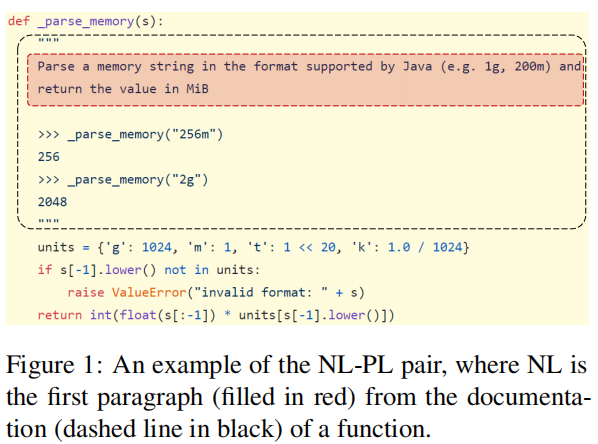
A data example is shown above. The authors apply several filters: (1) each project is used by at least one other project; (2) each document is truncated to a single segment; (3) documents with fewer than three tokens are removed; (4) code with fewer than three lines is removed; (5) functions whose names contain the substring “test” are removed.
Pre-Training CodeBERT
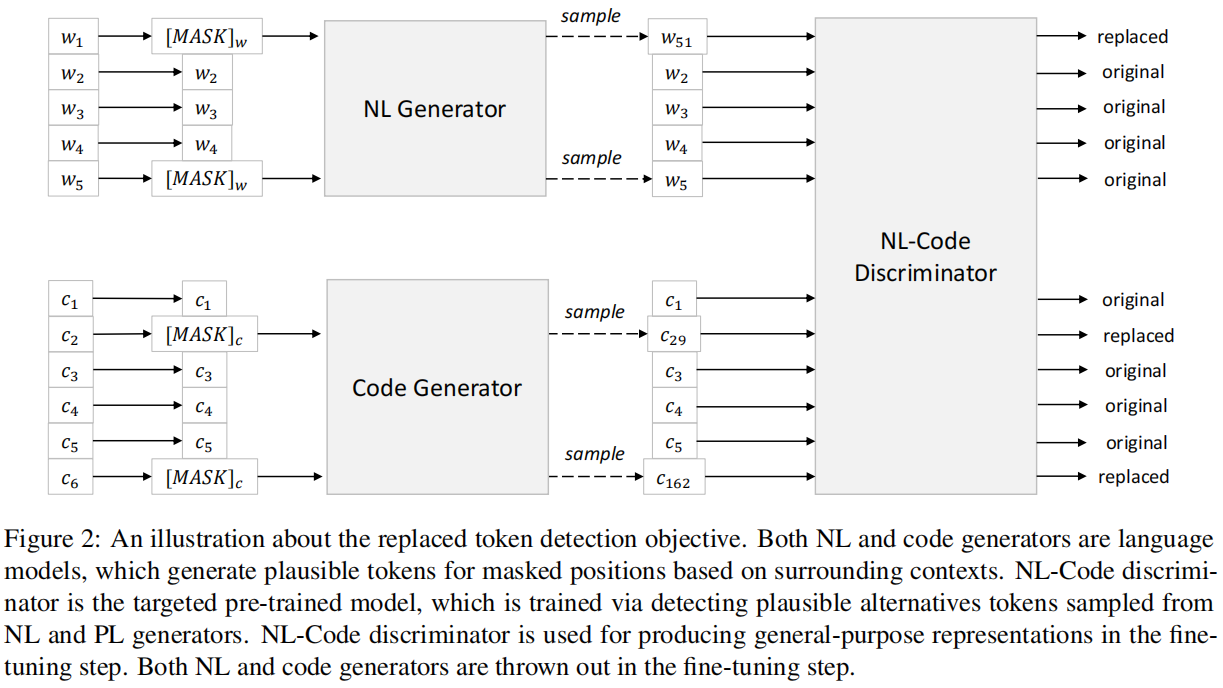
Two pre-training tasks are used:
- MLM (BERT-style masked language modeling): randomly mask tokens and predict them; this task uses NL–PL pairs.
- 15% of tokens are selected; of those, 80% are replaced with [MASK], 10% with random tokens, and 10% are left unchanged; the corrupted sequence is fed to BERT to predict the masked positions.
- RTD uses unimodal PL and NL data.
- From the ICLR 2020 paper ELECTRA: Pre-training Text Encoders as Discriminators Rather Than Generators: standard MLM in BERT trains on only 15% of tokens, which is computationally inefficient, and [MASK] does not appear at inference, causing a train–test mismatch.
- A generator first predicts masked tokens; those predictions replace [MASK]; a discriminator then labels each token as original or replaced.
Fine-Tuning CodeBERT
Fine-tuning is evaluated on natural-language–code search and code-to-text generation. For search, the [CLS] embedding scores semantic relevance between an NL query and code. For generation, an encoder–decoder setup is used with CodeBERT initializing the encoder.
Experiment
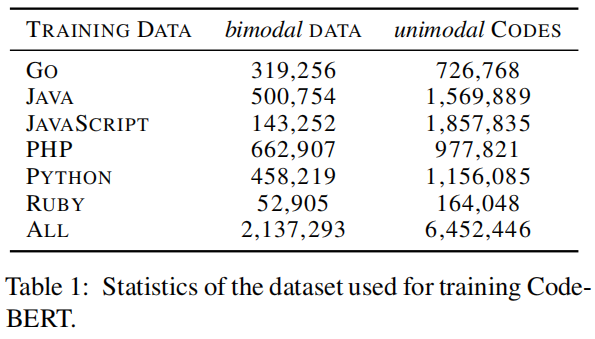
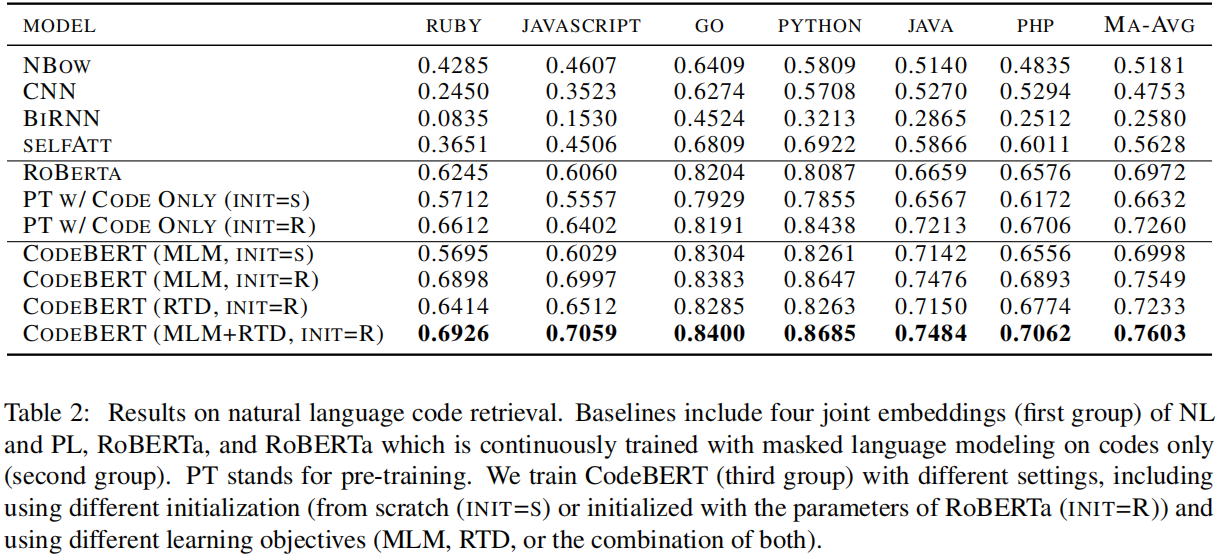
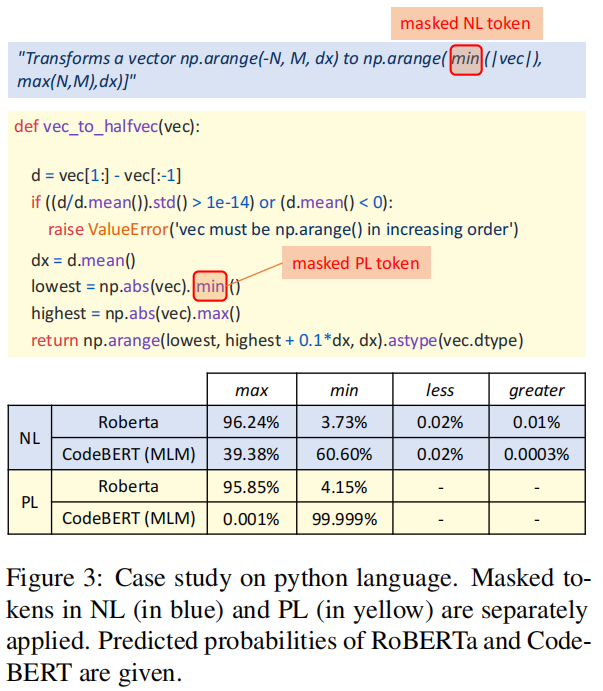
Beyond the two fine-tuning tasks, the authors probe what types of knowledge CodeBERT learns. Given an NL–PL pair, probing asks the model to pick the correct masked token among distractors via cloze-style items: one token is replaced with [MASK], and distractors are chosen using domain knowledge.
<HR align=left color=#987cb9 SIZE=1>