
EMNLP-2021 HAConvGNN:Hierarchical Attention Based Convolutional Graph Neural Network for Code Documentation Generation in Jupyter Notebooks
HAConvGNN: Hierarchical Attention-Based Convolutional Graph Neural Network
1. Summary
- The authors observe that roughly 25% of notebooks on GitHub lack comments and that such data remain scarce; they therefore introduce a new Jupyter notebook dataset. A key characteristic is that a single comment may align with up to four code cells (the ratio of code cells to Markdown comments is 2.2195). Comments are categorized into three types: (1) process and headline; (2) result; (3) reasoning and education.
- They argue that documentation can be produced jointly by humans and AI.
- They propose a graph-based hierarchical attention architecture and validate it with human evaluation.
2. Model architecture
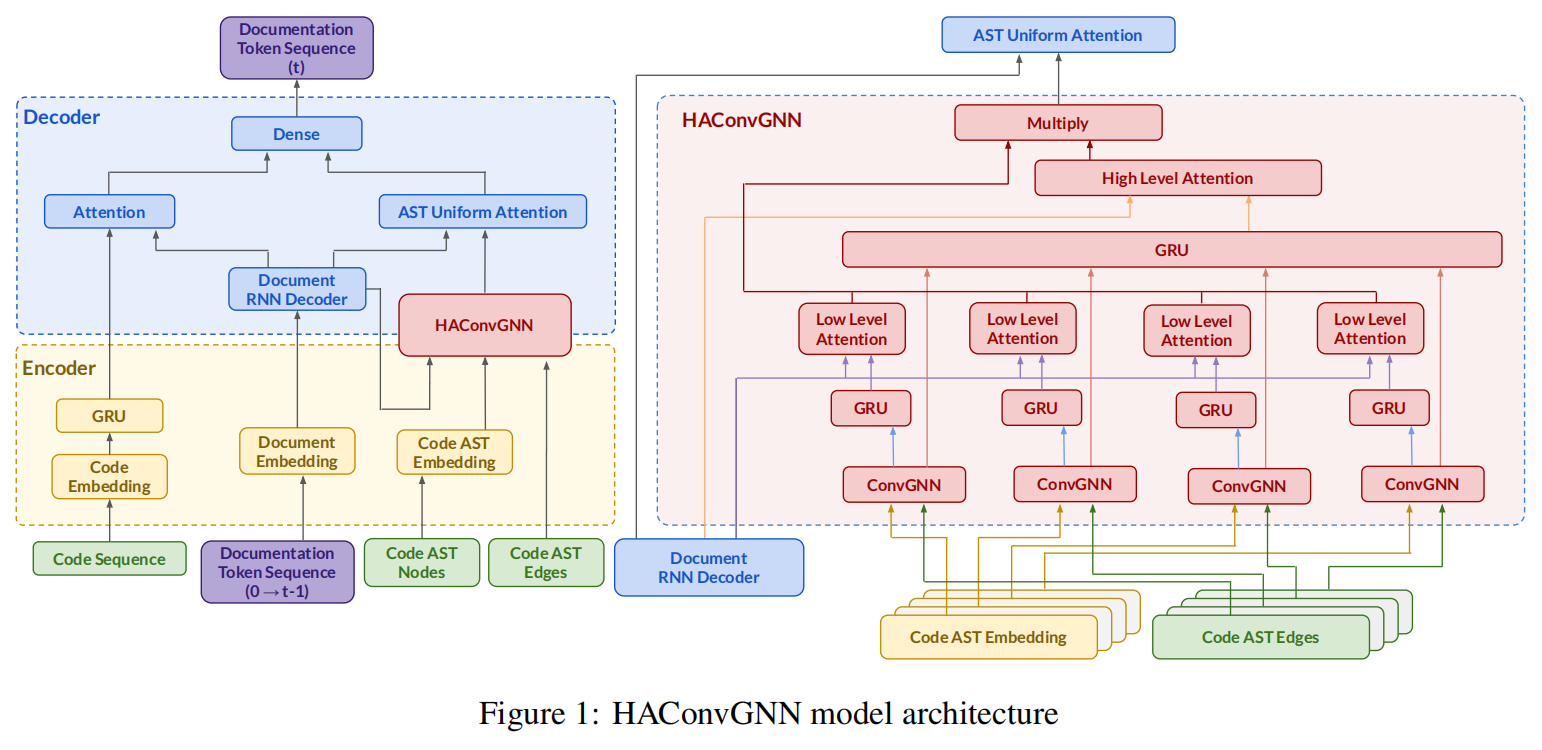
2.1 Input
- tokenized code sequence
- tokenized documentation sequence
- nodes of the AST graph built from the code sequence
- edges (topology) of the AST graph built from the code sequence
2.2 Embeddings
Three embedding layers: code embedding, document embedding, and Code AST embedding.
2.3 Encoder
One encoder encodes the source code sequence; four additional encoders encode the AST graphs of up to four code cells; a higher-level GRU encoder aggregates the outputs of these four AST encoders into a higher-level representation.
2.4 HAConvGNN
Low-level attention plus high-level attention.
3. Human evaluation
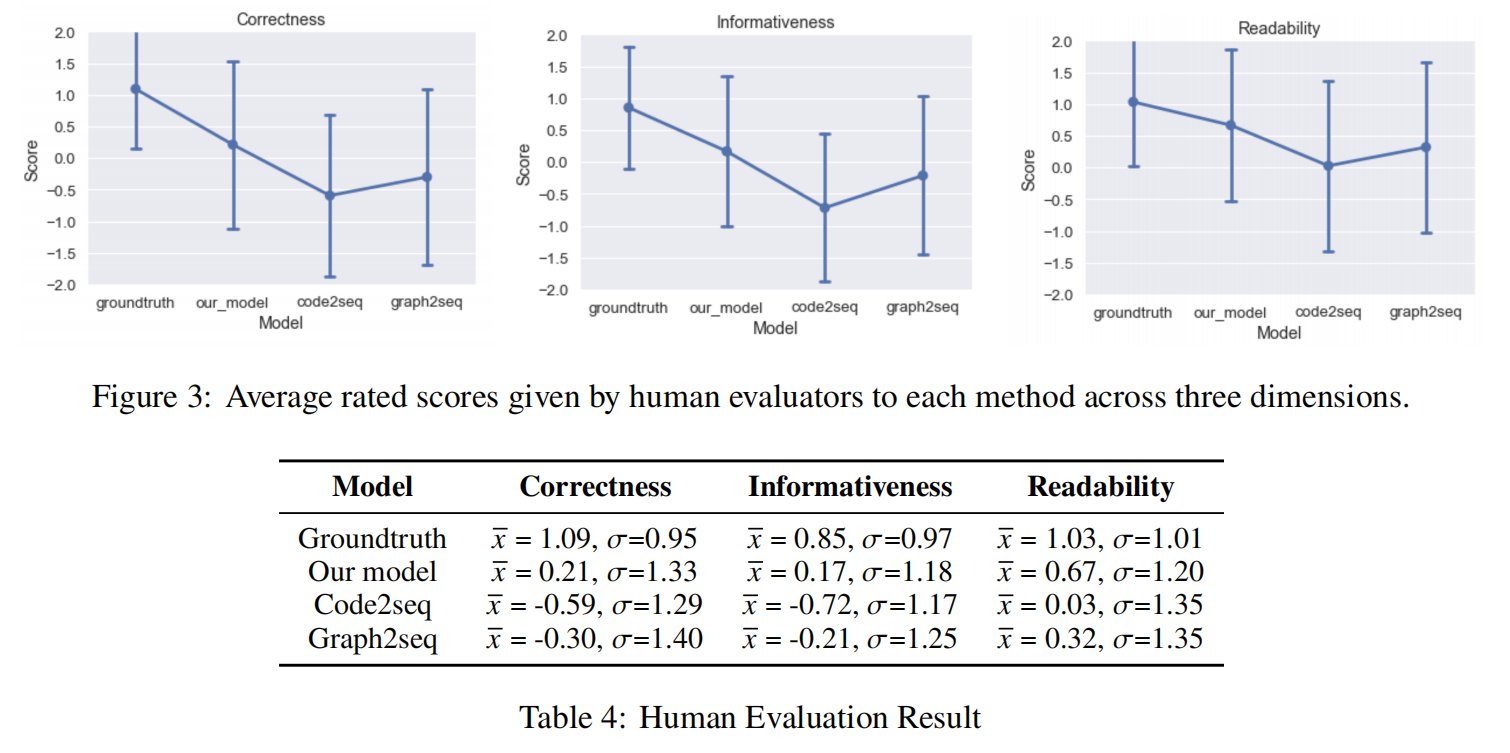
- Evaluation criteria: informativeness, readability, and correctness.
- In each round, 30 code–documentation pairs are selected; each pair is shown to five annotators, who choose among four candidate outputs, one of which is the ground truth.
<HR align=left color=#987cb9 SIZE=1>