
Fitness · arXiv 2026
VenusREM-Harness
A general, model-agnostic, training-free harness that improves mutation-effect scores from any frozen protein foundation model, using family-specific evolutionary evidence and structural context.
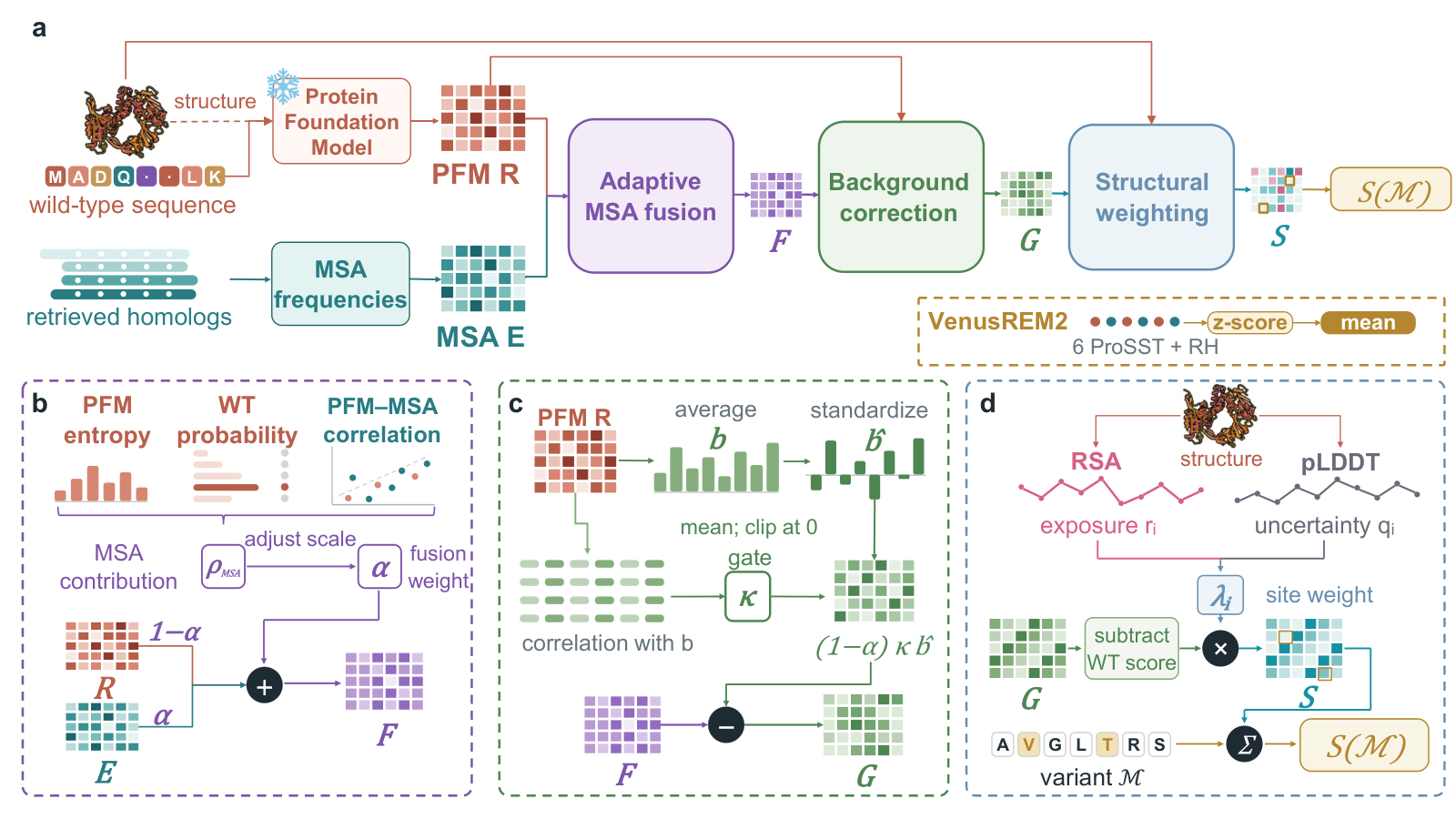
What the harness does
Protein foundation models (PFMs) are widely used for fitness prediction, but they share amino-acid preferences inherited from their training corpora, and unreliable inputs can further distort scores. VenusREM-Harness (VRH) leaves the PFM frozen. It is model-agnostic and training-free: MSA evidence is mixed in according to model uncertainty, then gated background correction and score shrinkage use structural confidence and solvent exposure as additional constraints.
The same procedure applies to sequence models, inverse-folding models, and structure-aware models. VenusREM is the earlier retrieval-enhanced scorer this line builds on; VRH generalizes that idea beyond one model.
Results
Across 1,211 assays and 3.1 million measured variants from ProteinGym, VenusMutHub, and the new viral benchmark VenusViroHub, all 71 tested configurations improve Spearman correlation on all three benchmarks, by 0.073 on average.
VenusREM2, built by passing six ProSST models through the harness and averaging z-scored outputs, is the first method to rank first in every function, taxon, MSA-depth, and mutation-depth category on ProteinGym, with Average Spearman 0.556 — 0.038 above the previous best.
Citation
If you use VenusREM-Harness or VenusREM2, please cite:
@misc{tan2026venusremharness,
  title={A General Harness for Protein Foundation Model Fitness Prediction},
  author={Tan, Yang and Tian, Qijia and Sun, Gangyu and Zhong, Bozitao and Li, Mingchen and Yu, Yuanxi and Dong, Nanqing and Hong, Liang},
  year={2026},
  eprint={2609.34654},
  archivePrefix={arXiv},
  primaryClass={q-bio.QM},
  url={https://arxiv.org/abs/2609.34654}
}