
COLING-2025 AutoProteinEngine:A Large Language Model Driven Agent Framework for Multimodal AutoML in Protein Engineering
AutoPE: An Agent for Automatically Training PLM Models
Abstract
Protein engineering is essential for biomedical applications, but traditional approaches are often inefficient and resource-intensive. Although deep learning (DL) models show great promise, training or applying them remains challenging for biologists without specialized computational expertise. To address this gap, the authors propose AutoProteinEngine (AutoPE), a large language model (LLM)–driven agent framework designed for multimodal automated machine learning (AutoML) in protein engineering. A key innovation of AutoPE is that it lets biologists without a deep learning background interact with DL models through natural language, substantially lowering the technical barrier for protein engineering tasks.
The framework uniquely combines LLMs with AutoML to:
- Handle both protein sequence and graph modalities and perform model selection.
- Automate hyperparameter optimization.
- Automatically retrieve data from protein databases.
Evaluated on two real-world protein engineering tasks, AutoPE achieves substantial gains over conventional zero-shot and manual fine-tuning baselines. Overall, AutoPE bridges deep learning and biologists’ domain knowledge, enabling researchers to leverage DL effectively without extensive programming skills.
1 Introduction
Protein engineering focuses on designing and optimizing proteins with specific functions and plays a critical role in biomedical areas such as drug discovery, enzyme optimization, and biomaterials design. However, classical methods—including directed evolution and rational design—often suffer from low efficiency, limited success rates, and high resource demands.
Deep learning models exemplified by the ESM and AlphaFold families have greatly improved efficiency and accuracy on tasks such as protein structure prediction. Yet for biologists who lack professional programming and machine learning expertise, training or fine-tuning these complex DL models is a major hurdle. Concrete difficulties include:
- Complex model architectures: Effective modification and interpretation require a solid understanding of DL principles.
- Difficult hyperparameter optimization: Tuning hyperparameters for best performance depends heavily on ML experience and intuition.
- Specialized data preprocessing: Feeding protein data into models typically requires dedicated preprocessing pipelines.
- Multimodal data: Protein data can appear as sequences and graphs, which further complicates training and optimization.
Although automated machine learning (AutoML) aims to reduce the human effort needed to train DL models, existing AutoML frameworks still expect users to have substantial deep learning and programming knowledge, limiting adoption among biologists without computational backgrounds. Moreover, general-purpose frameworks often lack domain knowledge specific to protein engineering and struggle to handle protein sequence and graph data effectively.
To meet these challenges, the authors propose an LLM-based agent framework tailored to multimodal AutoML for protein engineering. Leveraging the conversational interaction capabilities of LLMs lowers the learning curve and aims to bridge DL models and biologists’ domain expertise, making protein engineering workflows more efficient and accessible.
2 Methods
2.1 LLM-driven AutoML
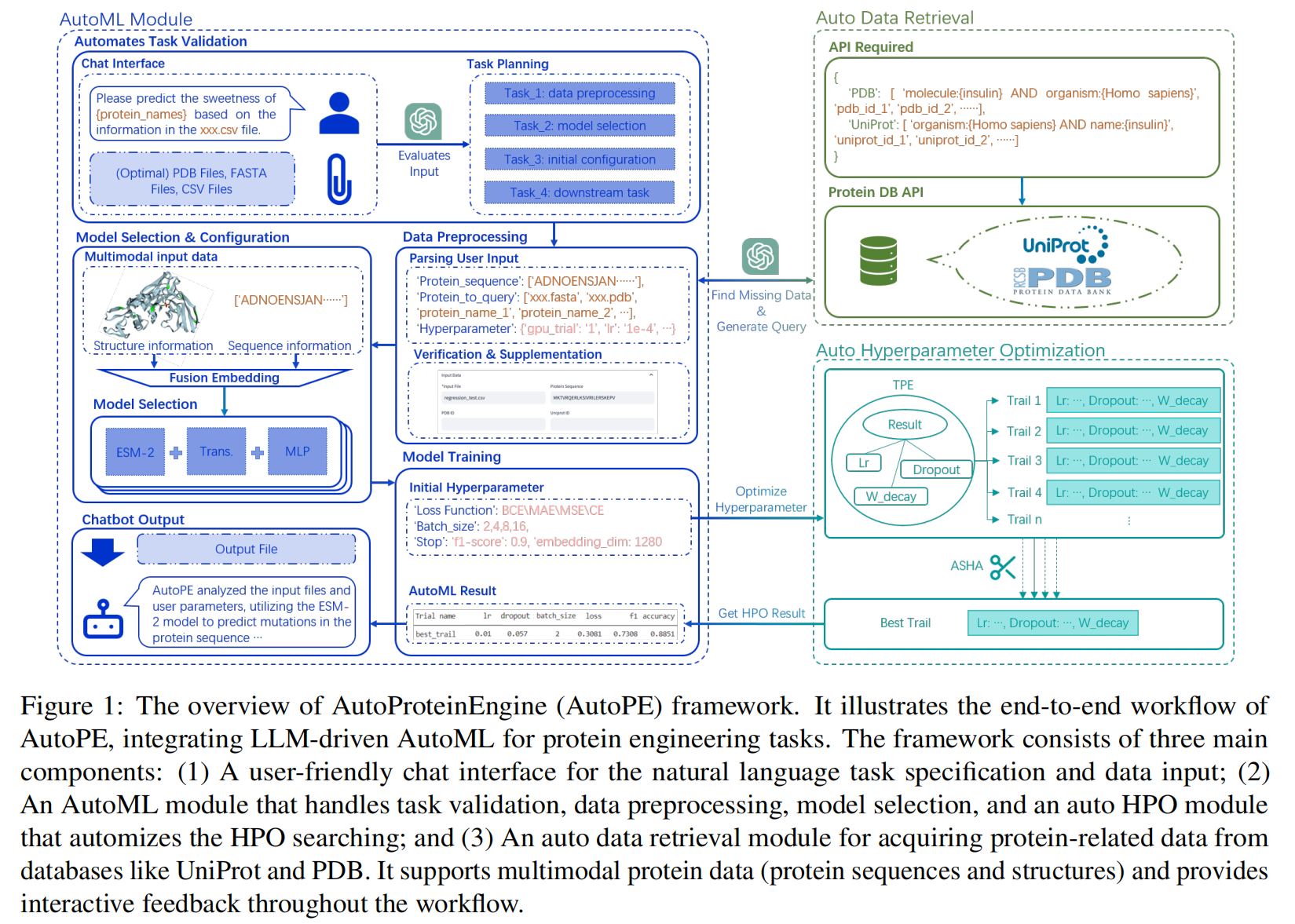
This is the core of the AutoPE framework: an AutoML module driven by a large language model (LLM) that automates tasks in protein engineering.
- Interaction: Users (e.g., biologists) need not have deep computational expertise; they describe protein engineering tasks in natural language, such as “I need to train a model to predict mutations for a given protein sequence.”
- Task validation: The LLM first assesses whether the user’s request falls within AutoPE’s scope (e.g., protein stability prediction, protein–protein interaction prediction). If the description is unclear or out of scope, the system clarifies or refines the request through dialogue.
- Task planning: Once validated, the LLM devises an action plan covering data preprocessing, model selection, configuration, and related steps. It uses retrieval-augmented generation (RAG) to pull information from relevant literature so the plan incorporates protein-engineering domain knowledge.
- Data preprocessing: If user-provided data are incomplete, a data retrieval module is activated to supplement records from online databases such as PDB (Protein Data Bank) and UniProt. The LLM automatically constructs database queries suited to the task.
- Model selection and configuration: Following the plan, AutoPE selects and configures models from a predefined library (e.g., ESM family, AlphaFold). For multimodal inputs in sequence and graph form, AutoPE uses a late fusion scheme to combine embeddings from different modalities and exploit complementary information.
- Model training: The LLM optimizes a general training pipeline while incorporating model-specific details. This includes choosing loss functions, setting batch size and learning rate according to model and dataset scale, and applying early stopping and model checkpointing to mitigate overfitting. The LLM also applies task-relevant data augmentation, such as random mutations on sequence data.
2.2 Auto Hyperparameter Optimization
To further improve performance and usability, AutoPE includes an automatic hyperparameter optimization (HPO) module.
- Core algorithms: The module combines two stages:
- Tree-structured Parzen Estimator (TPE): TPE models the probability of configurations that yield good performance, efficiently exploring the hyperparameter space and focusing on regions likely to improve results.
- Asynchronous Successive Halving Algorithm (ASHA): ASHA acts as a scheduler that terminates underperforming trials early and reallocates compute to more promising configurations.
- Interaction and interpretability: Before HPO starts, AutoPE interacts with the user to confirm hyperparameter settings, allowing researchers to inject domain knowledge. During optimization, the system provides natural-language feedback, translating numeric metrics such as MSE or F1-score into easy-to-read summaries and improving interpretability. Users can also allocate compute via natural-language instructions, e.g., specifying the number of GPUs per trial.
2.3 Auto Data Retrieval
This module streamlines acquisition of data required for protein engineering tasks.
- Natural-language queries: Users can state data needs in natural language, e.g., “I need sequence and structure data for human insulin.”
- Query generation: The LLM parses the request, identifies key elements (protein name: insulin; species: human; data types: sequence and structure), and automatically builds structured queries for UniProt and PDB. For example, a PDB query might be
molecule: {insulin} AND organism: {Homo sapiens}. - Interactive feedback and flexibility: If an initial search returns no hits, the LLM guides interactive dialogue, suggesting alternatives such as related structures from other mammals. The system also offers an editable table interface for manual entry or verification of retrieved data, which is useful for integrating private or unpublished records.
- Result summarization: After data collection, the LLM produces a detailed summary covering sources of retrieved sequences, PDB IDs and resolutions of relevant structures, key UniProt annotations, and any gaps or potential issues in the data.
3 Experiments
3.1 Dataset
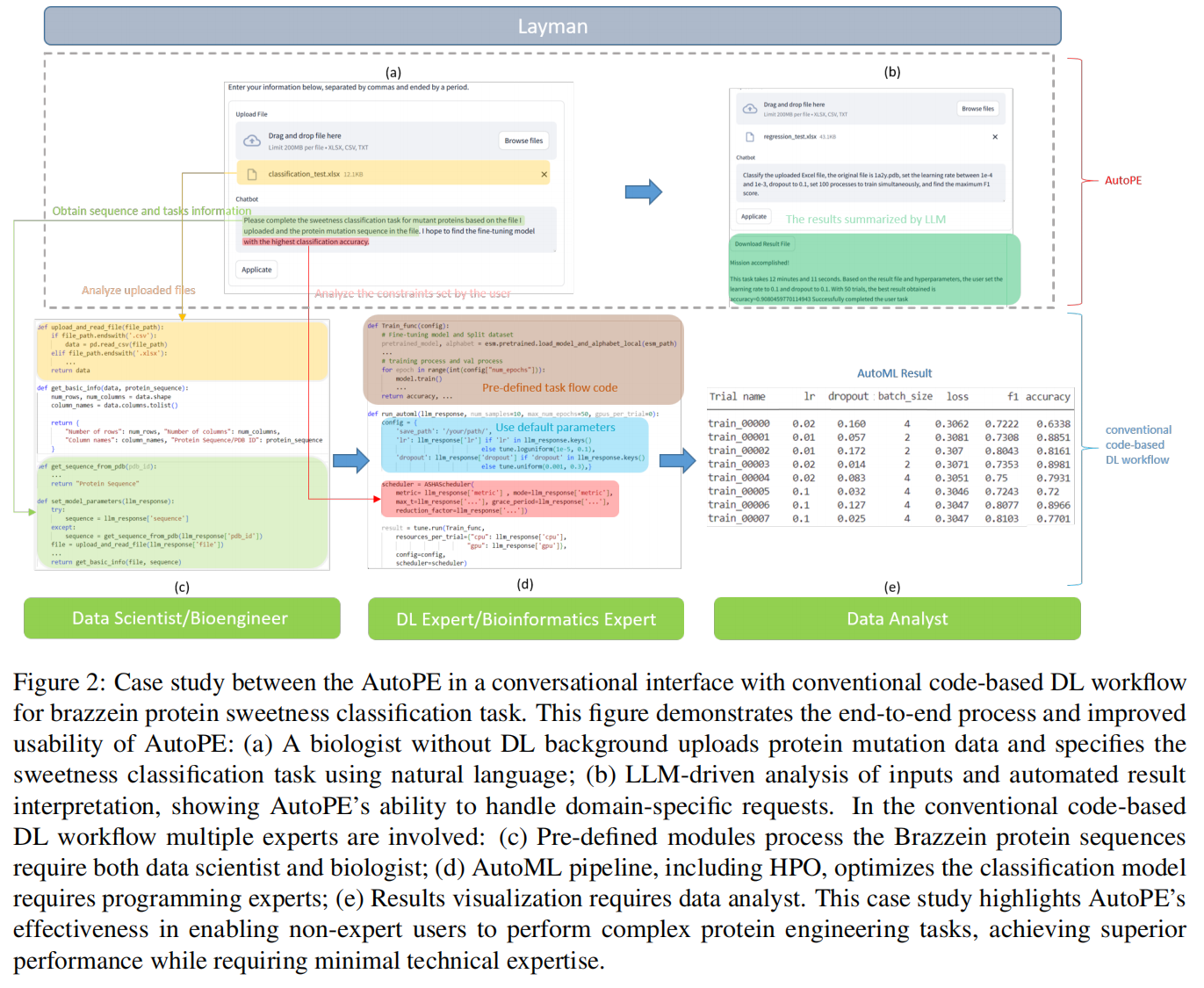
To evaluate AutoPE, the authors chose two proteins for a classification task and a regression task, respectively.
- Classification (Brazzein protein):
- Source: Brazzein is a high-intensity sweet protein.
- Composition: 435 Brazzein mutant entries with single- and multi-point mutations and corresponding relative sweetness measurements.
- Labeling: Mutants were labeled sweet or not sweet using a relative sweetness threshold of 100 (equivalent to sucrose sweetness).
- Regression (STM1221 protein):
- Source: STM1221 is a wild-type enzyme that specifically removes acetyl groups from target proteins.
- Composition: 234 enzyme activity scores under diverse mutations, measured by wet-lab experiments; continuous labels for predicting activity across mutations.
- Split: Each dataset was randomly split into 80% training and 20% test, with five-fold cross-validation.
3.2 Experiment Design and Implementation
Experiments compare AutoPE against zero-shot inference and manual fine-tuning.
- Zero-shot inference:
- Uses a pretrained protein language model (ESM) to extract features without task-specific fine-tuning.
- Serves as a baseline for assessing AutoPE’s generalization.
- After feature extraction, traditional ML algorithms such as logistic regression and k-nearest neighbors (KNN) predict functional scores.
- Manual fine-tuning:
- Improves task performance by manually fine-tuning a pretrained protein language model.
- Custom changes include adding a self-attention layer to capture medium- and long-range dependencies in protein sequences and better recognize complex mutations.
- Hyperparameter search was performed manually by an ML engineer with three years of experience in deep learning and protein engineering.
- Evaluation metrics:
- Classification: F1-score (balances precision and recall), ROC-AUC (overall discriminative ability), and SRCC (rank preservation).
- Regression: MSE (mean squared error between predictions and ground truth), MAE (mean absolute error, less sensitive to outliers), and R² (explained variance).
- Implementation details:
- The LLM used in AutoPE is TourSynbio-7B.
- All experiments ran on eight NVIDIA 4090 GPUs.
3.3 Results
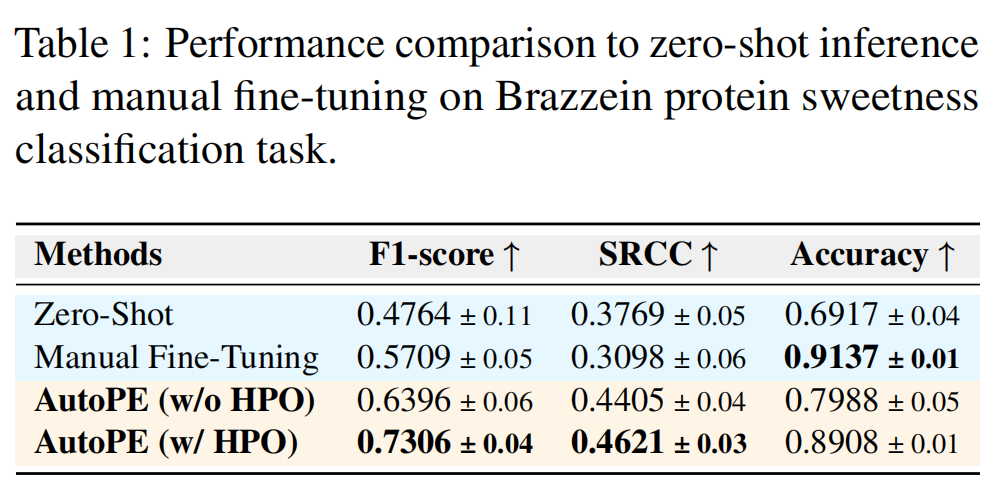
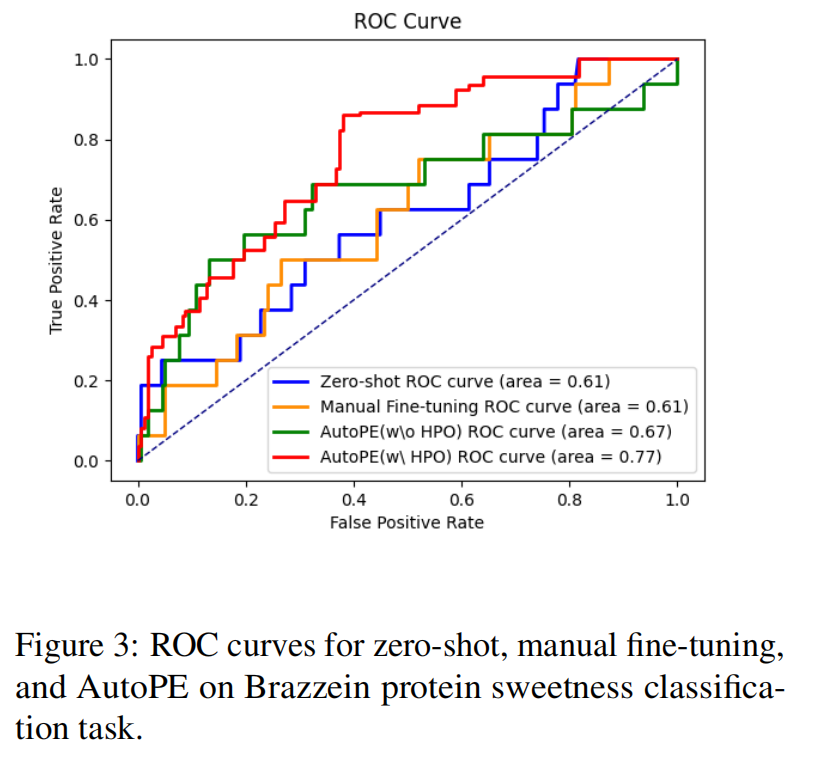
Classification results (Table 1 and Figure 3):
- AutoPE performs strongly, achieving excellent results across metrics; its ROC curve lies closest to the upper-left corner.
- Ablation studies confirm the effectiveness of the auto-HPO module. AutoPE with HPO achieves the highest F1-score (0.7306) and SRCC (0.4621).
- Compared with manual fine-tuning, manual tuning attains the highest accuracy but a lower F1-score, suggesting possible overfitting. AutoPE with HPO achieves the best trade-off between high accuracy (0.8908) and top F1-score and SRCC, indicating stronger robustness and generalization.
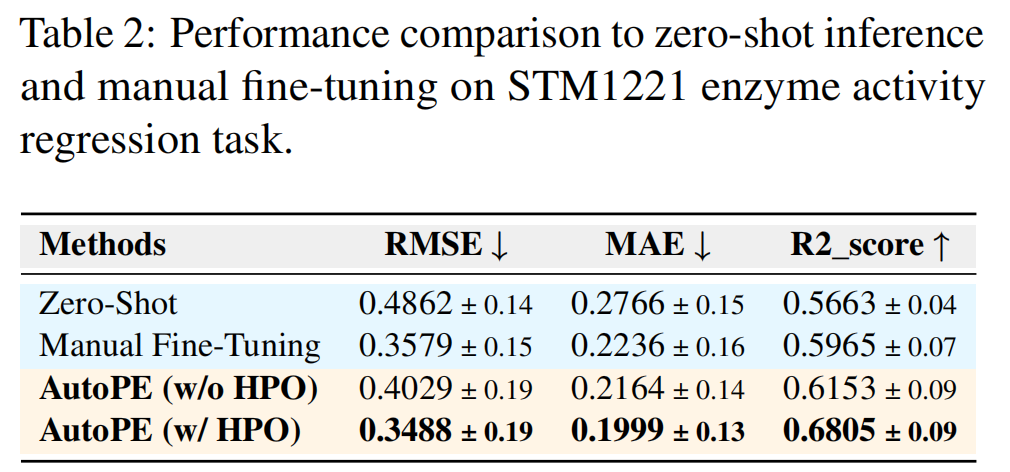
Regression results (Table 2):
- AutoPE again excels on all metrics.
- AutoPE with HPO achieves the lowest RMSE (0.3488) and MAE (0.1999) and the highest R² (0.6805), indicating the strongest explanation of variance in the target.
- Although manual fine-tuning is competitive on RMSE, AutoPE with HPO consistently outperforms it on every metric.