
arXiv-2025 Prot42:a Novel Family of Protein Language Models for Target-aware Protein Binder Generation
Paper: Prot42: a Novel Family of Protein Language Models for Target-aware Protein Binder Generation
Prot42: pretrained GPT for binder design
Abstract
This paper addresses a central challenge in protein engineering: traditional methods are complex, time-consuming, and resource-intensive. Although recent generative AI has made breakthroughs, most approaches still rely on the three-dimensional structure of the target protein and explicit binding-site information, as in AlphaProteo and RFdiffusion. These models face severe bottlenecks when structural information is unavailable.
To overcome this limitation, the authors introduce Prot42, a new family of Protein Language Models (pLMs) pretrained on large-scale unlabeled protein sequences. Using an advanced autoregressive decoder architecture inspired by decoder-only models in natural language processing, Prot42 captures evolutionary, structural, and functional features of proteins.
A standout feature of Prot42 is support for input sequences up to 8192 amino acid residues, far beyond mainstream models such as ProtBert and ESM-1b, which are typically capped at roughly 1024 residues. This enables Prot42 to model large proteins and multi-domain sequences for more complex biomolecular settings.
The paper further demonstrates two practical applications:
- Generation of high-affinity protein binders
- Generation of sequence-specific DNA-binding proteins
The models are publicly available on Hugging Face as an efficient, accurate, and scalable toolkit for rapid protein engineering tasks.
1 Introduction
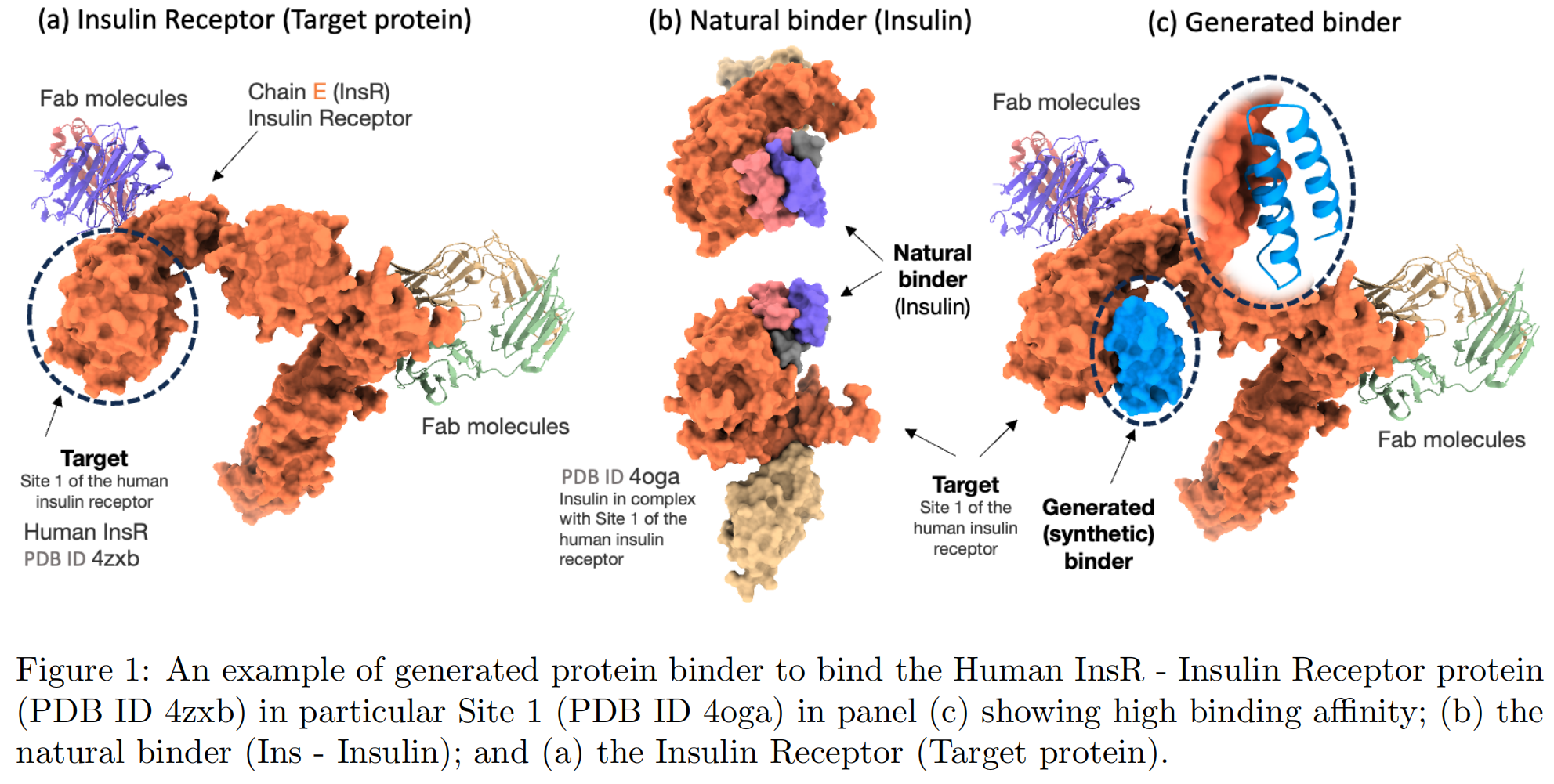
Protein binders—including antibodies and engineered proteins—play critical roles in biotechnology and therapeutic applications, from diagnostics to targeted drug delivery. Classical experimental routes to generate specific binders suffer from high resource consumption and combinatorial complexity. In recent years, structure-driven computational methods such as AlphaProteo and RFdiffusion have emerged as promising alternatives, achieving higher experimental success rates with substantially fewer candidates to screen. Nevertheless, these methods share a key limitation: they depend on the target’s three-dimensional structure and explicit binding-site information, which becomes a bottleneck for targets lacking structural data.
Protein language models (pLMs) offer another viable path, operating primarily at the sequence level and learning representations of evolutionary relationships and structural properties from large-scale unlabeled protein sequence data. Prior work shows that pLMs outperform traditional approaches based on physicochemical or statistical features on tasks such as functional annotation, structure prediction, and de novo sequence generation. Current pLMs, however, face two major constraints: limited maximum sequence length and lack of native generative capability. Models such as ESM-1b and ProtBert excel at representation learning but cannot generate new sequences and typically handle at most about 1024 amino acids, limiting their effectiveness on complex proteins and binding-interface modeling. Foundation models such as Evo-2 support million-token context windows but target DNA modeling, not protein-level generation, so a need remains for dedicated protein generative models.
In this work, the authors present Prot42, a new protein language model family built on a decoder-only autoregressive architecture inspired by recent NLP advances such as LLaMA. They pretrain two Prot42 variants with 500M and 1.1B parameters, initially supporting up to 1024 amino acid residues. Through continuous pretraining, they extend the context length to 8192, enabling the model to capture long-range dependencies essential for modeling large proteins, multi-domain complexes, and complex molecular interactions. This enriched representation is critical for generating high-affinity protein binders and for discovering new biomolecular interactions.
They describe Prot42’s model architecture, pretraining strategy, and context-length extension mechanism, and report gains in sequence modeling accuracy. Perplexity is used as the evaluation metric to verify predictive performance on longer sequences. To demonstrate utility, they focus on two applications: protein binder generation and sequence-specific DNA-binding protein generation. Results indicate that Prot42 has strong generative capability and can push the frontier of computational protein design toward fast, accurate, and scalable protein engineering.
As a capability illustration, Figure 1 shows an example in which the model generates a high-affinity binder targeting the insulin receptor (InsR) α subunit, compared with the natural binder insulin (PDB ID 4oga).
3 Methodology
This section describes how Prot42 is used to implement, for the first time, an instruction-tuning approach that generates high-affinity, long-sequence protein binders directly from target protein sequences, without any structural information or auxiliary task objectives.
A novel multimodal strategy integrates Gene42 genomic embeddings with Prot42 protein embeddings to further extend the model toward sequence-specific DNA-binding proteins. The approach removes reliance on explicit structural constraints or predefined binding motifs, highlighting how computational models can adapt to diverse molecular contexts when designing functional binders.
3.1 Data Preparation
Training uses the UniRef50 dataset of 63.2 million amino acid sequences, tokenized with a vocabulary of 20 standard amino acids. An X token denotes ambiguous or rare residues.
Each sequence is capped at 1024 tokens; longer sequences are discarded. This yields a filtered subset of 57.1 million sequences with an initial token packing density of 27%. To improve compute utilization, variable sequence length (VSL) packing maximizes token occupancy within a fixed context window.
This reduces the dataset to 16.2 million packed sequences while achieving 96% packing efficiency, substantially improving computational efficiency while preserving sequence diversity and integrity.
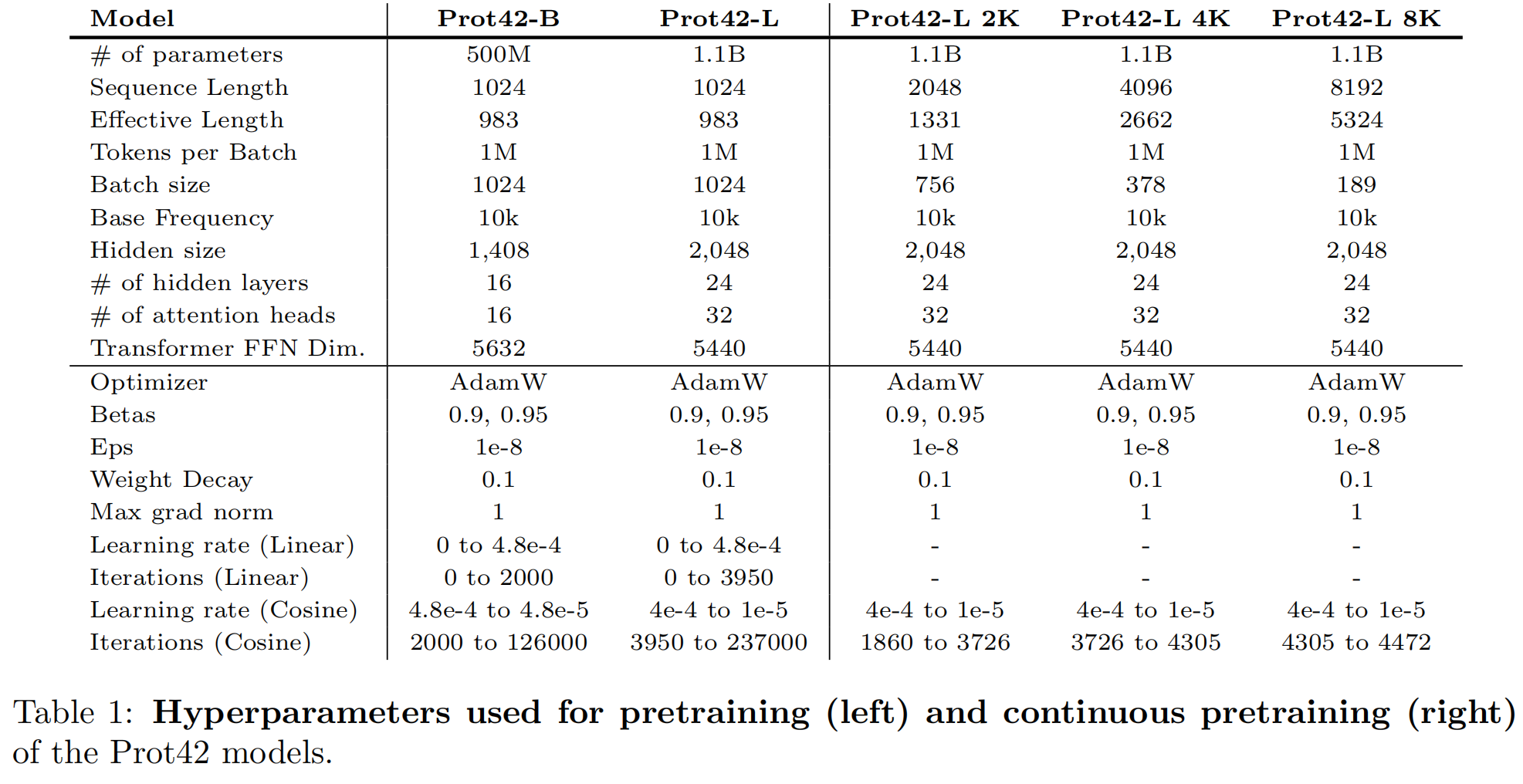
The following model variants were trained with the configurations below.
3.2 Model Architecture and Pretraining
Prot42 is a LLaMA-based decoder-only autoregressive Transformer. Two main models were trained: Prot42-B (500M parameters) and Prot42-L (1.1B parameters).
Hyperparameters were chosen via maximal update parametrization (μP): a small 81M-parameter model was trained for hyperparameter search, then settings were μ-transferred to the 500M and 1.1B models.
During training, each batch contained 1 million tokens in total; learning rate followed linear warm-up plus cosine decay. All training ran on Cerebras CS-2 hardware.
Continuous Pretraining for a Larger Context Length

Prot42-L was continuously extended from a 1024-length model to support 8192 residues by gradually increasing maximum sequence length (MSL).
Training schedule:
- The first 10% of steps use MSL = 1024;
- Later stages use increasing MSL: 2048 → 4096 → 8192;
- Each stage keeps the effective token count fixed at 1M.
Data splits are given in Table 2, with MSL, sample counts, steps, and mean effective length recorded per stage. The final stage reached a maximum effective sequence length of 5324.
Model Evaluation using Validation Perplexity
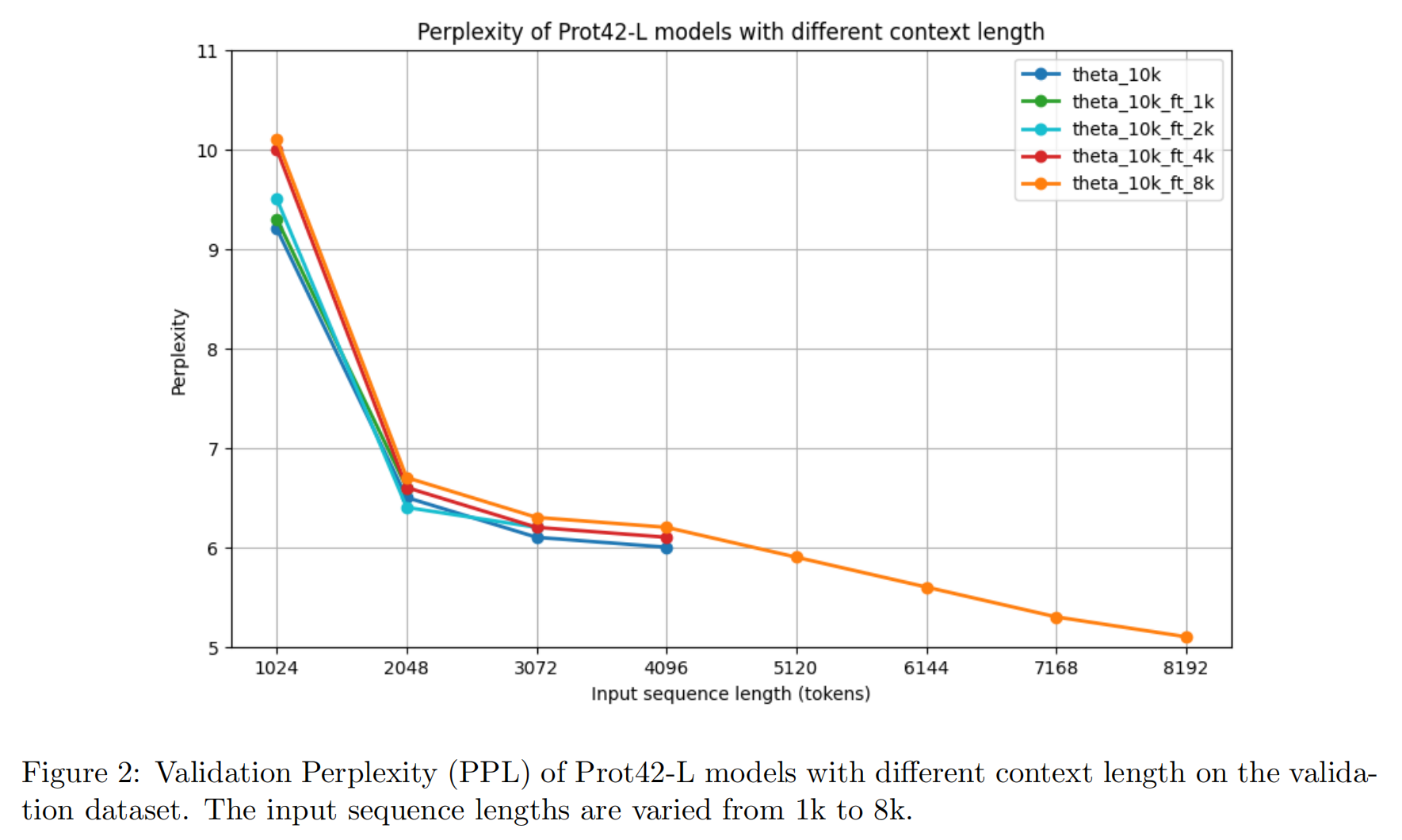
Perplexity (PPL) is the standard metric for autoregressive model quality. Models with context lengths from 1K to 8K were evaluated on a validation set. Results show:
- All models have higher PPL at 1024 tokens (9–10);
- PPL drops to about 6.5 at 2048 tokens;
- The 8K model reaches the lowest PPL of 5.1 at full context, indicating better modeling of long-range dependencies;
- Continued improvement from 4096 to 8192 tokens highlights strong long-sequence modeling.
Embeddings Evaluation
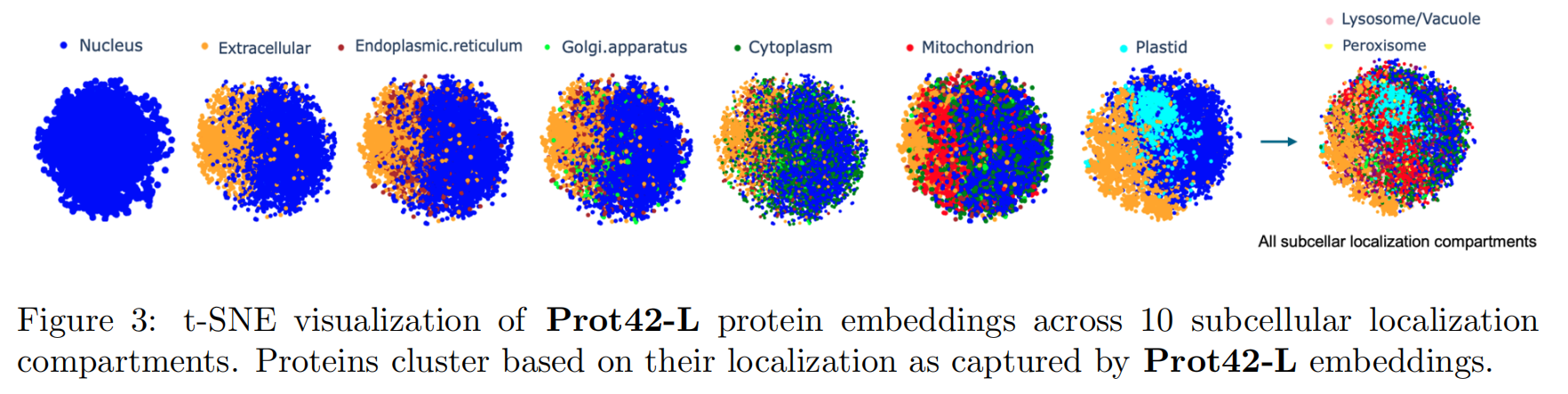
Protein sequences from the PEER benchmark and UniProt annotations were used to predict 10 subcellular localization classes (e.g., nucleus, mitochondrion, plasma membrane).
Each protein was embedded as a 32×2048 tensor, mean-pooled to a global representation, and visualized with t-SNE, showing clear separation of localization classes.
Results indicate that Prot42-L embeddings are biologically meaningful and useful for downstream tasks such as functional prediction, drug target discovery, and synthetic biology design.
3.3 Protein Binder Generation
Proteins rarely act in isolation; they interact and bind to form networks that drive cellular processes. Designing proteins that bind a target specifically is a fundamental problem in molecular biology with broad applications in therapeutics, synthetic biology, and related fields.
| Let the target amino acid sequence be $x = (x_1, x_2, …, x_n) \in \mathcal{X}$, where $x_i$ is the $i$-th residue of the target; let the binder sequence be $y = (y_1, y_2, …, y_m) \in \mathcal{Y}$, a sequence that binds the target. The goal is to model the conditional distribution $p(y | x)$—the probability of binder sequence $y$ given target $x$. |
The authors use a sequence-to-sequence model inspired by machine translation. Training uses a dataset of protein–protein pairs $\mathcal{B} = {(x_i, y_i)}$; each pair $(x, y) \in \mathcal{B}$ is concatenated as $s = (x_1, …, x_n, \texttt{[SEP]}, y_1, …, y_m)$. [SEP] is a special delimiter between target and binder.
Training optimizes the following autoregressive loss:

Here θ denotes model parameters; the loss starts predicting from the first binder token after the target and [SEP].
At inference, the model conditions on target sequence $x$, followed by [SEP] and an initial methionine (“M”), consistent with training data where sequences typically start with methionine.
Binder sequence $y$ is generated autoregressively according to:

To ensure diversity and quality, the authors use stochastic sampling with temperature scaling, nucleus (top-p) sampling, and top-k filtering. For token $i$, the sampling probability is:

Here $T$ is temperature; $z_i$ is the logit for the current token; $V’ \subseteq V$ is the candidate subset after top-k and top-p filtering.
The full generation process is:

where $\hat{Y} = (y_1, y_2, …, y_m)$ is the generated binder and $M_p$ denotes the Prot42 model.
Figure 4 illustrates a case where the target is VEGF-A (vascular endothelial growth factor A), chain V used as the binding target. The model learns $p(y \mid x)$ and autoregressively generates $\hat{Y}$.
At inference, the VEGF-A sequence is fed in, decoding starts with [SEP] and “M”, and each residue is sampled as above.
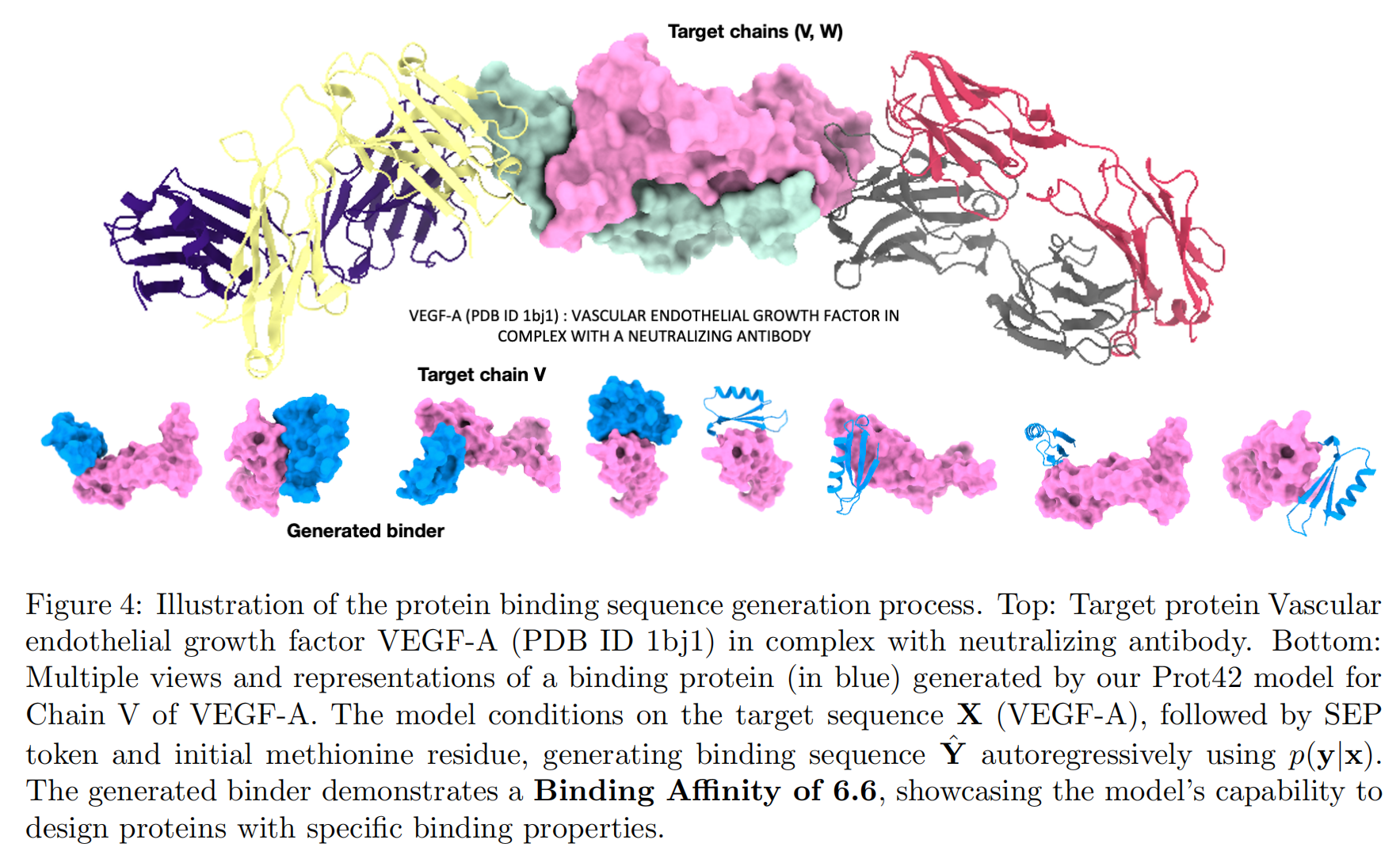
Structurally, the figure shows the binding region between generated binder and target and reports binding affinity $A(\hat{Y}, X)$ for quantitative assessment.
3.4 DNA Sequence-specific Binders Generation
Beyond protein–protein interactions, designing proteins that bind specific DNA sequences is important for gene regulation and genome engineering.
Given a dataset $\mathcal{D}$ of DNA–protein pairs, the goal is to generate a protein sequence $\hat{X}$ that binds a given DNA sequence. A pair can be written as $(X_d^{(1)}, X_d^{(2)}, X_p) \in \mathcal{D}$, where:
- $X_d^{(1)} = (d_1^{(1)}, d_2^{(1)}, …, d_n^{(1)})$ and $X_d^{(2)} = (d_1^{(2)}, d_2^{(2)}, …, d_n^{(2)})$ are length-$n$ DNA strands from vocabulary $\mathcal{V}_d$, representing the forward and reverse strands.
- $X_p = (p_1, p_2, …, p_m)$ is a protein sequence of $m$ amino acid tokens.
DNA model $M_d$ encodes DNA into latent representations:
- $H_d^{(1)} = (h_1^{(1)}, …, h_n^{(1)})$ from $X_d^{(1)}$
- $H_d^{(2)} = (h_1^{(2)}, …, h_n^{(2)})$ from $X_d^{(2)}$, where each $h_t^{(i)} \in \mathbb{R}^{1408}$ is an embedding from the DNA model.
Protein model $M_p$ encodes $X_p$ as $E_p = (e_1, e_2, …, e_m), \quad e_i \in \mathbb{R}^{2048}$.
To inject DNA context into protein generation, DNA representations are projected from 1408 to 2048 dimensions:

Integration uses cross-attention to fuse DNA information with protein embeddings. Attention scores are computed as:
$A = \text{Softmax}\left(\frac{QK^\top}{\sqrt{2048}}\right)$

- Query $Q = \theta_q (H_d^{(1)} \oplus H_d^{(2)})$
- Key and value $K = \theta_k E_p$, $V = \theta_v E_p$
Here $\oplus$ denotes concatenation; $\theta_q, \theta_k, \theta_v \in \mathbb{R}^{2048 \times 2048}$ are trainable.
This yields DNA-modulated protein features: $C_p = A V, \quad E_p’ = E_p + C_p$
where $C_p$ is fused context and $E_p’$ feeds the protein decoder.
Protein generation remains autoregressive: each token depends on prior tokens and DNA context. The output distribution is $p_t = \text{Softmax}(\theta_h e_t’ + \theta_c C_t), \quad \hat{p}t = \arg\max_j (p{t,j})$.
with learnable $\theta_h, \theta_c$; the final protein sequence is:

At inference, both DNA strands are encoded and passed to $M_p$; generation starts from a fixed “M” token so the model focuses on binding-site prediction.
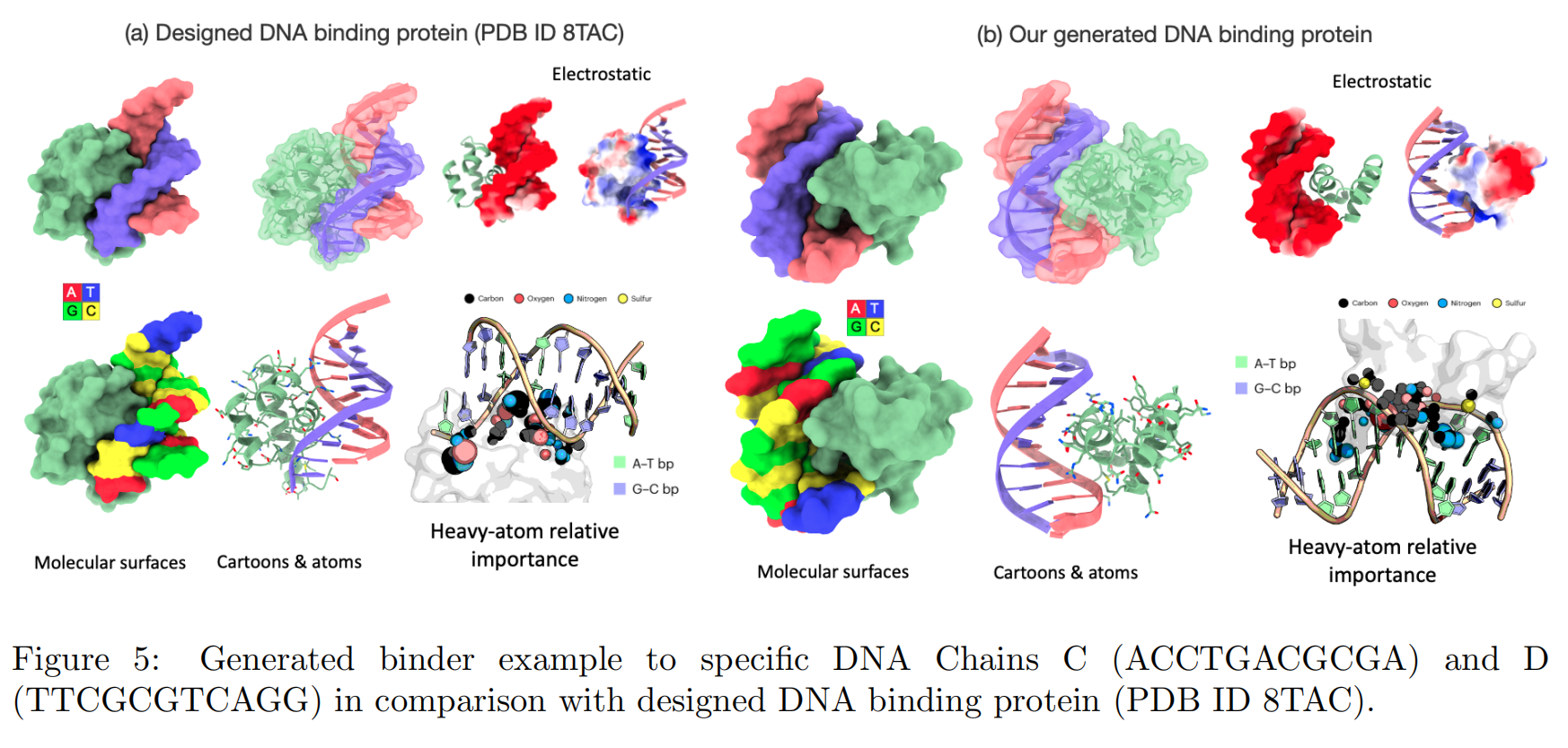
Figure 5 shows DNA strands C = ACCTGACGCGA and D = TTCGCGTCAGG; Prot42 generates a binding protein compared with a known DNA-binding protein (PDB ID: 8TAC). Structural visualization shows effective DNA–protein matching in three dimensions.
4 Experimental Evaluation
4.1 Evaluation on PEER Benchmarks
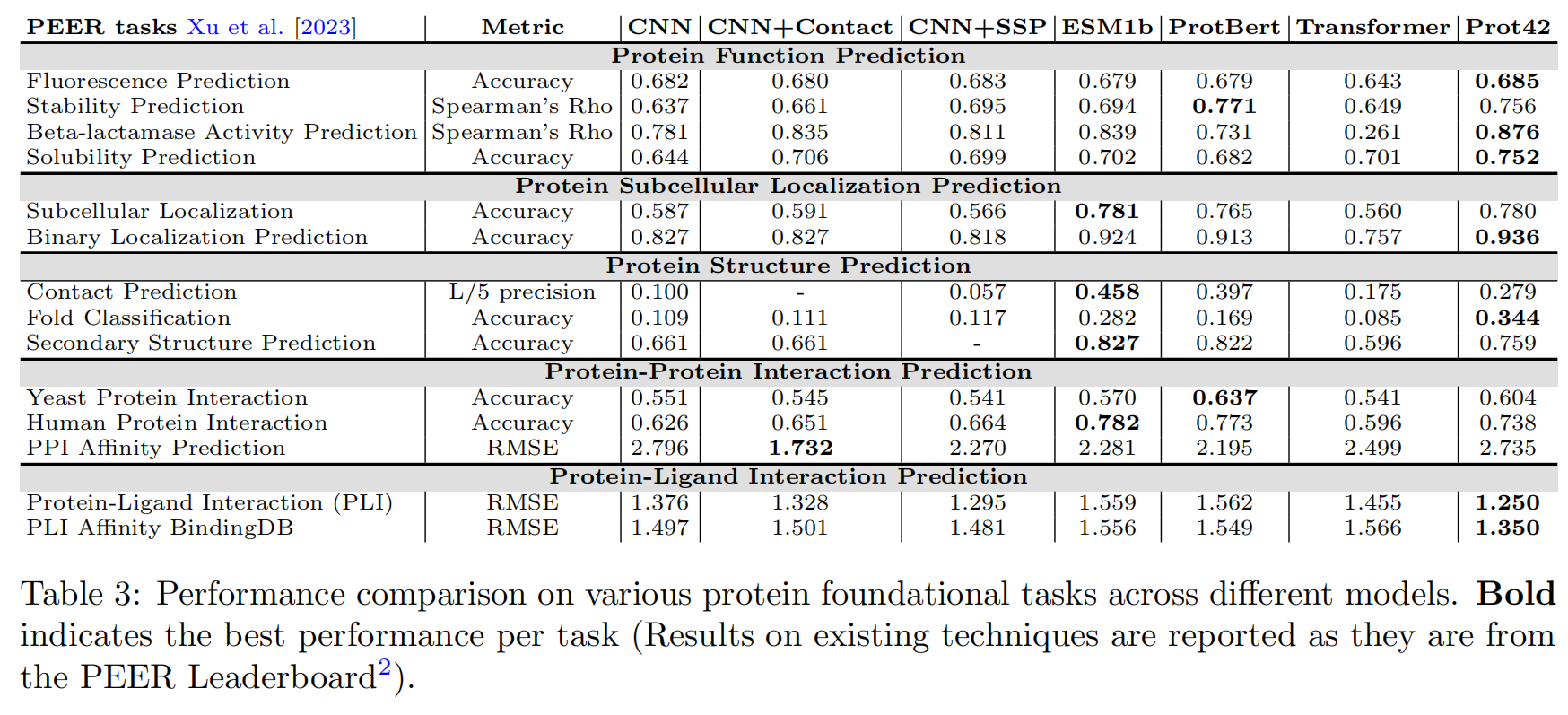
On the PEER benchmark (Protein sEquence undERstanding), Prot42 was evaluated on 14 downstream tasks, including:
- Functional prediction (fluorescence, stability, enzyme activity, solubility)
- Subcellular localization
- Structure-related tasks (contact maps, fold classification, secondary structure)
- Protein–protein and protein–small-molecule interaction prediction
Summary:
- Prot42 performs strongly on function prediction, reaching best results on stability, enzyme activity, and solubility.
- On subcellular localization, accuracy matches or slightly exceeds ESM-1b and related models.
- On structure tasks (contact maps, secondary structure), results are competitive.
- Interaction prediction tasks also show reliable performance.
For protein–ligand tasks, Chem42 chemical embeddings were integrated to further improve predictions.
4.2 Protein Binders generation
This task compares Prot42 with structure-dependent methods such as AlphaProteo for designing binding proteins.
Targets include BHRF1 (EBV anti-apoptotic protein), SARS-CoV-2 RBD, IL-7Rα, PD-L1, TrkA, IL-17A, and TNF-α.
Protocol:
- Train on high-confidence pairs from STRING (score ≥ 90%);
- Cap target and binder length at 250;
- After fine-tuning, generate 500 binder candidates per target;
- Predict target–binder complexes with Boltz-1;
- Score with PRODIGY: binding free energy (ΔG), dissociation constant (Kd), interface area, contact residues, polarity distribution, etc.
Key results:
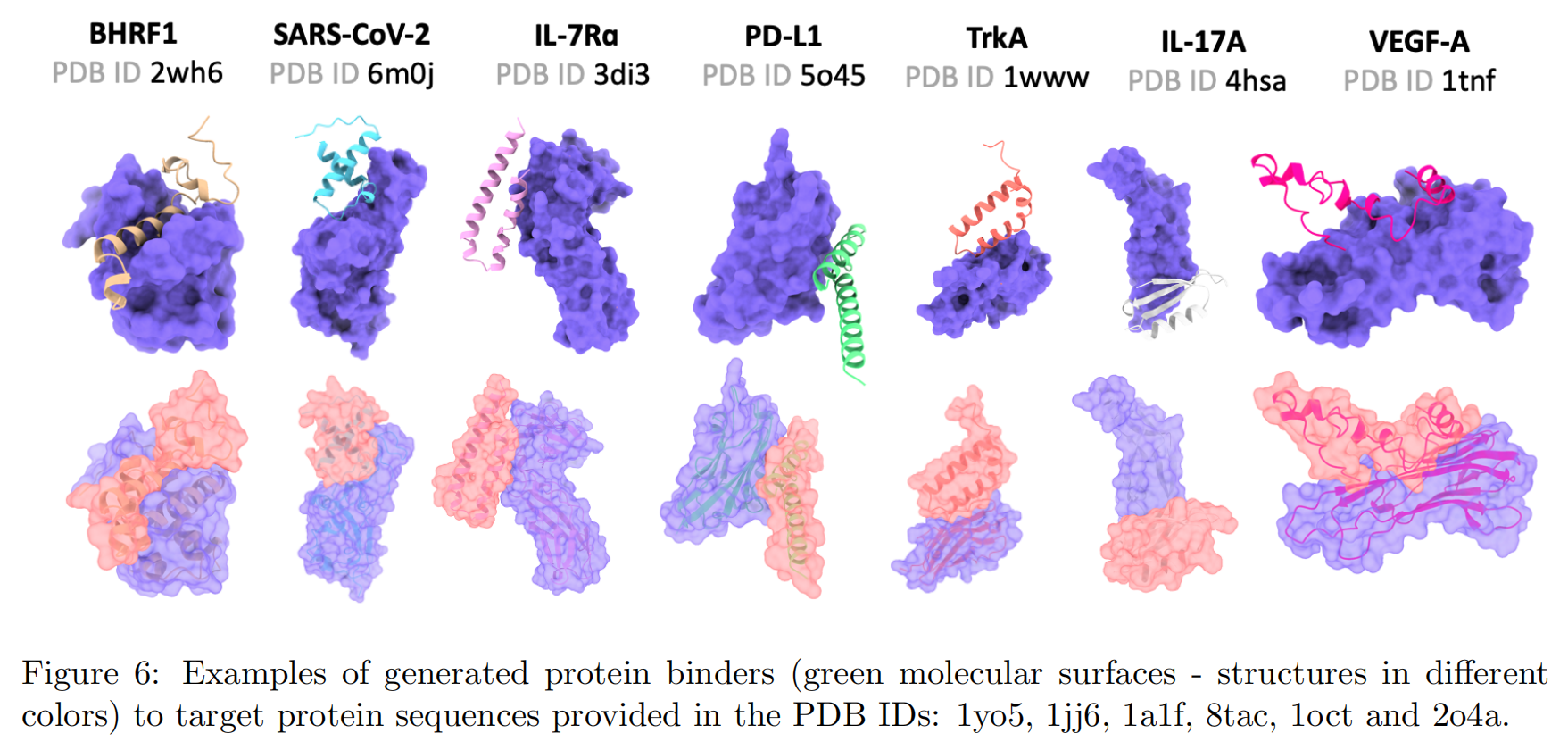
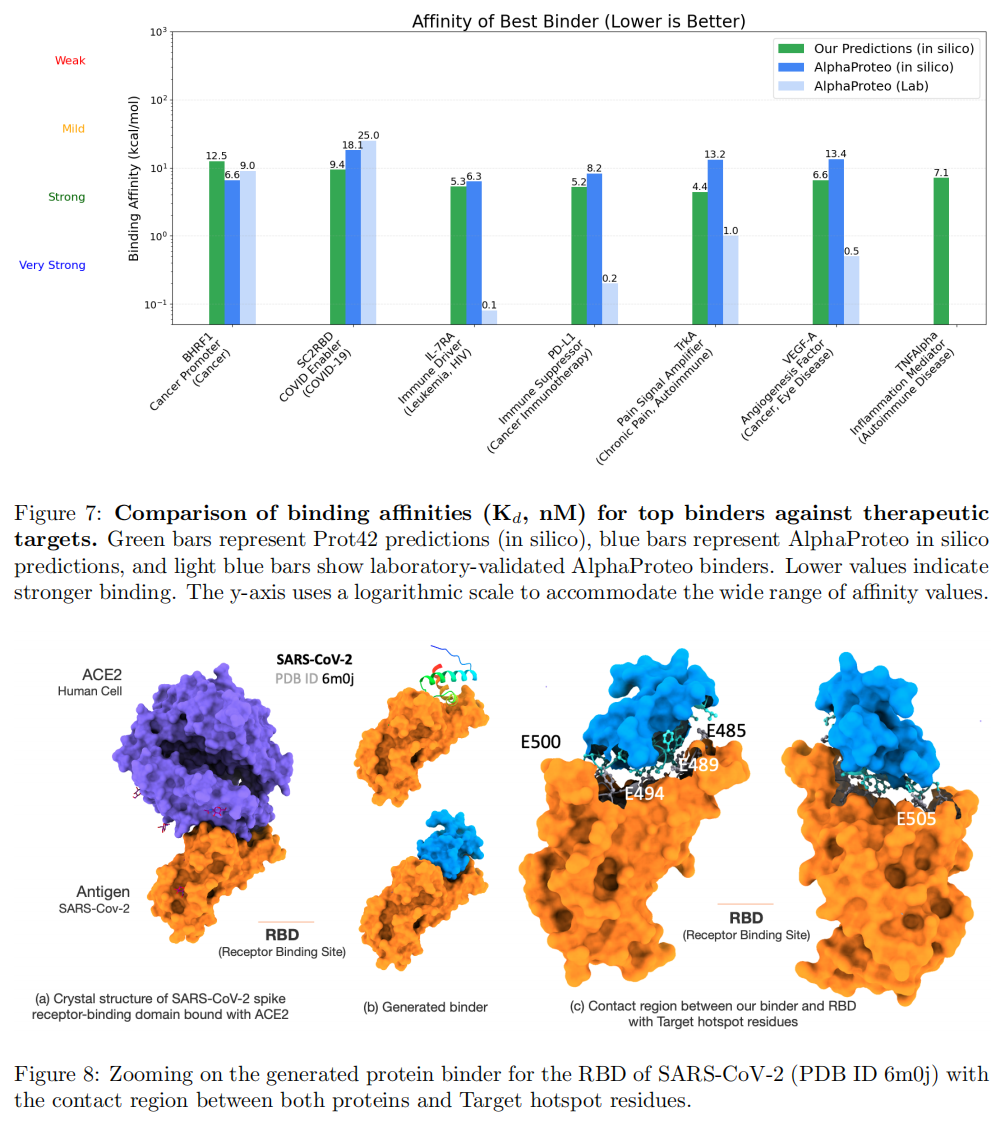
- Prot42 generated high-affinity binders with nanomolar (nM) Kd across all targets;
- Kd values for most targets outperform AlphaProteo in silico results;
- Standout performance on TrkA, PD-L1, and VEGF-A;
- Example structures include SARS-CoV-2 RBD binders docking key sites (e.g., E484–E505);
- Generated binders may serve as competitive inhibitors to block infection.
4.3 DNA Sequence-specific Binders Generation
This experiment uses 922 DNA–protein pairs from the PDIdb 2010 dataset.
Data include structures such as PDB IDs 1TUP, 1JJ6, 1A1F, and 8TAC, with the goal of generating proteins that recognize specific DNA sequences.
Validation:
- DeepPBS assesses binding specificity of generated proteins to target DNA;
- DeepPBS uses structural, physicochemical, and geometric context to predict position weight matrices (PWMs), indirectly measuring binding capability.
Results:
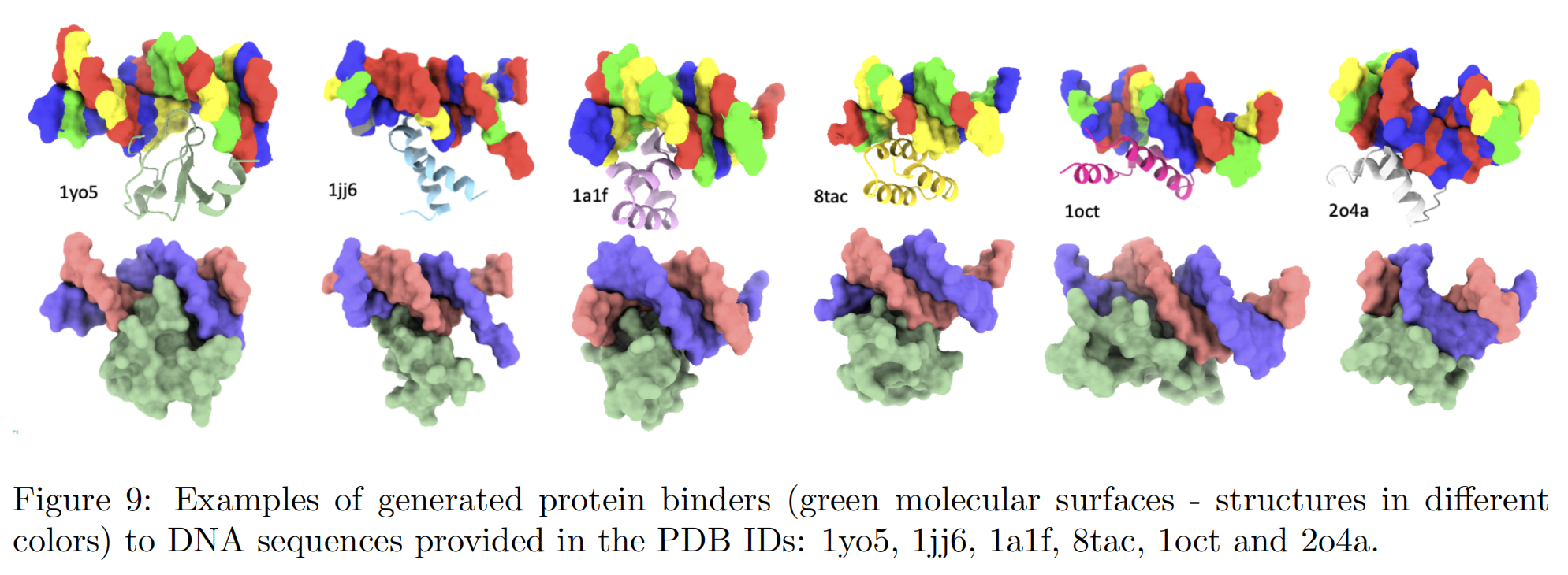
- Prot42 binders dock accurately in the DNA major groove;
- Binding pose and shape closely match reference proteins;
- Figure 9 shows multiple successful three-dimensional complexes.