
CVPR-2015 Beyond Short Snippets:Deep Networks for Video Classification
Paper: Beyond Short Snippets:Deep Networks for Video Classification
Work from Google
Longer Video Processing: The Role of Pooling and LSTM in Video Understanding
Abstract
The paper proposes two ways to handle long videos: exploring different pooling operations, and using an LSTM to connect CNN outputs.
Approach
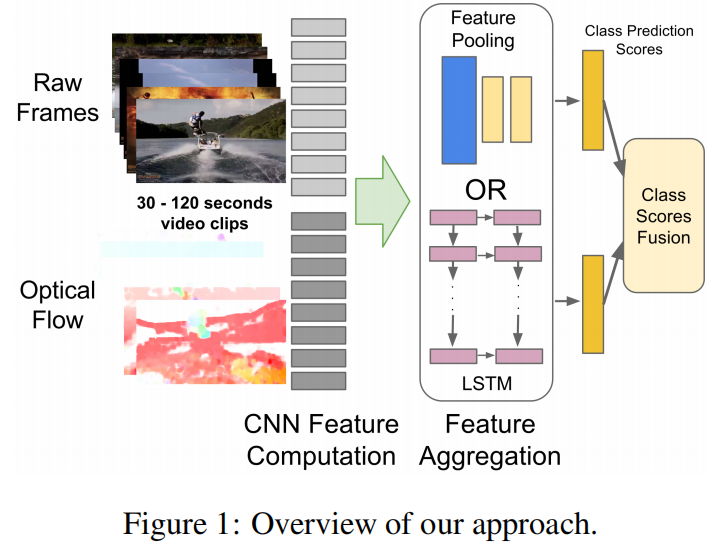
Following the two-stream idea, using only a few frames from the raw video is too short; what if there are many more frames?
First, features must be extracted from all frames (e.g., hand-crafted descriptors or convolutional networks). The key question is how to pool after extraction—simple max or average pooling, and this paper explores many variants. The overall conclusion is that they perform similarly, with ConvPooling working best. They also try LSTM-based feature fusion, but the gain is limited.
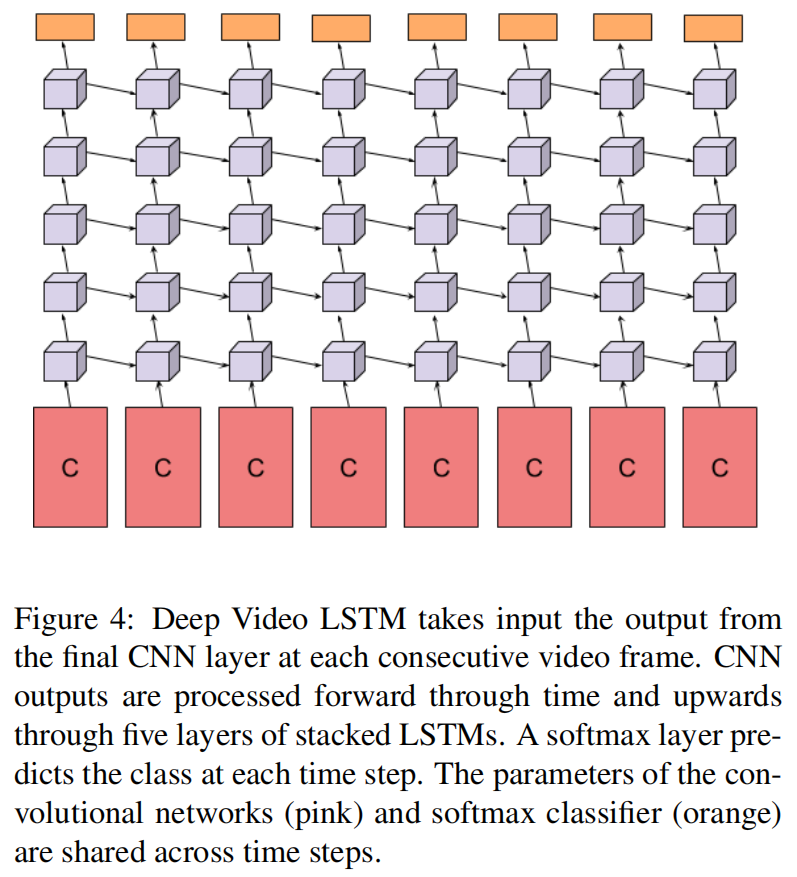
Each video frame is passed through a convolutional network (weight sharing) to extract features; a five-layer LSTM is used, followed by softmax.
Result

On Sports-1M, the LSTM is not as helpful as expected—perhaps because LSTM captures relatively high-level patterns, and even with many frames the clip is still fairly short, so semantic content does not change much. The LSTM mostly receives similar inputs and may learn little, so improvements stay small. LSTM should matter more when motion is strong or videos are truly long.
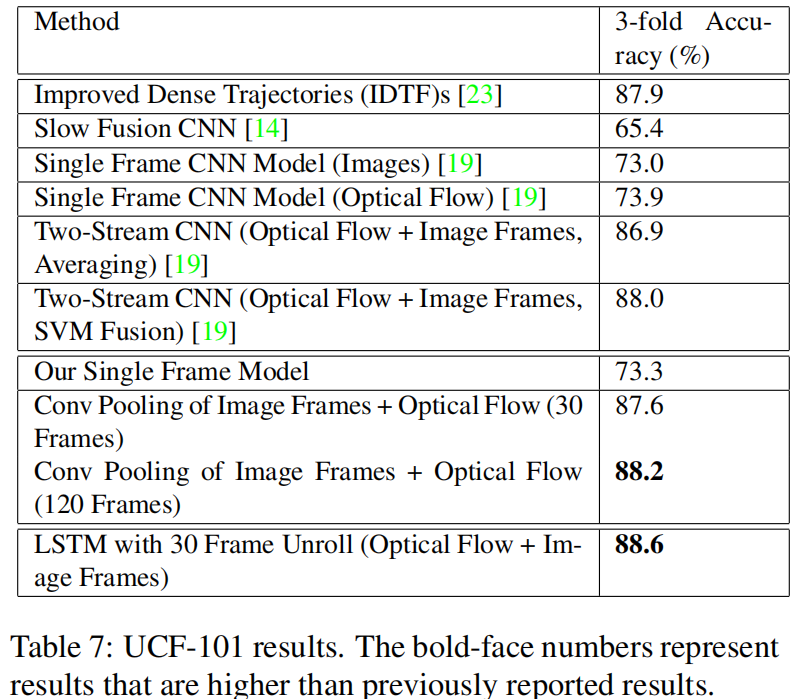
On UCF-101, results improve only slightly; the gain is very limited.
<HR align=left color=#987cb9 SIZE=1>