
CVPR-2016 Convolutional Two-Stream Network Fusion for Video Action Recognition
Paper: Convolutional Two-Stream Network Fusion for Video Action Recognition
How to Fuse the Two Streams: Early Fusion Works Slightly Better
Abstract
The paper explores a range of ways to fuse the optical-flow and spatial streams—temporal versus spatial fusion, and the layer at which fusion is performed—and identifies a comparatively strong fusion design.
Approach
Spatial fusion
Once temporal and spatial streams are available, how to relate channel responses at the same pixel location:
- Max fusion: take the maximum at corresponding locations
- Concatenation fusion: concatenate along channels
- Conv fusion: stack the two maps and apply a convolution
- Sum fusion: element-wise addition
- Bilinear fusion: outer product of the feature maps, then a weighted average over all dimensions
Where to fuse the networks
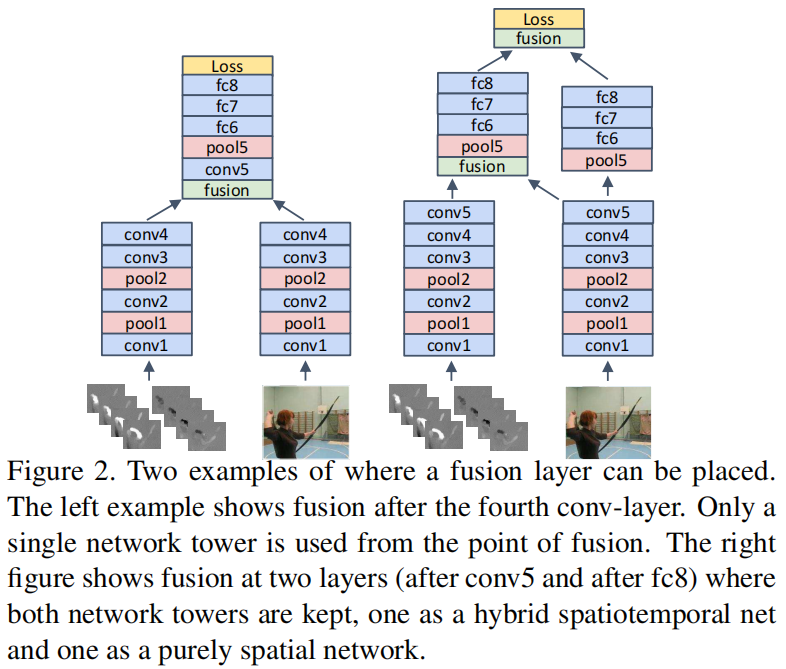
- Run spatial and temporal streams separately and fuse at Conv4
- Run them separately, incorporate the spatial stream for merging while preserving the full spatial stream, then fuse again at the end
Temporal fusion
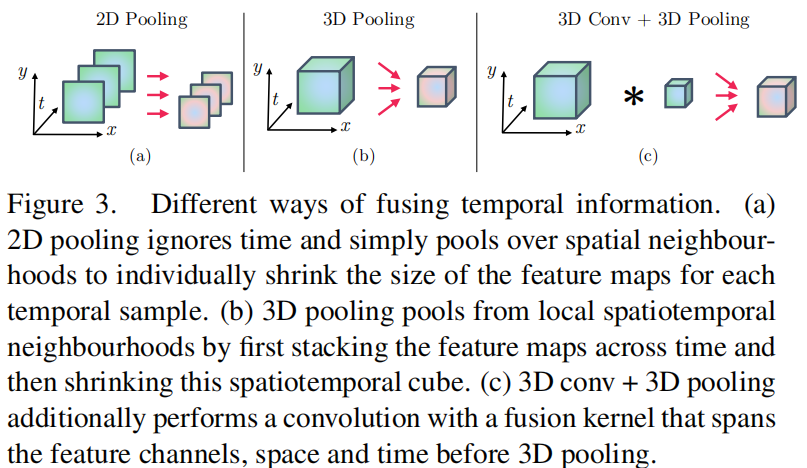
- 2D pooling
- 3D pooling
- 3D conv + 3D pooling
Proposed architecture
Joint spatiotemporal learning plus temporal learning
The two final classification heads are combined with a weighted average to obtain the final prediction.
Evaluation
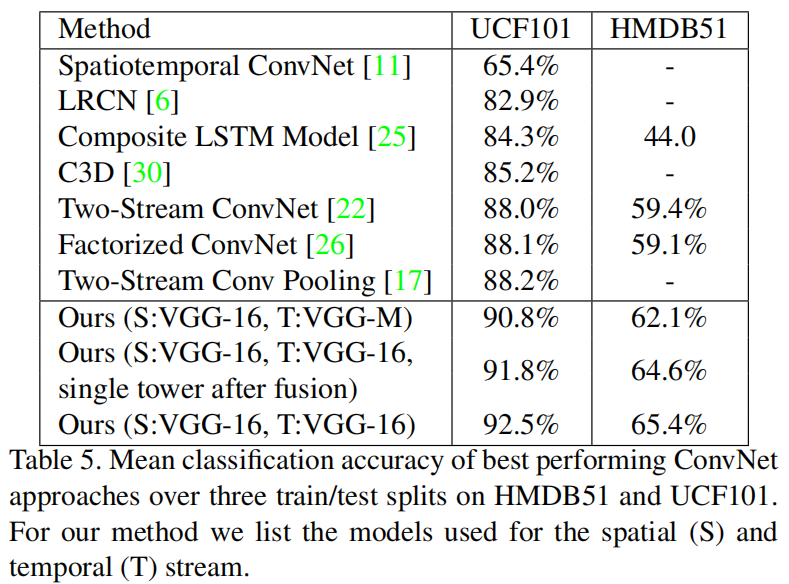
On very small datasets, very deep networks are prone to overfitting. Adopting early fusion yields a clear improvement on HMDB51.
<HR align=left color=#987cb9 SIZE=1>