
NeurIPS-2014 Two-Stream Convolutional Networks for Action Recognition in Videos
Paper: Two-Stream Convolutional Networks for Action Recognition in Videos
Two-Stream ConvNets: Spatial + Temporal — A Landmark for Video Understanding
Neural networks initially struggled to learn useful object representations. This work instead feeds optical flow—motion features extracted by classical methods—into the network to learn the mapping. Supplying such priors can substantially boost network performance.
Abstract
- Learn appearance (spatial) and motion (temporal) information.
-
Contributions:
2.1 Propose a two-stream architecture with large accuracy gains.
2.2 Strong performance even with limited training data.
2.3 Mitigate data scarcity via multitask learning: train the backbone on two datasets jointly.
Introduction
- Temporal cues in video provide important signals for recognition, and video naturally enables rich data augmentation.
- Naively feeding raw video into a network works poorly—often worse than hand-crafted features. Classical pipelines rely on optical flow to capture motion well, motivating a two-stream design with late fusion over logits.
- The design is inspired by processing in the human brain.
Related Work
- Spatio-temporal features evolved into 3D networks; dense point trajectories evolved into the two-stream approach.
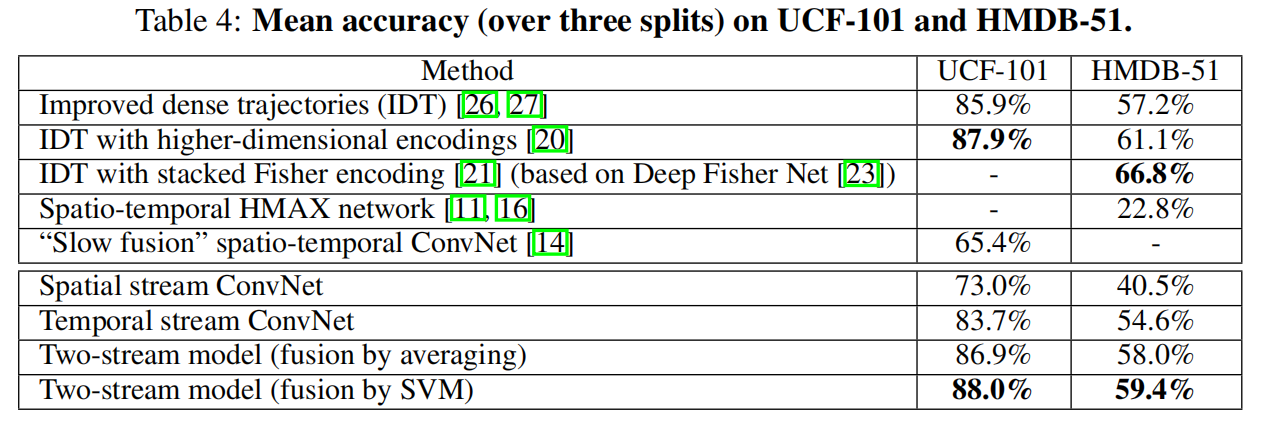
- Feeding video frames one-by-one into a 2D network versus stacking sequences of frames into a 3D or 2D network for joint spatio-temporal learning yields similarly weak results—about 20 points below traditional methods. This suggests such pipelines fail to capture action and temporal structure and highlighted the importance of explicit motion/temporal modeling.
Model
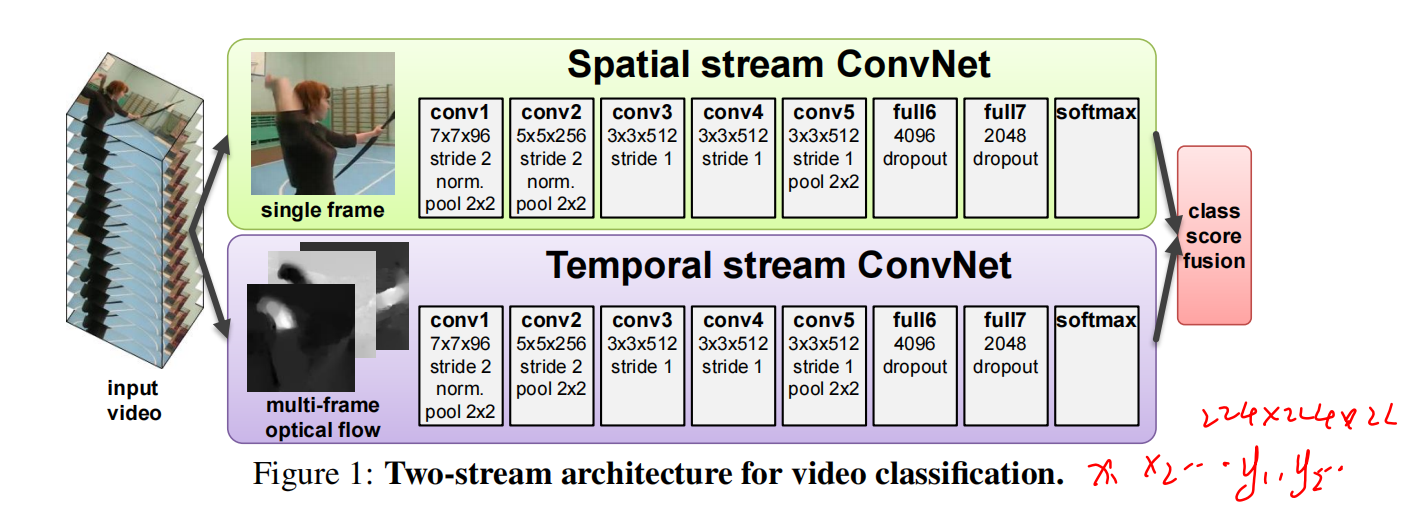
Spatial stream ConvNet
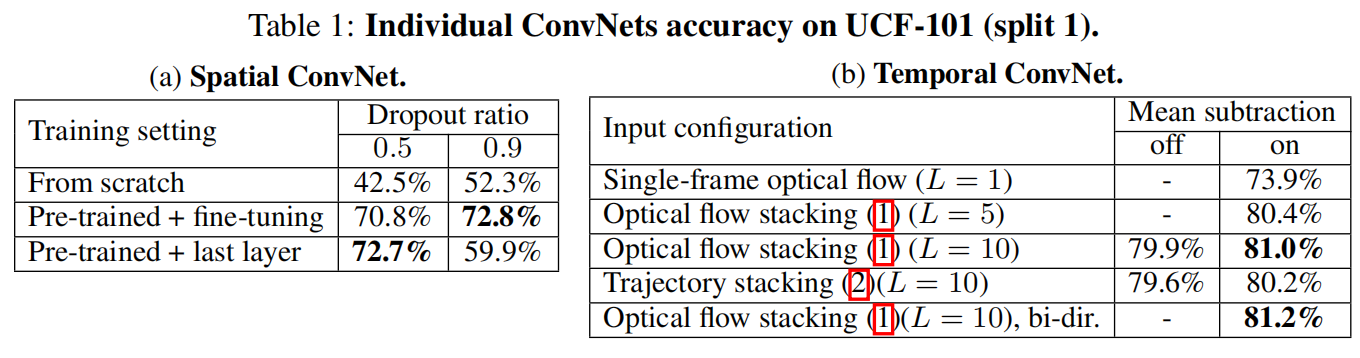
Processes video frame by frame; temporal context is largely unused, similar to image classification, yet accuracy is already strong. Static appearance carries strong cues, and fine-tuning a model pretrained on ImageNet works very well.
Optical flow ConvNet
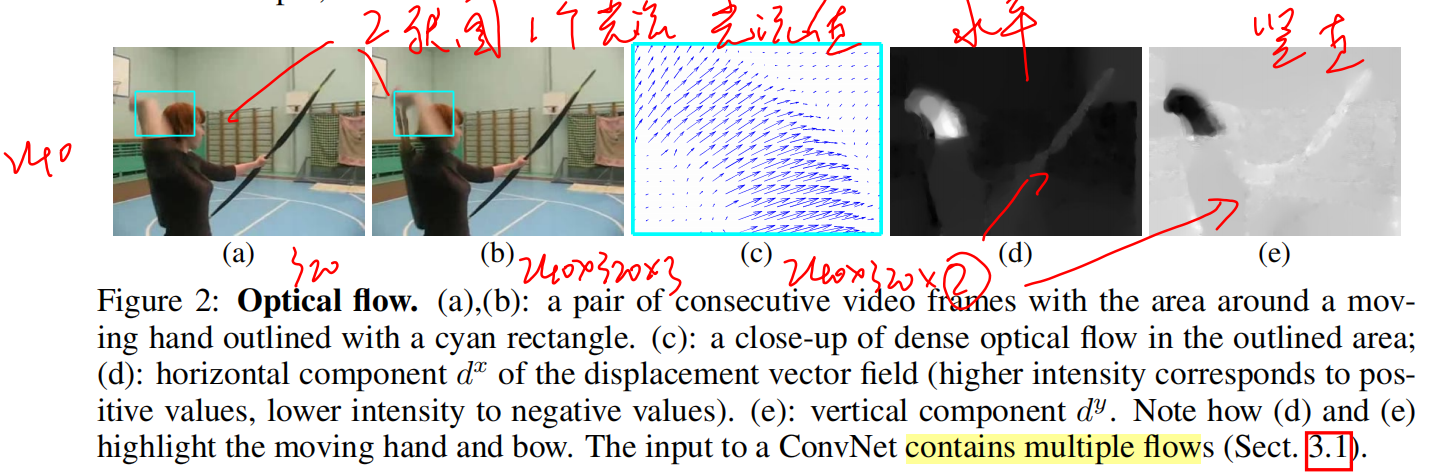
- For a clip of length L frames, there are L-1 optical-flow fields.
-
Feeding only the flow between two consecutive frames into a 2D network reduces the task to a single-step classification, which the authors argue is too weak. To model temporal structure, they stack multiple flow maps—first stacking horizontal displacement, then vertical displacement.
2.1 Simple direct stacking.
2.2 Stacking along flow trajectories.
2.3 Experiments show trajectory-based stacking underperforms stacking anchored at initial pixel locations.
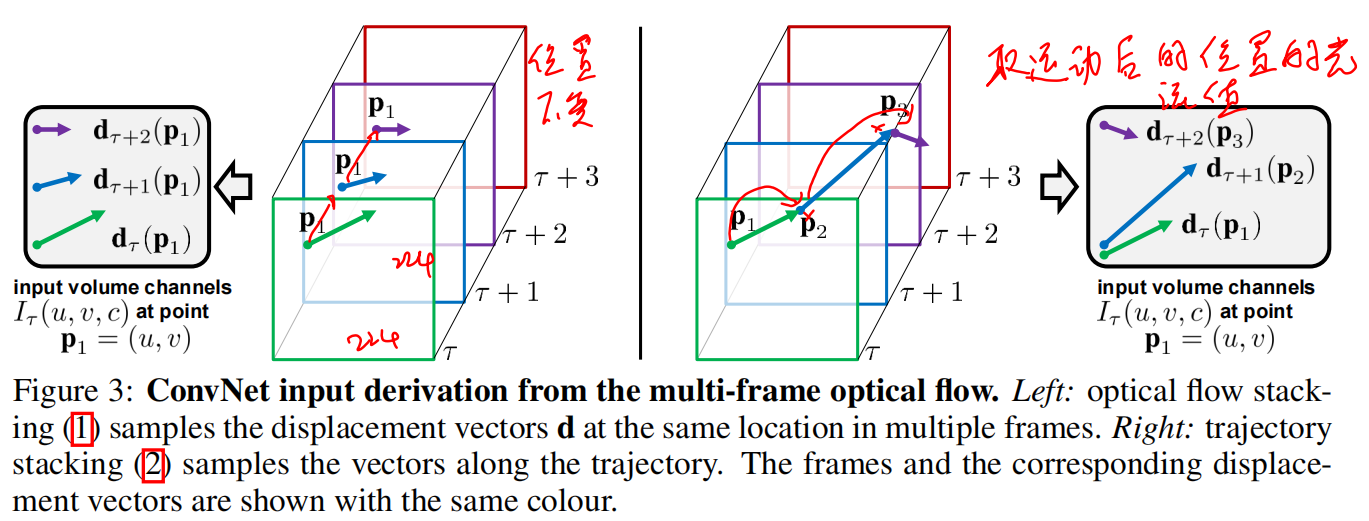
- Bidirectional optical flow: this bidirectional setup at least does not hurt accuracy.
Implementation Details
- Sample 25 frames at equal intervals regardless of the original clip length.
- Test-time evaluation uses many crops/views (dataset-dependent).
- Optical-flow extraction is slow, and dense flow maps are storage-heavy; the authors also propose compression strategies.
Evaluation
<HR align=left color=#987cb9 SIZE=1>