
ICCV-2015 Learning Spatiotemporal Features with 3D Convolutional Networks
Paper: Learning Spatiotemporal Features with 3D Convolutional Networks
Pipelines built on extracted optical flow are a poor fit for real-time use: each new dataset requires recomputing flow, extraction is slow, and inference still needs flow—so latency suffers badly. A method that learns temporal structure directly from data, without modeling time in a separate stage, would be preferable.
C3D: Feature Extraction with 3D Networks
Abstract
The authors train a deeper 3D convolutional network on a larger dataset (Sports-1M); the design is relatively simple and intuitive.
Model

Roughly, they drop one conv layer from each VGG block and change all conv kernels from 3×3 to 3×3×3.
They extract features from the final 4096-dimensional layer, train an SVM classifier on them for classification, and obtain strong results with low overhead.
Experiment
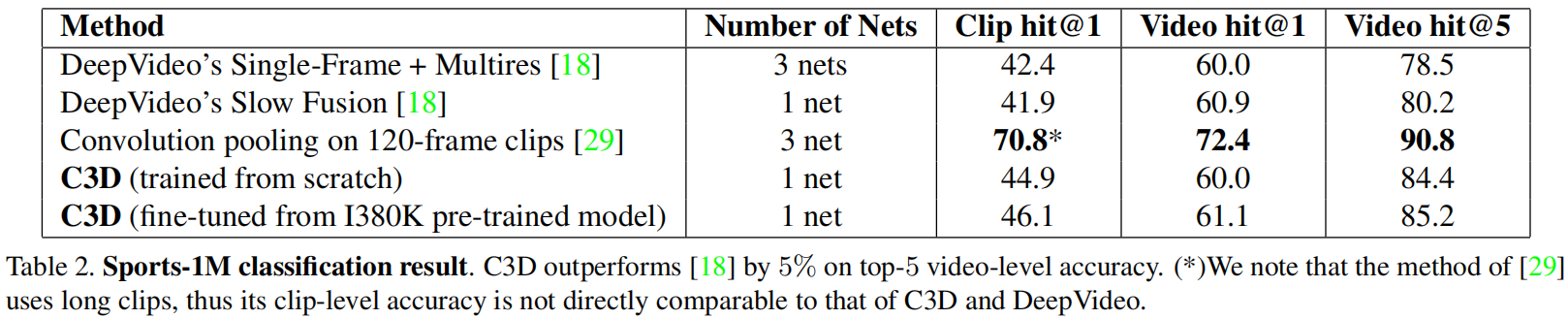
Because the pipeline performs spatiotemporal learning end to end, the authors argue that 3D networks are better suited to video understanding than 2D networks.
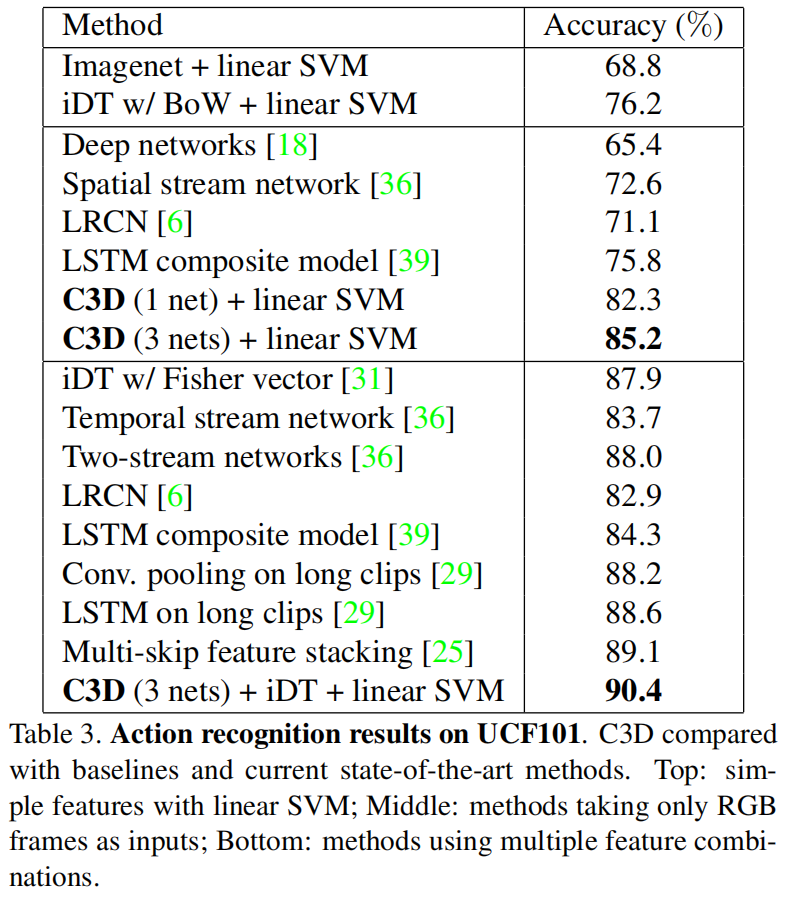
On UCF101, performance relative to other work is only average; even with ensembling it is not standout. Training is very long (about a month even at Facebook), so fine-tuning is unfriendly—the authors recommend feature extraction instead and provide Python and MATLAB interfaces that take a video and return a 4096-dimensional feature for downstream tasks.
<HR align=left color=#987cb9 SIZE=1>