
KDD-2020 GCC:Graph Contrastive Coding for Graph Neural Network Pre-Training
Paper: GCC:Graph Contrastive Coding for Graph Neural Network Pre-Training
GCC: Contrastive Learning via Subgraph Instance Discrimination
Abstract
Graph neural networks perform well on many downstream tasks and apply to real-world problems, but prior work largely designs elaborate, dataset-specific models for particular domains and does not transfer well out of domain. The authors propose GCC (Graph Contrastive Coding), with a pre-training task based on subgraph instance discrimination. Experiments on three graph learning tasks and ten graph datasets show competitive or superior results compared with task-specific methods, indicating substantial remaining potential for pre-train–fine-tune pipelines on graphs.
Introduction
This paper aims to design a self-supervised pre-training framework for GNNs, followed by fine-tuning on different graph tasks or different graphs. It uses contrastive learning with subgraph instance discrimination as the proxy task.
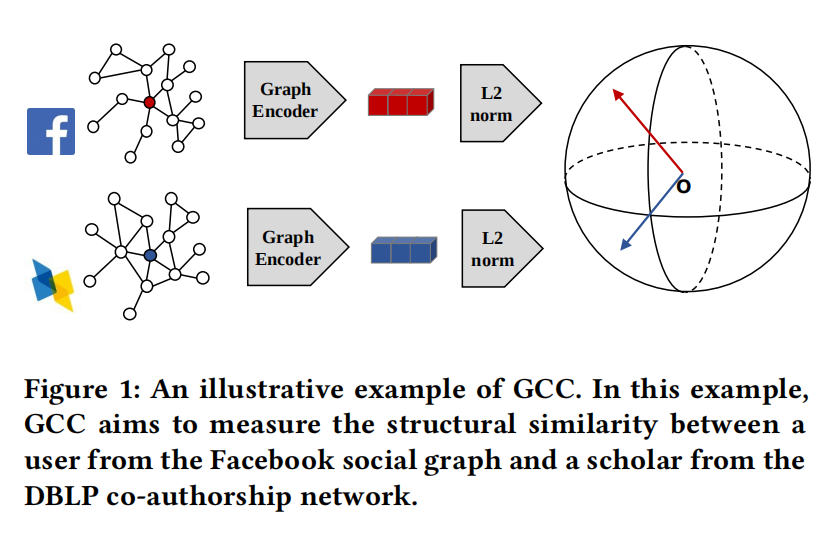
For each vertex, subgraphs are sampled from its multi-hop neighborhood as instance entities. The goal is to distinguish subgraphs sampled around one vertex from those sampled around other vertices.
Graph Contrastive Coding (GCC)
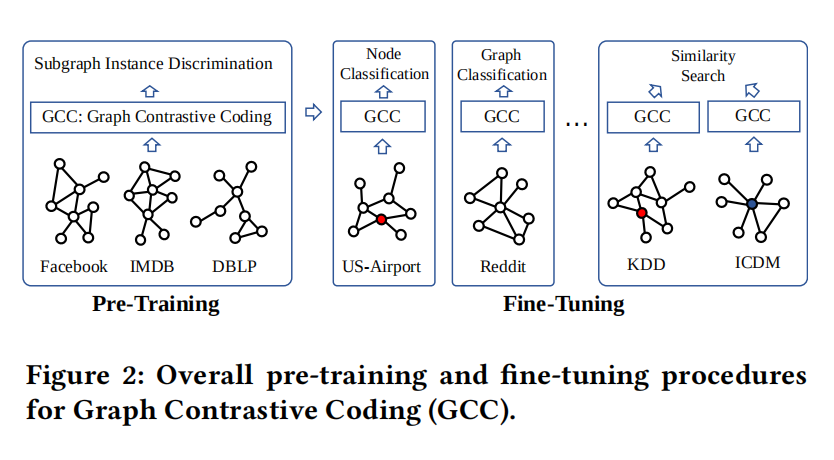
The GNN Pre-Training Problem
The GNN pre-training objective is to learn a mapping from nodes to low-dimensional feature vectors with two desired properties:
- Structural similarity: nodes with similar local topology should map to nearby points in representation space.
- Transferability: the representation should generalize to nodes not seen during pre-training.
GCC Pre-Training
In a dictionary-lookup view, given an encoded query $q$ and a dictionary of $K{+}1$ encoded keys ${k_0, \ldots, k_K}$, contrastive learning identifies the single matching key for $q$ (denoted $k^+$) using InfoNCE.

Three design questions:
- How to define subgraph instances in a graph
- How to define similar instance pairs
- What constitutes an appropriate graph encoder
Q1: Design (subgraph) instances in graphs
Using a single node as an instance is insufficient, because before training the model sees purely structural signals without additional features or attributes.
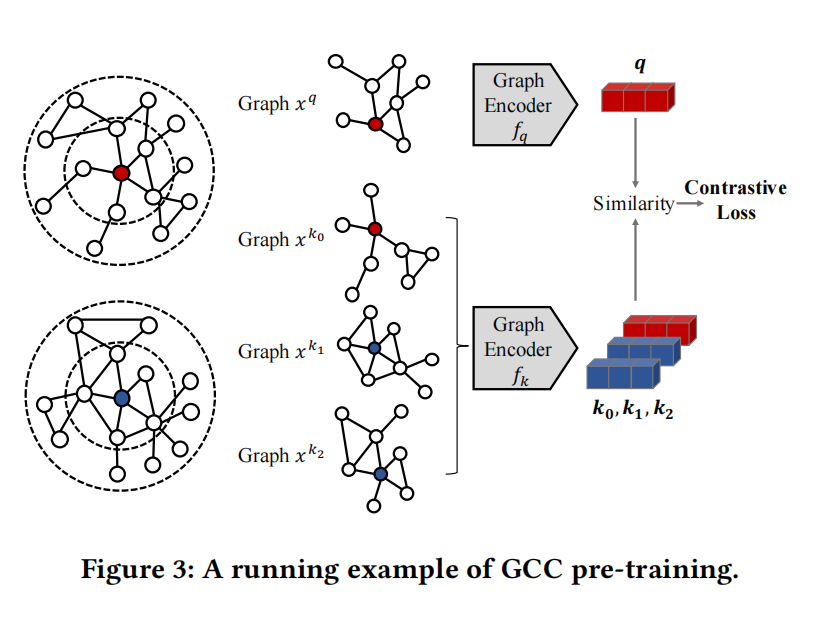
The two panels on the left of Figure 3 illustrate 2-ego subgraphs. GCC treats each r-ego network as its own distinct class and trains the model to separate similar instances from dissimilar ones.
Q2: Define (dis)similar instances
In computer vision, augmentations such as rotation and cropping yield positive pairs. For r-ego networks, augmentation follows three main steps:
- Random walk with restart: start a random walk on $G$ from ego vertex $v$. At each step, the walk moves to a neighbor with probability proportional to edge weight; with a fixed positive probability it returns to the start vertex.
- Subgraph induction: repeat random walks; the resulting samples are treated as augmented views.
- Anonymization: relabel vertices in the sampled subgraph in an arbitrary order.
Repeating this procedure yields positive pairs; augmentations drawn from different r-ego networks form negative pairs. The pipeline can be implemented with the DGL library.
In random-walk-with-restart sampling, the restart probability controls the radius $r$ of the ego network; the authors use 0.8 as the restart probability.
The anonymization step preserves underlying structural patterns while hiding exact vertex indices. This avoids a trivial solution to subgraph instance discrimination—merely checking whether two subgraphs share the same vertex labels—and helps transfer learned models across graphs, because the encoder is not tied to a fixed vertex set.
Q3: Define graph encoders
GCC is largely encoder-agnostic; the authors use GIN, but most GNN encoders require vertex features. They therefore initialize vertex features from the graph structure of each sampled subgraph, using generalized positional embeddings.
Experiment
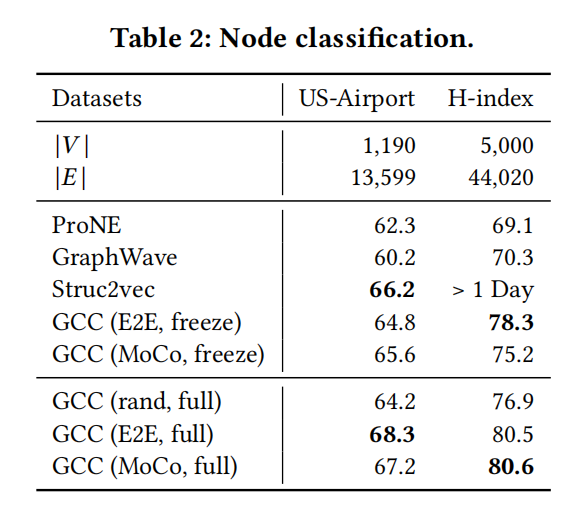
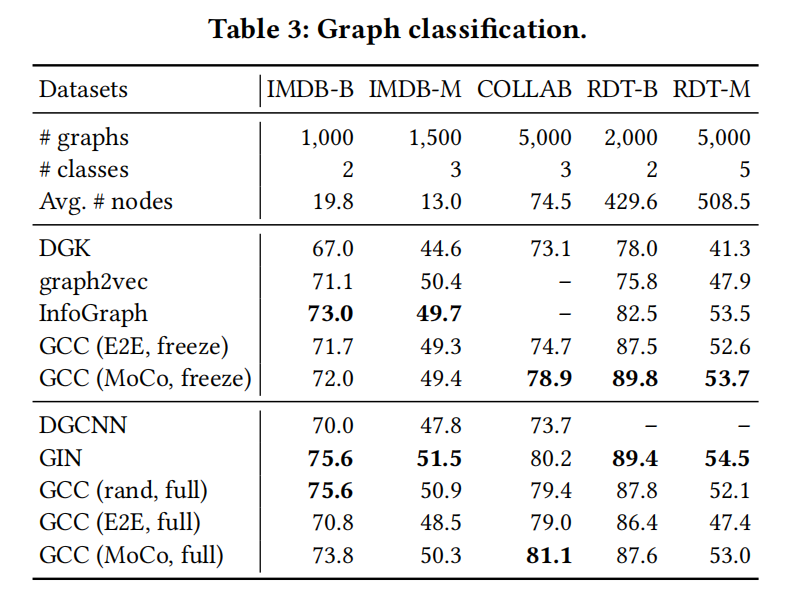
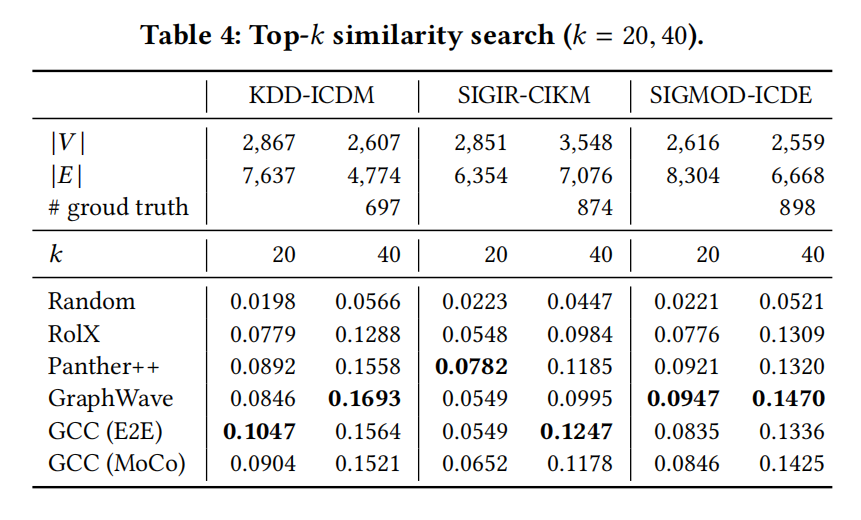
<HR align=left color=#987cb9 SIZE=1>