
arXiv-2020 Neural Subgraph Matching
Paper: Neural Subgraph Matching
Code: https://github.com/snap-stanford/neural-subgraph-learning-GNN
NeuroMatch: Subgraph Matching via Graph Decomposition
Abstract
NeuroMatch is a graph neural network (GNN) architecture for efficient subgraph matching. Given a large target graph and a small query graph, NeuroMatch identifies neighborhoods of the target graph that contain the query graph as a subgraph. NeuroMatch uses a GNN to learn graph embeddings in an ordered embedding space that reflects structural properties of the subgraph relation (transitivity, antisymmetry, and nontrivial intersection), enabling real-time approximate subgraph matching at scales that were previously infeasible: it can match a 100-node query graph in target graphs of size 500k. Experiments show that NeuroMatch is 100× faster than existing combinatorial methods and 18% more accurate than existing approximate subgraph matching methods.
Introduction
Subgraph isomorphism matching has many applications:
- In the social sciences, subgraph analysis plays a major role in studying network effects in social networks.
- Information retrieval systems use subgraph structure in knowledge graphs for semantic generalization, analogical reasoning, and relation prediction.
- In chemistry, subgraph matching is a robust and accurate way to measure similarity between compounds.
- In biology, subgraph matching is essential for analyzing protein–protein interaction networks, where identifying and predicting functional motifs is a primary tool for understanding biological mechanisms such as disease, aging, and medicine.
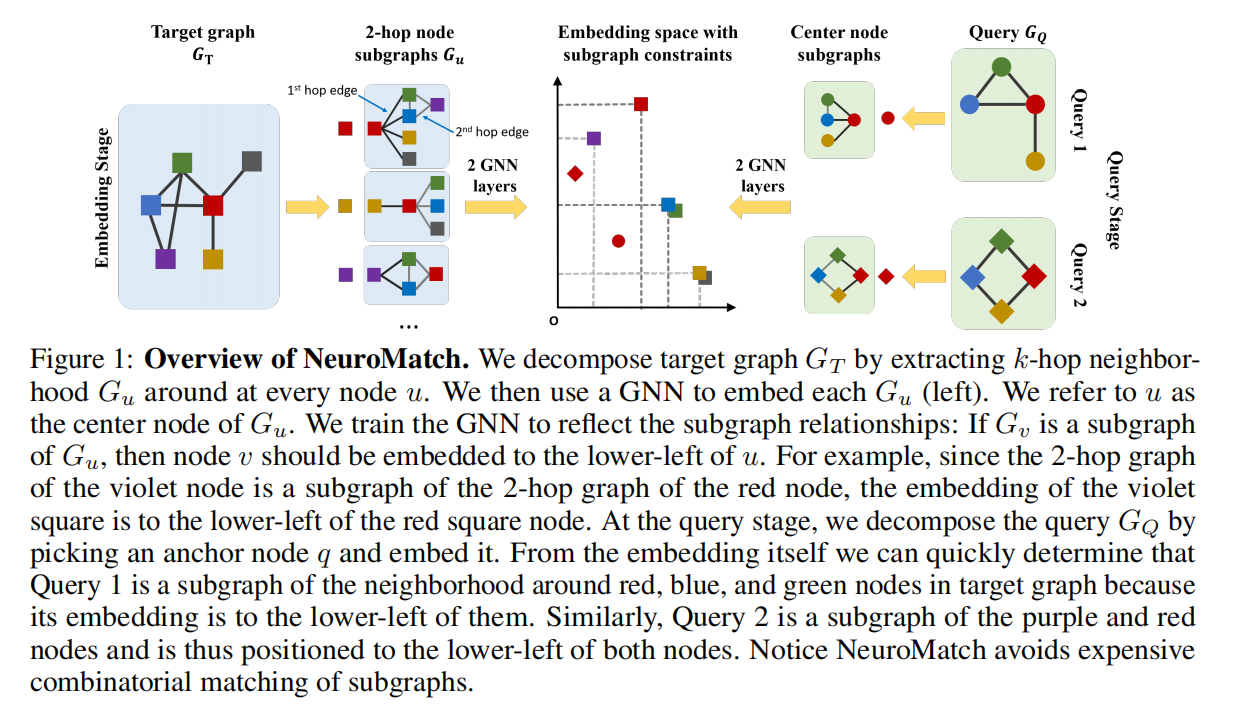
The target graph (G_T) and query graph (G_Q) are decomposed into many small overlapping graphs, and a graph neural network (GNN) embeds each piece so that we can quickly decide whether one graph is a subgraph of another.
There are two stages: an embedding stage and a query stage. In the embedding stage, the target graph (G_T) is decomposed into multiple subnetworks (G_u): for each node (u), a subnetwork (G_u) around (u) is extracted and a GNN yields an embedding for (u) that captures the neighborhood structure around (u). In the query stage, the embedding of each node (q) in the query graph (G_q) is computed from the neighborhood of (q). Embeddings of all pairs ((q, u)) are then compared to determine whether (G_Q) is a subgraph of (G_T).
NeuroMatch Architecture
Problem Setup
Problem 1. Matching query to datasets
Given a target graph (G_T) and a query graph (G_Q), predict whether (G_Q) is isomorphic to a subgraph of (G_T).
Problem 2. Matching neighborhoods
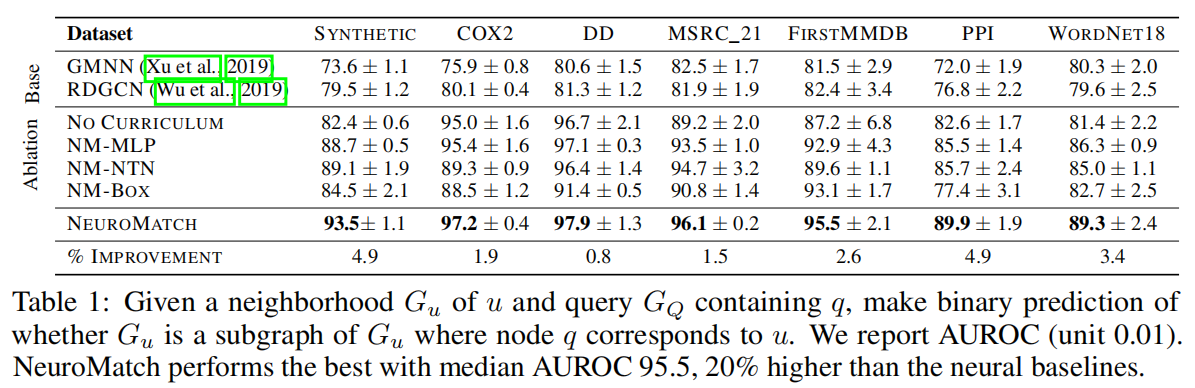
Given a neighborhood (G_u) around node (u) and a query (G_Q) anchored at node (q), make a binary prediction of whether (G_q) is a subgraph of (G_u), where node (q) corresponds to (u).
Overview of NeuroMatch
Embedding stage
In the embedding stage, (G_T) is decomposed into a collection of subgraphs; each node (u) is represented by the embedding of its neighborhood.
Query stage
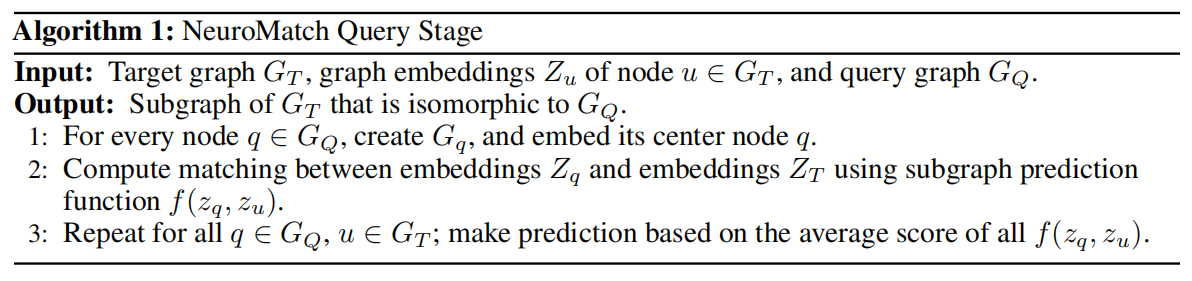
A subgraph prediction function is designed to decide whether the query subgraph (G_q) anchored at (q) is a subgraph of the target neighborhood (G_u).
Practical considerations and design choices
The number of layers (k) must account for the size of the query graph; (k) is at least the diameter of the graph.
Experiments use a variant of GIN combined with skip connections to encode the query graph and neighborhoods.
Subgraph Prediction Function (f(Z_q, Z_u))
Given the target node embedding (z_u) and a center node (q \in G_Q), the subgraph prediction function decides whether (u \in G_T) has a (k)-hop neighborhood that is isomorphic to the role of (q) in (G_Q). The key point is that the subgraph prediction function makes its decision using only the embeddings (z_q) and (z_u) of nodes (q) and (u).
Subgraph prediction function
If (G_q) is a subgraph of (G_u), then the embedding of (q) should lie to the lower left of that of (u).

Max-margin loss is used; (P) denotes positive pairs and (N) negative pairs.


Training NeuroMatch
Training data
Positive samples: sample (G_u) from (G_T), then sample (G_q) from (G_u); such ((G_q, G_u)) pairs are positive.
Negative samples: sample different (u) and (q) from (G_T); or perturb the query so that it is no longer a subgraph of the original graph.
Test data
Three strategies are used to generate test queries: BFS, random walk, and a degree-weighted sampling strategy.
Curriculum
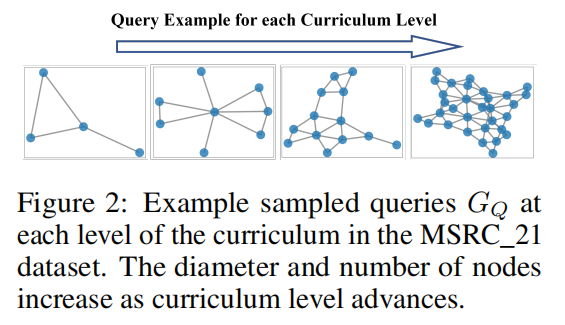
Training starts on simple queries, then gradually adds more complex queries and larger batch sizes.
Experiments
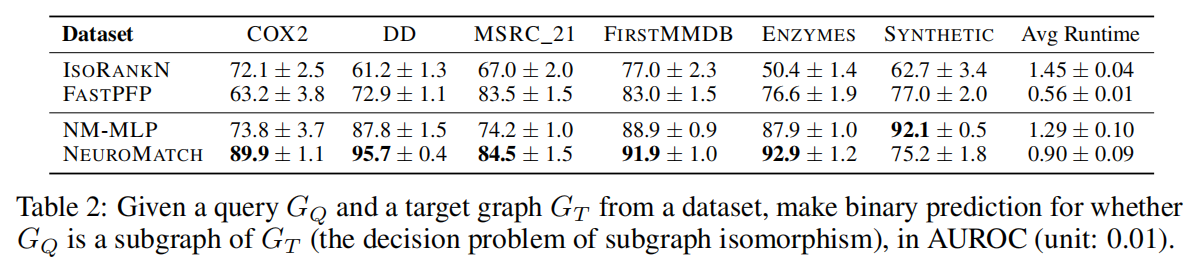
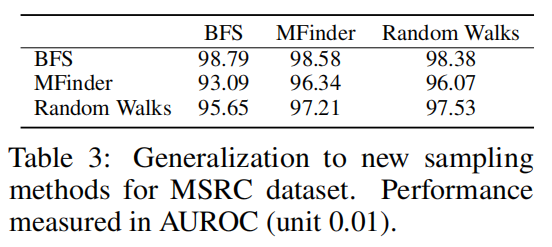
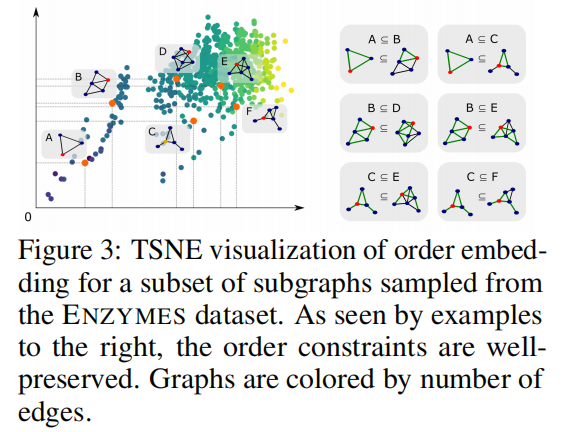
<HR align=left color=#987cb9 SIZE=1>