KDD-2023 Pre-training Antibody Language Models for Antigen-Specific Computational Antibody Design
Paper: Pre-training Antibody Language Models for Antigen-Specific Computational Antibody Design
ABGNN: Pre-trained AbBERT + RefineGNN for antibody–antigen encoding
Abstract
Antibodies are proteins that protect the human body effectively by binding pathogens. In recent years, deep-learning-based computational antibody design has attracted broad attention because it can automatically mine antibody patterns from data to complement human expertise. However, computational methods rely heavily on high-quality antibody structural data, which remain scarce. Moreover, the complementarity-determining regions (CDRs)—the key segments that govern antibody specificity and binding affinity—are highly variable and difficult to predict; limited availability of high-quality antibody structures further aggravates CDR generation. Fortunately, large-scale antibody sequence data are available to support CDR modeling and reduce dependence on structural data. Inspired by the success of pre-trained models in protein modeling, this work develops an antibody pre-trained language model and integrates it systematically into antigen-specific antibody design. Specifically, a novel antibody language model is pre-trained on sequence data; a one-shot method is proposed to generate CDR sequence and structure jointly, mitigating the high computational cost and error propagation of autoregressive approaches; and carefully designed modules leverage the pre-trained antibody model to strengthen antigen-specific antibody generation. Experiments show that the proposed method outperforms existing baselines on sequence and structure generation, CDR-H3 design for antigen binding, and antibody optimization.
1 Introduction
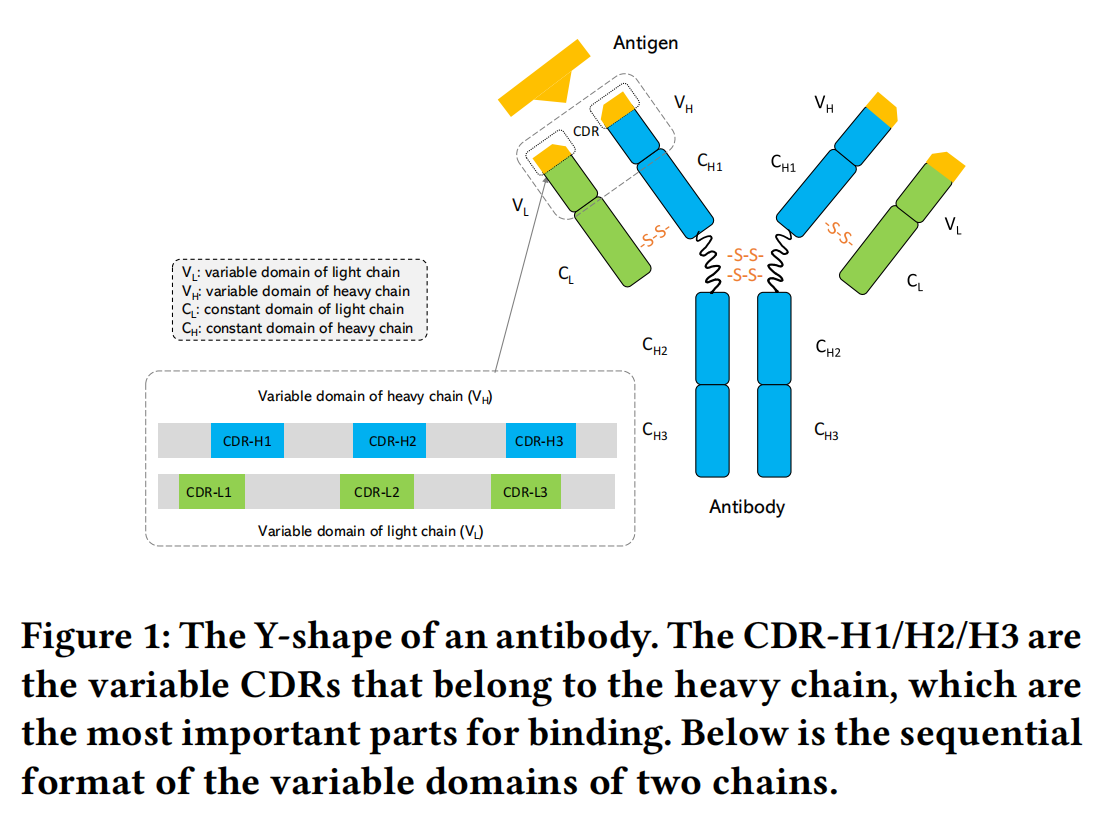
Antibodies are Y-shaped proteins that play a central role in the human immune system and can be used to treat infections, cancer, and other diseases. They are highly specific: most therapeutic antibodies are monoclonal, and each antibody typically binds one particular antigen. Binding specificity is largely determined by the complementarity-determining regions (CDRs), especially CDR-H3 on the heavy chain—the most critical and most variable segment. The main challenge in antibody design is therefore to identify and design new CDRs that bind a given antigen effectively and stably.
In recent years, computational methods have been explored to automatically generate CDR sequences with desired properties such as high binding affinity. Deep learning shows strong potential in antibody design, including deep generative models and graph neural networks. Early work focused mainly on CDR sequence generation; more recently, joint design of sequence and three-dimensional structure has become a more promising direction. For example, some studies use deep graph neural networks to model antibody sequence and structure simultaneously. Nevertheless, current methods still face several challenges. First, the number of antibody 3D structures in existing datasets is limited: the widely used SAbDab database contains only thousands of structures, and antigen–antibody complexes are even scarcer, which hampers training of deep models—especially for highly variable CDR structures. Second, most antibody design pipelines generate amino-acid types and structural coordinates autoregressively, step by step. That paradigm is inefficient (many iterative steps) and suffers from error accumulation: mistakes in early steps propagate and degrade overall generation quality.
To address these challenges, this paper proposes several strategies:
- Although structural data are limited, antibody sequence data are abundant, and prior work shows that sequence determines structure. The authors therefore design an antibody sequence pre-training procedure to exploit large-scale sequence data, improve antibody representations, and alleviate scarcity of structural data.
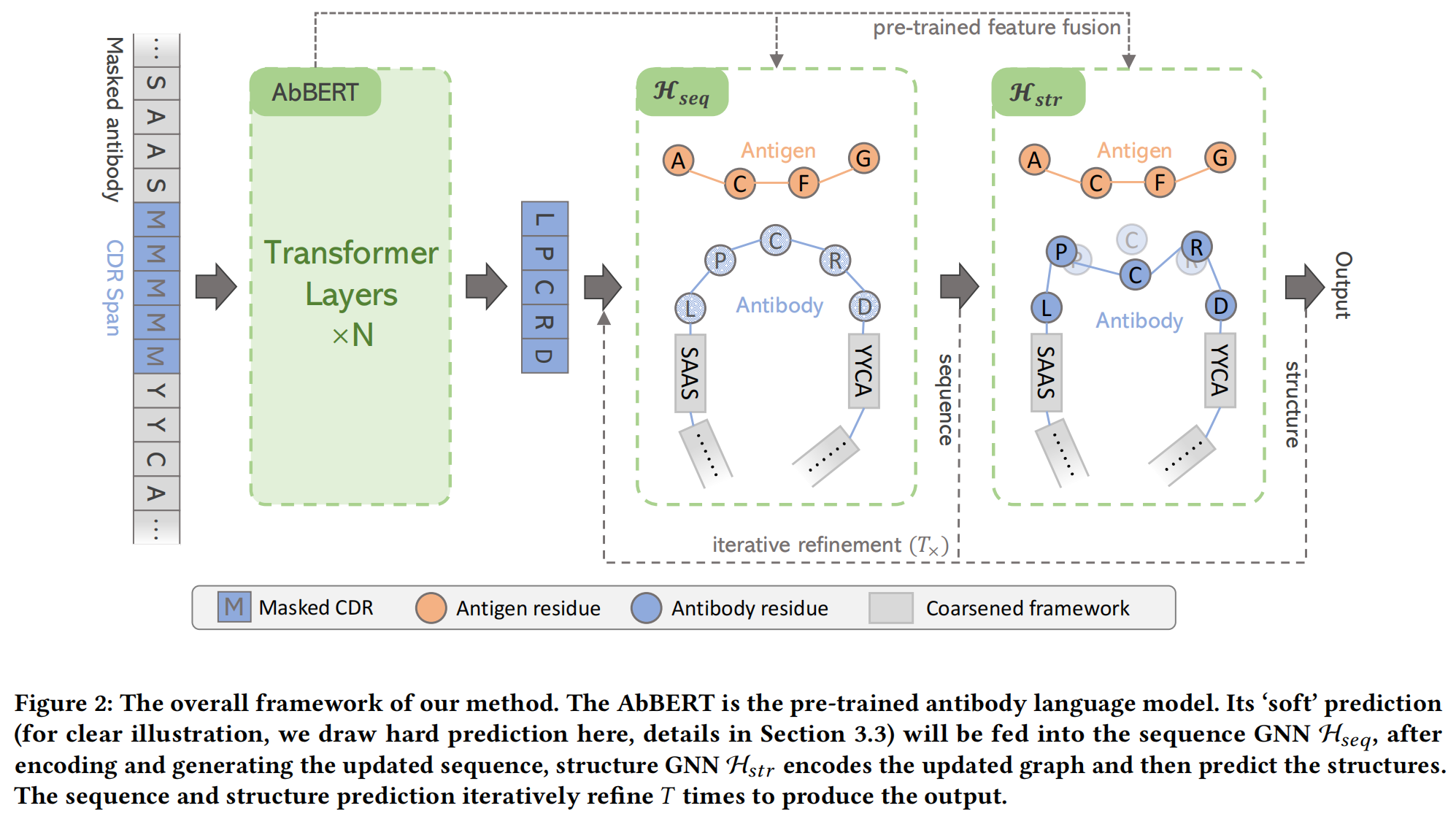
- They propose a one-shot method to generate CDR sequence and structure jointly. Compared with autoregressive generation, all CDR residues are predicted at once and structure is updated in one shot, avoiding error propagation. Multiple iterative refinement steps (similar to AlphaFold2) are added to further improve the output.
- The pre-trained antibody language model is integrated systematically into the antibody design model—not merely for initialization. Prompt tuning is used so the pre-trained model retains its prior capabilities while supplying transferable knowledge for downstream antibody design. Intermediate representations from the pre-trained model are fused with the design model to strengthen CDR sequence and structure prediction.
These strategies are evaluated on sequence and structure generation, antigen-binding CDR-H3 design, and antibody optimization. Results show state-of-the-art performance on multiple metrics together with improved efficiency and accuracy. Main contributions:
- An antibody-specific pre-training approach applied successfully to joint antibody sequence–structure design.
- A one-shot generation strategy that improves efficiency and limits error accumulation.
- Extensive experiments demonstrating effectiveness and state-of-the-art antibody design performance.
3 Methods
3.1 Background and Overview
An antibody consists of two symmetric halves, each with a heavy and a light chain (VH and VL). The variable region contains the framework and three CDRs (CDR-H1/H2/H3). CDRs govern antigen binding; CDR-H3 is the most variable and accurate prediction of CDR-H3 is the core challenge in antibody design. The method builds on deep graph neural networks (GNNs) and antigen–antibody complexes. Unlike prior work, it uses only the antigen epitope, not the full antigen, and conditions on the antibody framework to improve design accuracy.
The pipeline uses sequence representations from the AbBERT pre-trained model, sequence GNN (H_seq) and structure GNN (H_str) for joint sequence–structure generation, and multi-round iterative refinement. The overall framework is shown in Figure 2.
3.2 AbBERT: Antibody Pre-training
Because high-quality antibody structures are scarce while sequence data are plentiful, the authors follow successful protein pre-training practice and train AbBERT, an antibody language model, to improve representations and downstream design.
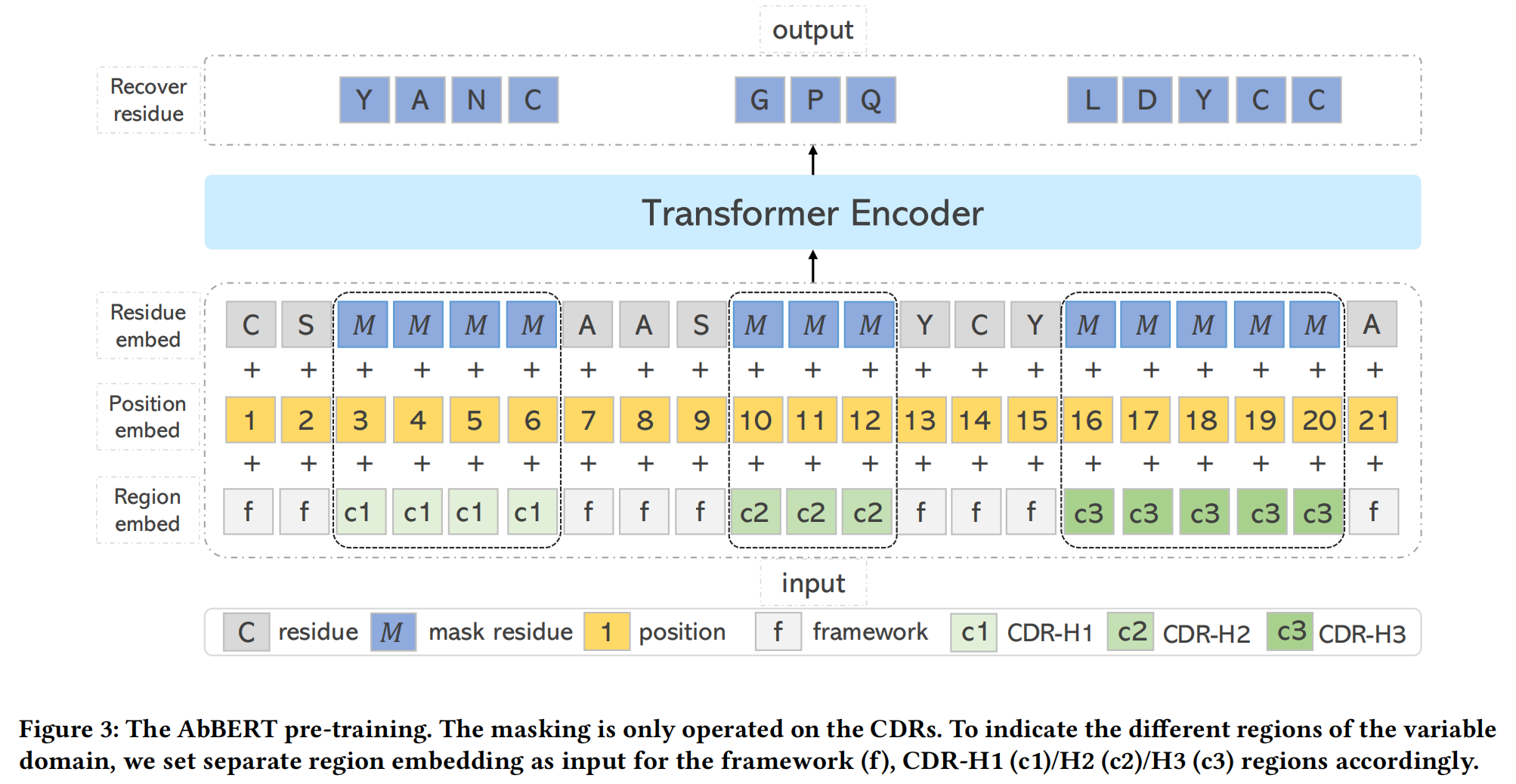
AbBERT pre-training follows a BERT-style masked language model (MLM), adapted to antibody sequences:

- Training uses only the heavy chain (VH), which is central to antibody function.
- Pre-training covers only the variable region (VH), not the constant region.
- Masking strategy: unlike standard BERT, AbBERT masks only CDR tokens; framework tokens provide context to improve CDR prediction.
- Region embedding: separate embeddings for CDR-H1/H2/H3 and framework help the model distinguish functional regions.
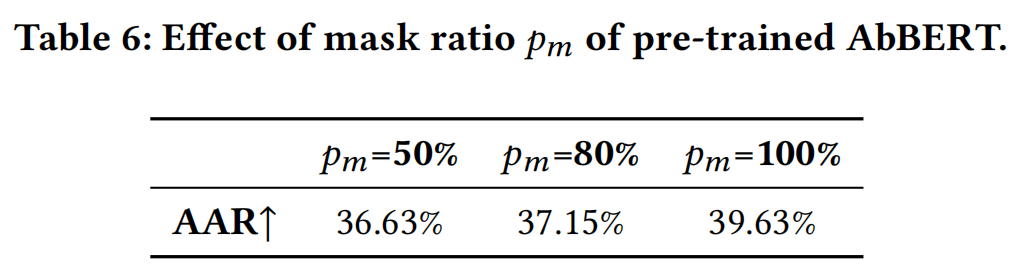
- Masking ratio: because CDRs comprise roughly 15% of the VH sequence, experiments use high mask ratios (50%, 80%, and 100%) so the model learns CDR patterns effectively.
After training, AbBERT can predict all CDR residues in one shot, improving efficiency and supplying strong initialization for antibody design.
3.3 Antibody Sequence-structure Co-design
Antibody design is cast as a 3D graph completion task: predict paratope (CDR) structure and the corresponding sequence. A hierarchical graph neural network (GNN) encodes and decodes sequence (H_seq) and structure (H_str). All graphs use K-nearest neighbors (KNN); nodes can be atom- or residue-level.
Unlike Jin et al. [18], the model conditions on epitope and paratope and additionally on the antibody framework. AbBERT provides initialization and feature fusion to improve design.
3.3.1 Encoding
Encoding is performed jointly by H_seq and H_str with hierarchical processing at atom and residue levels.
- Atom-level encoding
- Captures fine-grained interactions between antibody and antigen.
- Includes backbone and side-chain atoms.
- Radial basis functions (RBF) encode inter-atomic distances for the GNN.
- Residue-level encoding
- Captures global structural patterns of antibody–antigen binding.
- Per-residue features: amino-acid type, dihedral angles, polarity, hydropathy.
- Message passing networks (MPNs) propagate residue features.
Framework Encoding
Because framework regions are long, a coarse-grained encoder reduces cost:
-
The framework is split into residue blocks.
-
Each block embedding is the mean over residues in the block.
-
Formulation:

Here $E(B_f^j)$ and $z(B_f^j)$ denote features and coordinates of residues in framework block j.
Initialization
CDR sequence and structure are unknown at design time, so initialization matters. Two strategies are used:
-
Sequence Initialization
-
Prior work often randomly guesses initial sequences; here AbBERT supplies a soft predictive distribution.
-
CDR states are initialized from AbBERT’s soft distribution:

$P(B_p^i \hat{B})$ is AbBERT’s amino-acid probability distribution; $f(k)$ is the feature vector for amino acid k.
-
-
Structure Initialization
- Prior methods use complex distance-based initialization; here linear interpolation between framework flanking residues is simpler and efficient.
Atom-level Encoding
Node features:
- In the atom graph, each atom is a node.
- Features are one-hot atom types.
Edge features:
- Edges use RBF on distance: $f(B_p^i, G_e^j) = \text{RBF}(| z(B_p^i, k) - z(G_e^j, l) |)$
- $B_p^i, G_e^j$ are antibody and antigen atoms; $z(B_p^i, k)$ and $z(G_e^j, l)$ are 3D coordinates; RBF encodes distance.
- An MPN computes atom-level feature vectors.
Residue-level Encoding
Node features:
- In the residue graph, each residue is a node.
- Position uses Cα 3D coordinates.
- Amino-acid features $f(B_p^i)$ combine dihedral angles, polarity, and hydropathy.
Hierarchical Feature Fusion:
-
Atom-level information is summed into residue nodes:

-
Notes:
- ⊕ denotes concatenation.
- $f(B_p^i)$ and $f(G_e^j)$ are initial residue features for antibody and antigen.
- $\sum_k h(B_p^i, k)$ is the sum of atom-level features.
Edge Features:
- Residue-graph edge features $f(B_p^i, B_p^j)$ include Euclidean distance, direction, and rotation between residues.
- $f(B_p^i, B_p^j)$ encodes geometric relations between antibody residues $B_p^i$ and $B_p^j$.
Residue-level Message Passing:
- Given node and edge features, an MPN learns residue-level representations for epitope and paratope.
3.2.2 Decoding
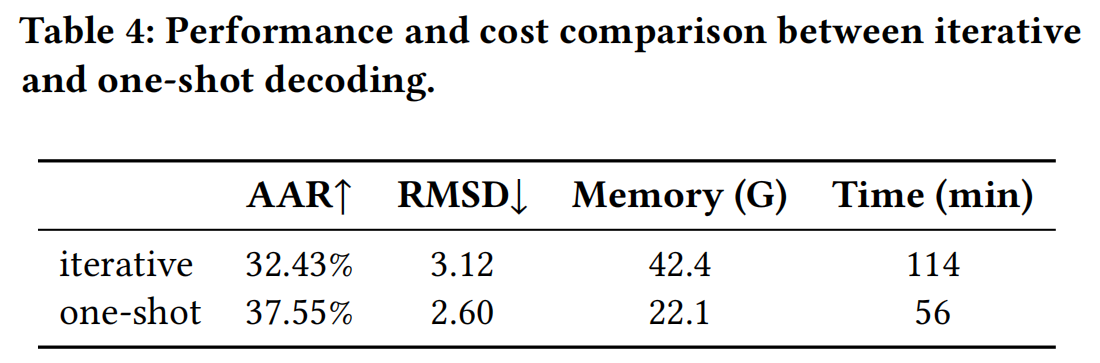
Sequence and structure prediction use one-shot generation instead of autoregressive decoding:
- Limitations of autoregressive methods:
- Low efficiency: amino acids are predicted sequentially with heavy computation.
- Error accumulation: early mistakes propagate and bias the final output.
- One-shot strategy in this work: all CDR residues are generated together; structure is predicted in parallel, limiting error propagation; T rounds of iterative refinement follow, as in AlphaFold2.
Sequence Generation
-
Multi-class cross-entropy predicts amino acids:

-
For the first T−1 refinement rounds, soft distributions are used; the final round applies hard sampling for amino-acid types.
Structure Decoding
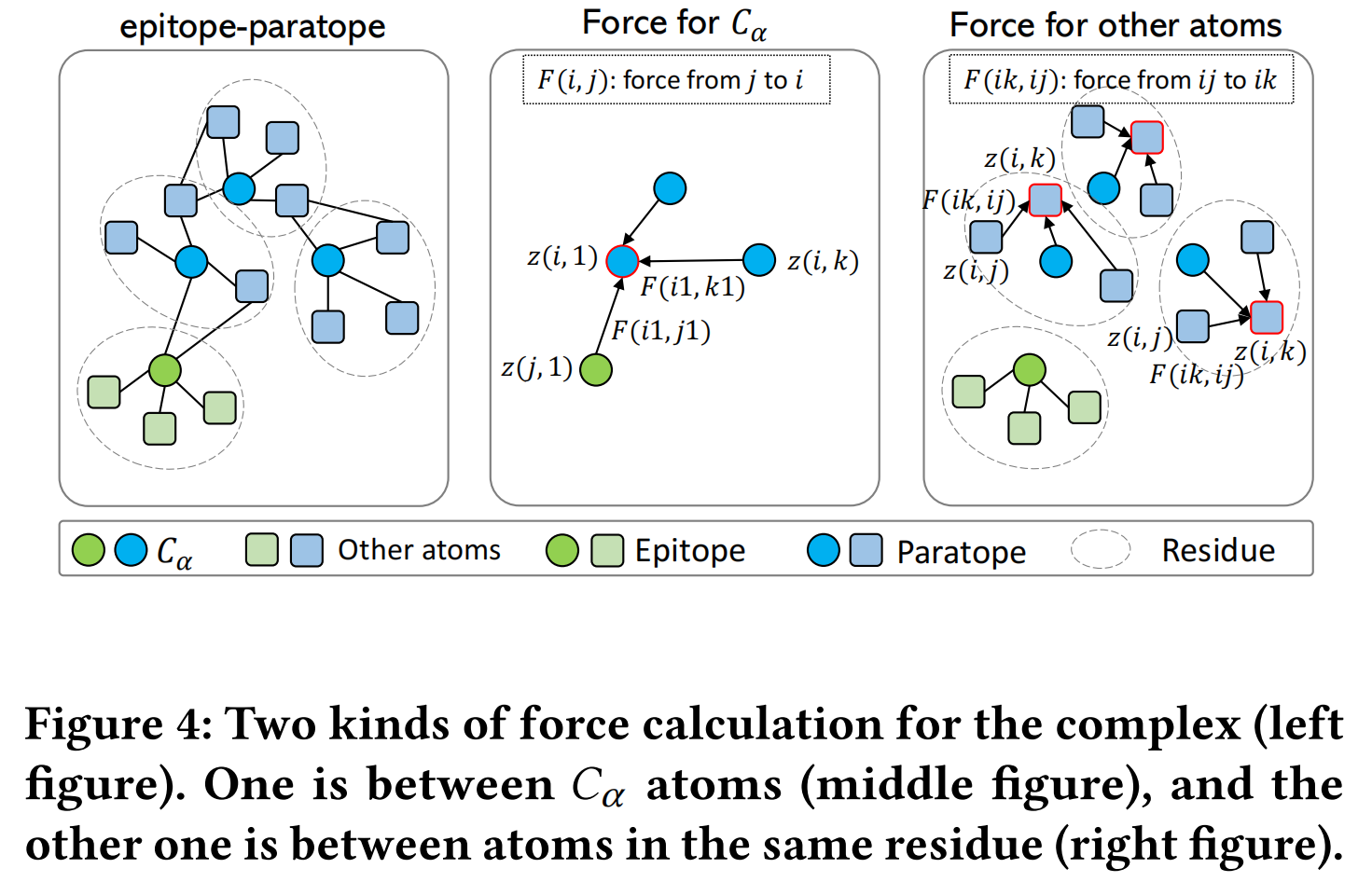
- A force-based update preserves SE(3) equivariance instead of direct coordinate regression.
-
Forces between Cα atoms update backbone coordinates:
$F(i, j) = g(h(B_p^i), h(B_p^j)) \cdot (z(B_p^i) - z(B_p^j))$
$g$ is an FFN; $z(B_p^i)$ is the coordinate of CDR residue i.
- Update rule:
z_t(B_p^i) = z_{t-1}(B_p^i) + \frac{1}{n} \sum_{j \neq i} F_t(i, j) + \frac{1}{m} \sum_k F_t(i, k)$n$ and $m$ count neighboring Cα atoms and other atoms, respectively.
3.4 Incorporating Pre-training
CDR sequence prediction needs good initialization; random init often yields unstable generation. AbBERT’s soft predictive distribution initializes CDR residue features.
Beyond initialization, AbBERT is used throughout design, not only at the input. Multi-layer feature fusion injects AbBERT representations into the antibody GNN:
-
Fusion:
- During H_seq and H_str, AbBERT intermediate representations strengthen CDR sequence modeling.
-
AbBERT contextual representations are added as extra input:

Prefix-tuning:
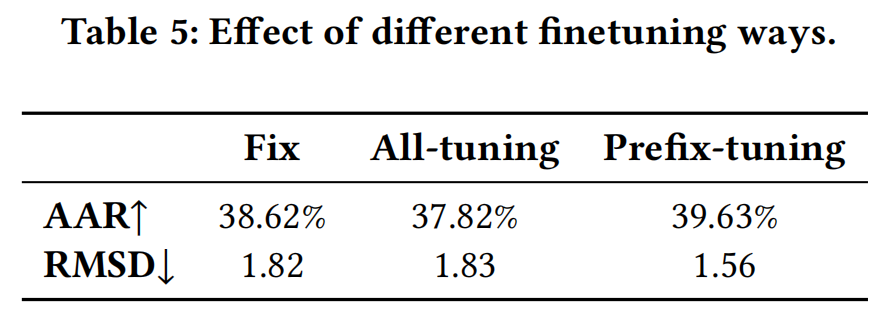
- Standard fine-tuning can cause catastrophic forgetting of pre-training; prefix-tuning avoids updating AbBERT weights:
- AbBERT parameters are frozen; only learnable prefix vectors adapt the model to antibody design.
- This preserves AbBERT knowledge while fitting the downstream generation task.
3.5 Summary and Algorithm
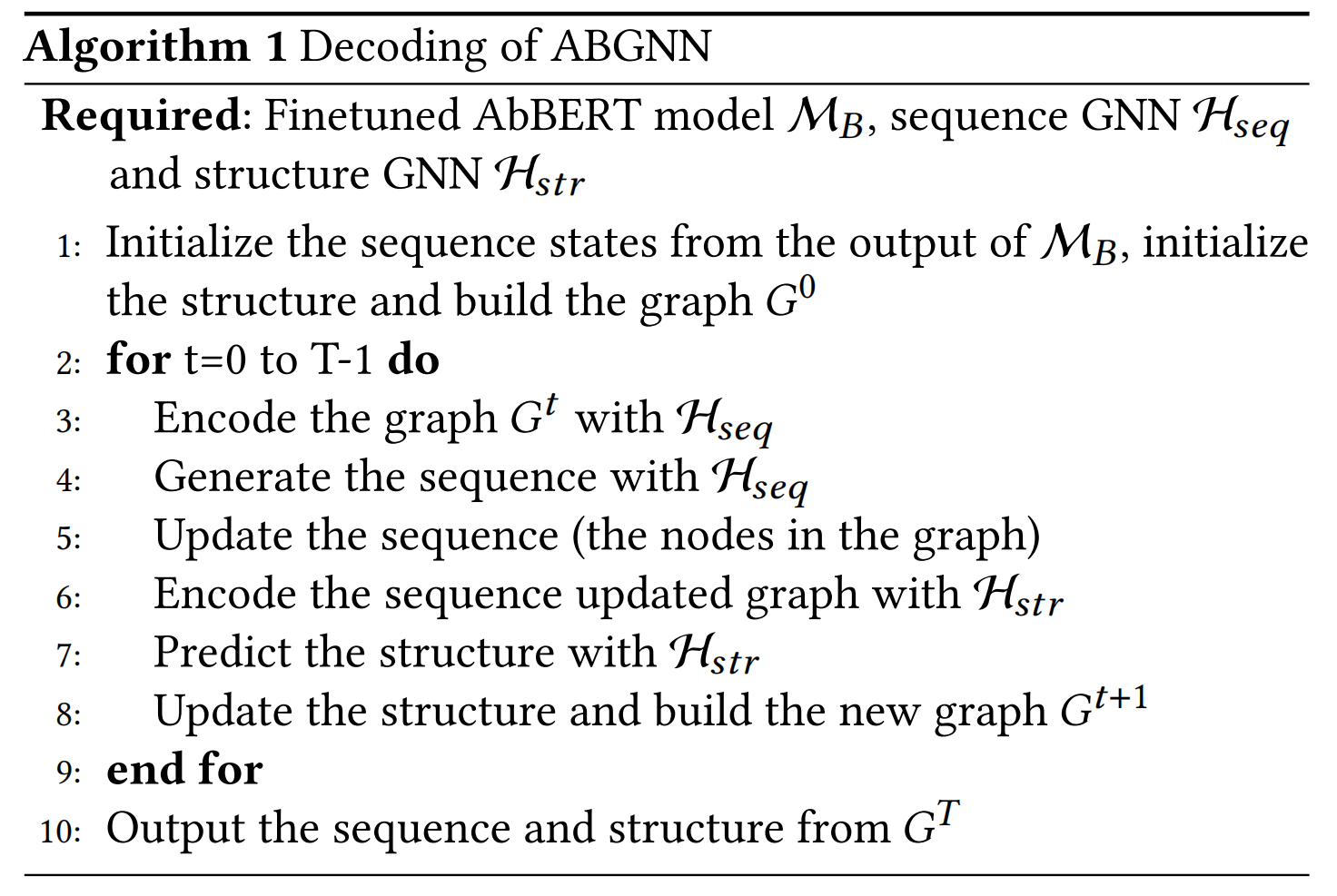
- Inputs: antigen epitope, antibody framework, initial CDR
- Initialization: AbBERT soft distributions for CDR sequence features; linear interpolation for CDR coordinates
- Sequence–structure co-design:
- H_seq predicts CDR sequence (softmax distributions).
- H_str predicts CDR structure (force-driven coordinate updates).
- T iterative refinement steps adjust structure toward physical stability and antigen binding.
- Outputs: optimized CDR sequence and structure
4 Experiments
4.1 Overview Settings
(1) Sequence and Structure Prediction (2) Antigen-binding CDR-H3 Design (3) Antibody Optimization for SARS-CoV-2
Baseline Models
Baselines for fair comparison:
- RAbD (Rosetta Antibody Design): physics-based sequence generation and energy minimization.
- LSTM-based methods: sequence only, no structure.
- AR-GNN (Autoregressive Graph Neural Network): encodes the antibody and predicts amino acids autoregressively.
- RefineGNN: like AR-GNN but refines structure between residue steps; different resolution for CDR vs. framework to emphasize CDRs.
- HSRN (Hierarchical Structure Refinement Network): hierarchical equivariant message passing for antigen–antibody interaction with autoregressive decoding and iterative refinement.
- MEAN: internal and external message passing for context vs. surface; models light chain, heavy chain, and antigen.
Model Settings
- Pre-trained AbBERT: 12-layer Transformer (BERT-base), hidden size 768, 12 attention heads, prefix-tuning with 5 soft tokens
- GNNs (H_seq and H_str)
- 9-nearest-neighbor graph edges
- 4-layer MPNs, hidden dimension 256
- Framework compressed: one block per 8 residues
- Refinement steps T = 5
Pre-training
- Data: Observed Antibody Space (OAS), over one billion antibody sequences across immune states, organisms, and individuals.
- Processing
- Heavy-chain sequences only.
- Filtering and clustering (MMseqs2, minimum 70% sequence identity) to reduce redundancy.
- 50 million sequences sampled for pre-training.
- Training: 16× 32GB V100 GPUs; batch size 256 per GPU, gradient accumulation 4, learning rate 0.0003
4.2 Task 1: Sequence and Structure Prediction
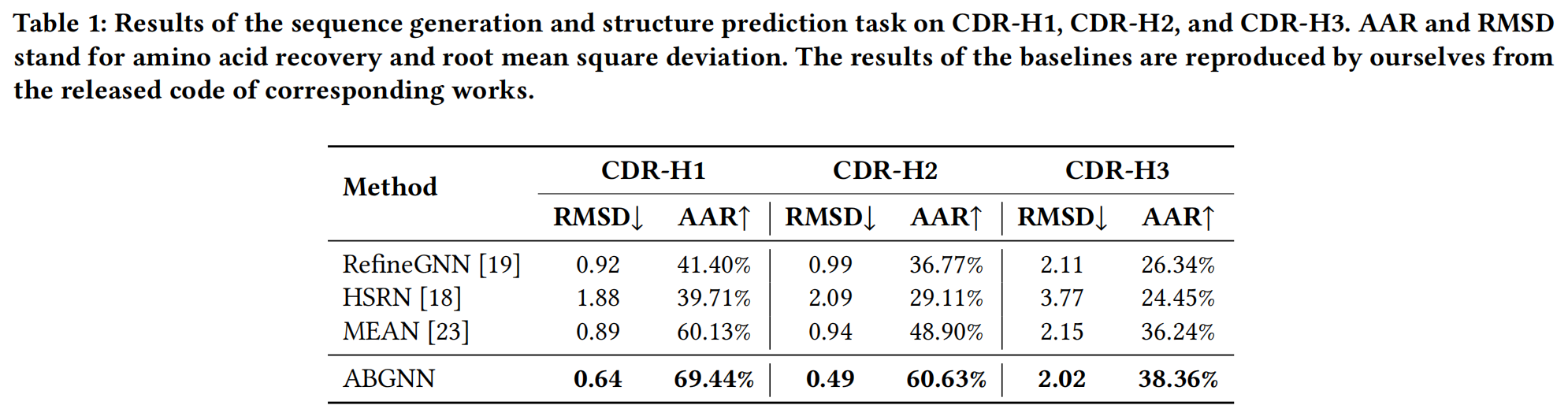
This task evaluates joint sequence and structure prediction for CDR design on antigen–antibody complexes, generating full CDR segments with amino-acid sequence and 3D structure.
- Dataset: SAbDab; MMseqs2 on CDR regions with >40% sequence identity defining clusters; random 8:1:1 train/val/test split; 765, 1093, and 1659 clusters for CDR-H1, CDR-H2, and CDR-H3.
- Evaluation: held-out antigens for generalization; emphasis on CDR-H3 because of its role in binding and function.
4.3 Task 2: Antigen-binding CDR-H3 Design
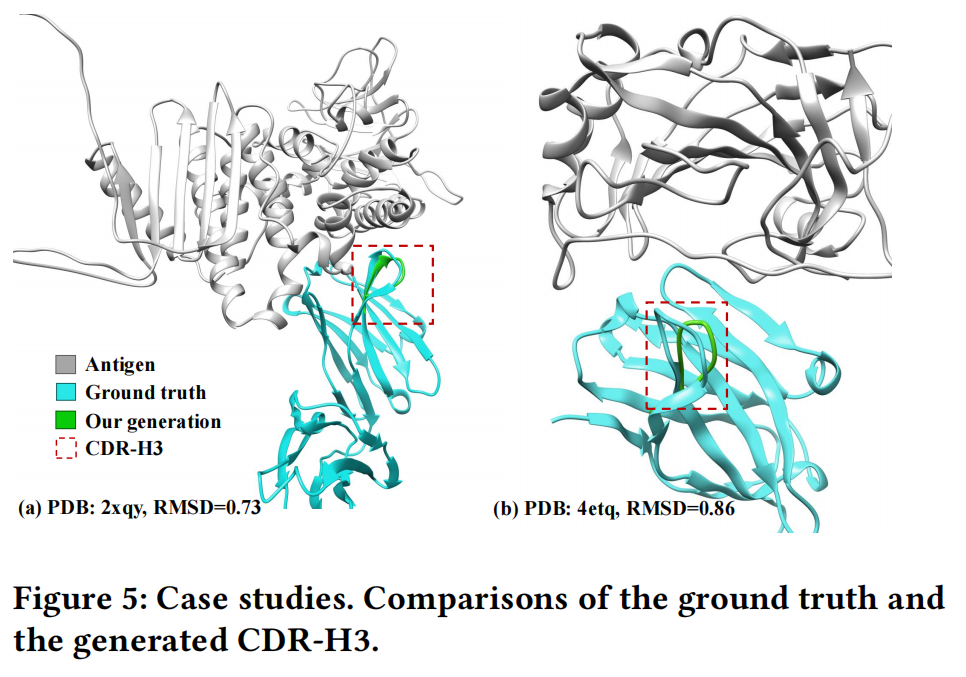
Data
This setting is harder than generic CDR design: the goal is CDR-H3 tailored to a specific antigen, so antigen is conditional input. Only CDR-H3 is generated.
- Test: Adolf-Bryfogle et al. [1], 60 antigen types in antibody–antigen complexes.
- Train: SAbDab complexes only (no antibody-only structures).
- Processing: Jin et al. [18] split with 2777 train and 169 validation complexes.
Inference Procedure
- Candidate generation: following Jin et al. [18], 10,000 CDR-H3 sequences per antibody at inference.
- Filtering: top 100 by lowest perplexity for AAR (amino acid recovery) and RMSD (root mean square deviation).
4.4 Task 3: SARS-CoV-2 Antibody Optimization
Data
Goal: optimize CDR-H3 of antibodies binding SARS-CoV-2. Data from the Coronavirus Antibody Database [41]: 2411 antibodies binding SARS-CoV-1 or SARS-CoV-2.
- Split: CDR-H3 8:1:1 train/val/test.
- Preprocessing: Jin et al. [19] with CDR filtering and sequence constraints (see original paper).
- Optimization:
- Training follows Jin et al. [19]; ITA (Iterative Targeted Antibody Optimization) fine-tunes generated antibodies.
- CDR generation and constraints match Jin et al. [19] for fair comparison.
Results
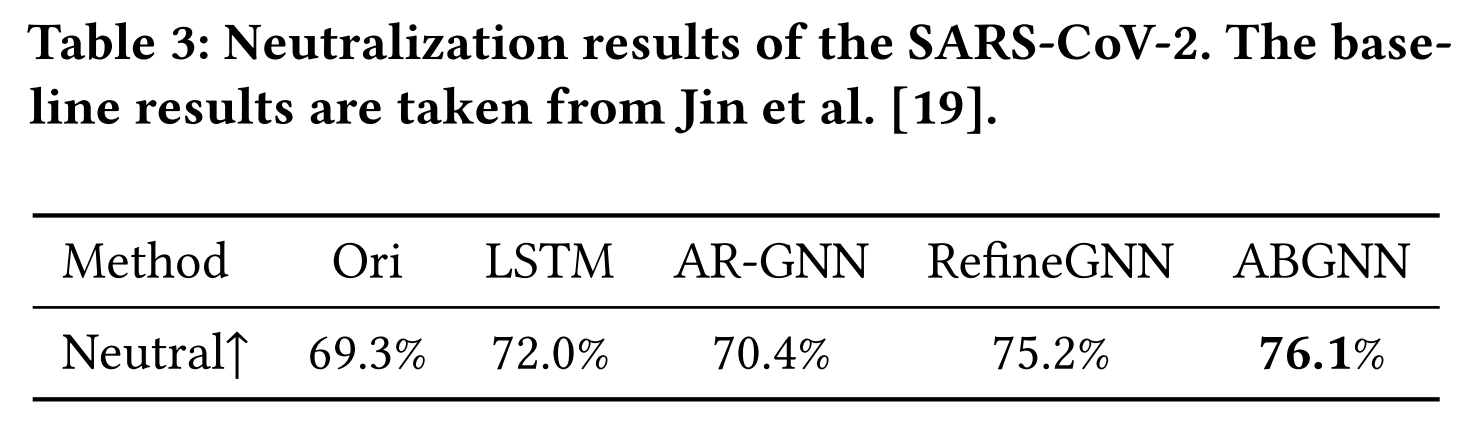
- Without wet-lab validation, evaluation uses a neutralization predictor.
- Binary classification with Jin et al. [19]’s pre-trained model scores neutralization.
- Findings:
- The proposed method improves predicted neutralization versus prior SOTA.
- Redesigned antibodies show higher predicted neutralization, supporting AbBERT for optimization.
5 Study
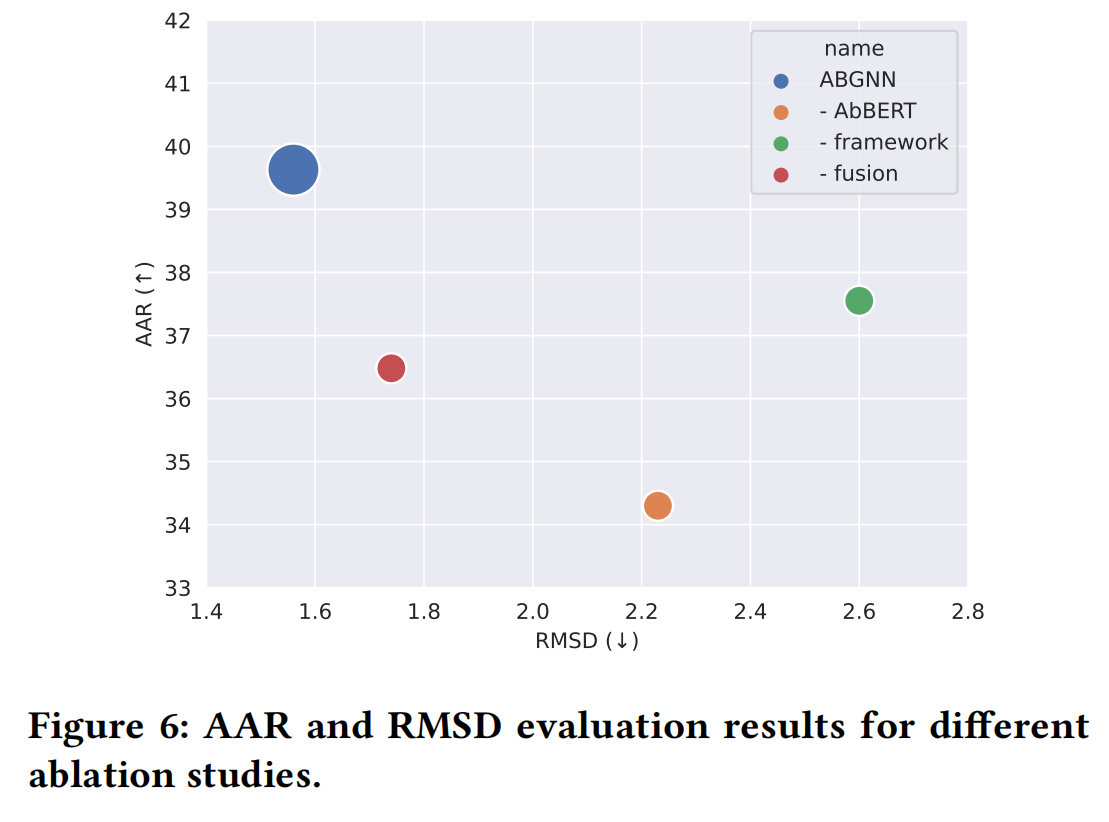
5.1 Ablation Study
5.2 Effect of Decoding ways
5.3 AbBERT Incorporating Ways
5.4 Effect of Pre-training