
NeurIPS-2023 Predicting a Protein’s Stability under a Million Mutations
Paper: Predicting a Protein’s Stability under a Million Mutations
Mutate Everything: large backbones with per-site MLP heads for massive mutation scoring
Abstract
Stabilizing proteins is a foundational step in protein engineering. Yet, because natural proteins have evolved under selective pressure, identifying a small set of mutations that improve thermodynamic stability is highly challenging. Deep learning has recently become a powerful tool for finding promising mutations, but existing methods are computationally expensive because the number of model forward passes scales with the number of mutations queried.
The main contribution is a simple, parallel decoding algorithm called “Mutate Everything.” It predicts the effect of all single- and double-point mutations in one forward pass, and can extend to higher-order mutations with minimal extra compute. The method is built on ESM2 and AlphaFold, neither of which was originally trained for thermodynamic stability prediction. It is trained on the Mega-Scale cDNA proteolysis dataset and achieves state-of-the-art performance on single- and higher-order mutation prediction on S669, ProTherm, and ProteinGym.
1 Introduction
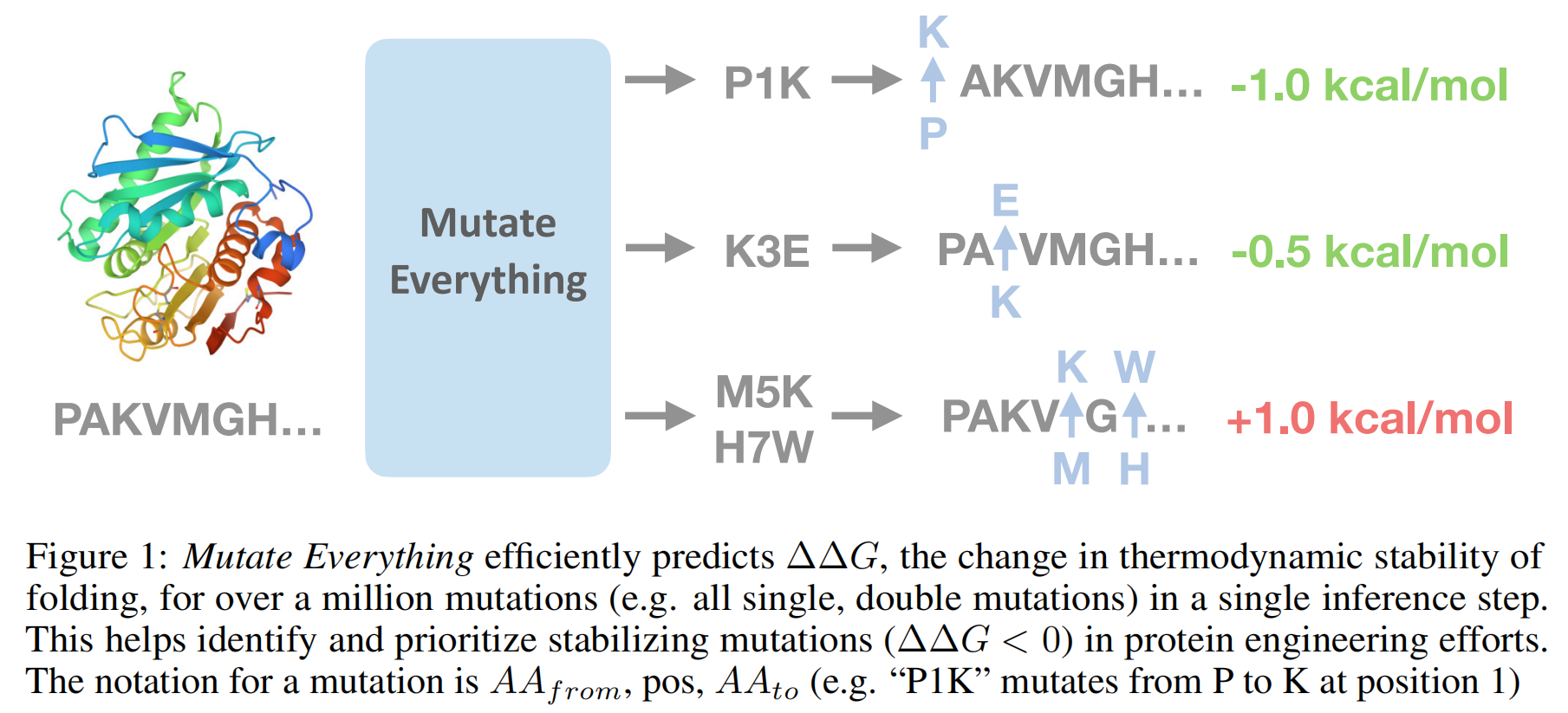
Protein engineering changes the sequence of natural proteins to improve their properties for industrial and pharmaceutical applications. Evolution, however, optimizes many traits in the native environment at once, so proteins often sit at marginal thermodynamic stability (roughly 5–15 kcal/mol). That margin means natural proteins frequently lose function when moved to more demanding industrial settings. Repurposing a natural protein for biotechnology therefore usually begins with mutations that are non-deleterious and stabilize structure. Only after the fold is stabilized do downstream engineering goals—which may require mutations that reduce stability—become practical to pursue.
Historically, stabilization was bottlenecked by lengthy laboratory characterization of rationally designed candidates or by the complexity of building and screening directed-evolution libraries.
High-throughput experiments have driven explosive growth in biological data, enabling deep learning to accelerate identification of stabilizing mutations. Successful stabilization often requires multiple mutations, not a single change. Most existing frameworks do not fully account for epistatic interactions when several mutations co-occur. Accelerating protein engineering therefore hinges on efficiently exploring higher-order mutations (combinations of simultaneous point changes) and their epistatic landscape. Because higher-order mutants are combinatorial, exhaustive search quickly becomes computationally infeasible.
Prior models for thermodynamic stability build embeddings or representations from the input sequence. This work’s decoder uses those representations and a linear network to form a representation for each possible single mutation. Mutation-level representations are aggregated for higher-order mutants and passed to a lightweight MLP head to predict ΔΔG. Because mutation-level representations are computed once, the model scales to millions of (higher-order) mutants at low cost for aggregation and the MLP head. Under a fixed compute budget, it evaluates millions more candidates than prior methods.
Mutate Everything estimates all single- and double-mutation effects for one protein on a single GPU in seconds, with the potential to score single and double mutants across the ~20,000 proteins in the human proteome. To the authors’ knowledge, it is the first tool that makes proteome-scale double-mutant analysis tractable. The approach can be paired with any model that produces sequence representations. In the paper, AlphaFold serves as the backbone, fine-tuned on experimentally measured ΔΔG labels, yielding the first accurate AlphaFold-based stability predictor.
The authors evaluate on ProTherm, S669, and ProteinGym. On the ProTherm higher-order subset (PTMul), the model reaches Spearman ρ = 0.53, versus 0.50 for the next-best method. On S669 single mutants, it reaches 0.56, improving on the previous best of 0.53. On ProteinGym, Mutate Everything raises the best Spearman correlation from 0.48 to 0.49. The method makes searching for the most stabilizing double mutations computationally feasible and prioritizes stabilizing mutants on the cDNA proteolysis double-mutant split (cDNA2), even though only ~3% of labeled mutants in that dataset are stabilizing.
3 Preliminary
Problem Setup
The goal is to predict how thermodynamic stability of protein w changes when a set of mutations (M₁,…,M_N) is introduced, as a real-valued ΔΔG ∈ ℝ. Each mutation set may be a single change or a higher-order combination.
Existing paradigms struggle to scale to very large mutation sets (e.g., millions). Models that handle higher-order mutants typically take the wild-type protein and the mutant sequence and predict the stability difference between them. For a small protein (e.g., 75 residues), enumerating all single and double mutants can exceed one million sequences, requiring over one million independent evaluations and rankings—prohibitively slow. This paper’s core idea is one forward pass through a fine-tuned backbone, then parallel decoding of all mutants with a lightweight decoder.
Feature Extraction
To mitigate scarce experimental labels, the authors fine-tune AlphaFold and other pretrained models. AlphaFold’s Evoformer captures co-evolution and residue–residue coupling; its Structure Module encodes 3D structure cues such as solvent accessibility and inter-residue distances. The paper argues these features correlate strongly with stability and how mutations perturb it.
4 Methodology
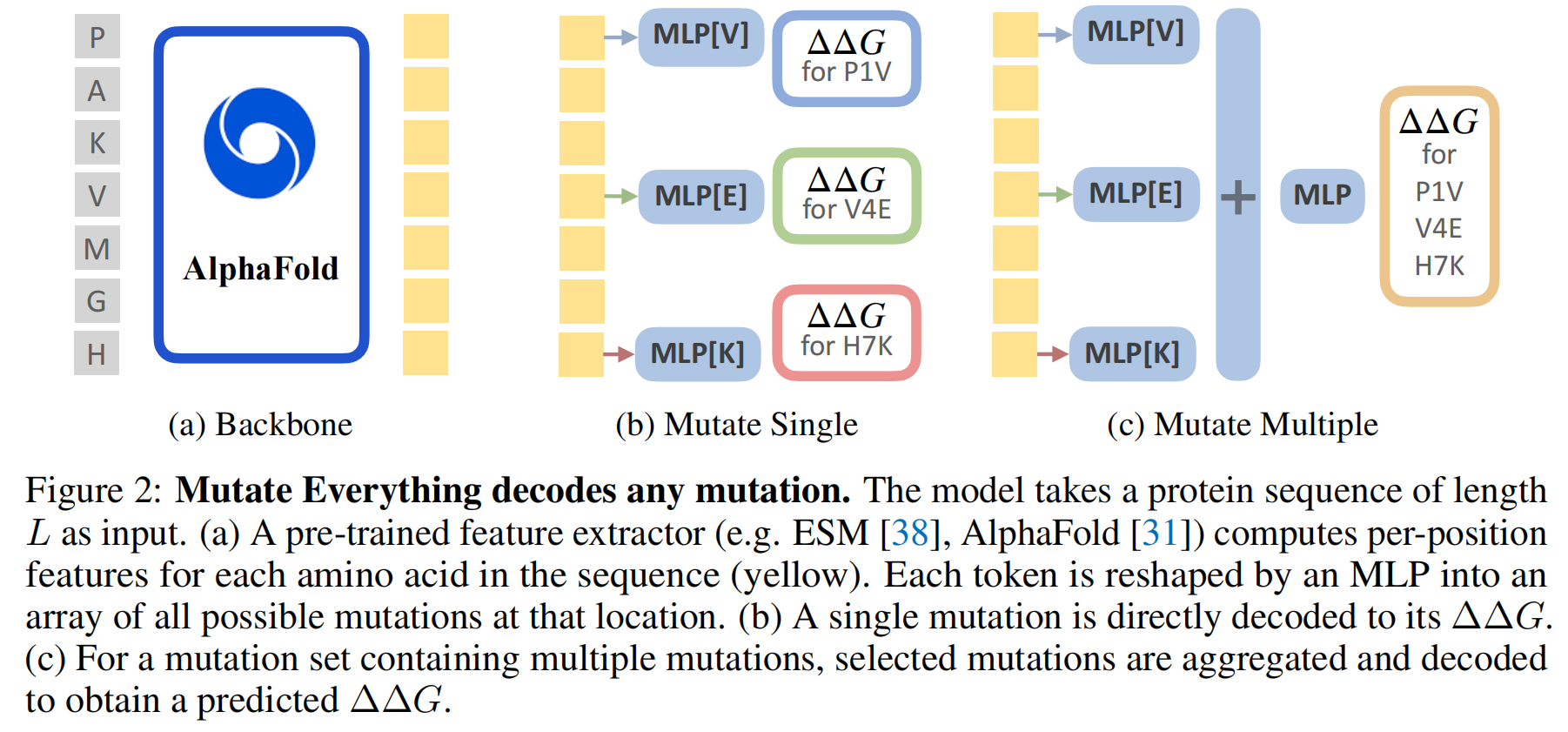
For a mutation $μ=(p,t)$ that changes position p to amino acid t, the model computes a latent mutation representation $z(μ)∈R^d$ capturing the mutational effect. It decomposes as $z(μ)=f^t(x_p)+h^t$. Sequence-dependent features $f^t∈{f^A,…,f^Y}$ project the site feature $x_p$ according to the mutant amino acid type. Sequence-independent features $h^t∈{h^A,…h^Y}$ are embeddings for each amino acid (A, C, …, Y). Intuitively, $f^t$ encodes local context and $h^t$ encodes the incoming residue type. Together they represent an amino-acid substitution.
Decoding single mutations
Decoding maps the mutation representation z(μ) to a scalar ΔΔG (change in thermodynamic stability).
A lightweight linear head g₁ performs this mapping by learning from z(μ) to ΔΔG.
Decoding higher-order mutations
Figure 2c illustrates higher-order decoding. The model sums the representations of each constituent single mutation.
The aggregated vector passes through a lightweight decoder head g (similar in spirit to the single-mutation head but with separate parameters) to predict the stability change for the higher-order mutant.
For K > 1, the authors use a useful trick: the head predicts a residual relative to the sum of predicted ΔΔG values for the constituent single mutants. The model thus learns deviations from additivity, capturing nonlinear epistasis. See Table 5d in the paper for empirical results.
Decoding a million mutations in one forward pass
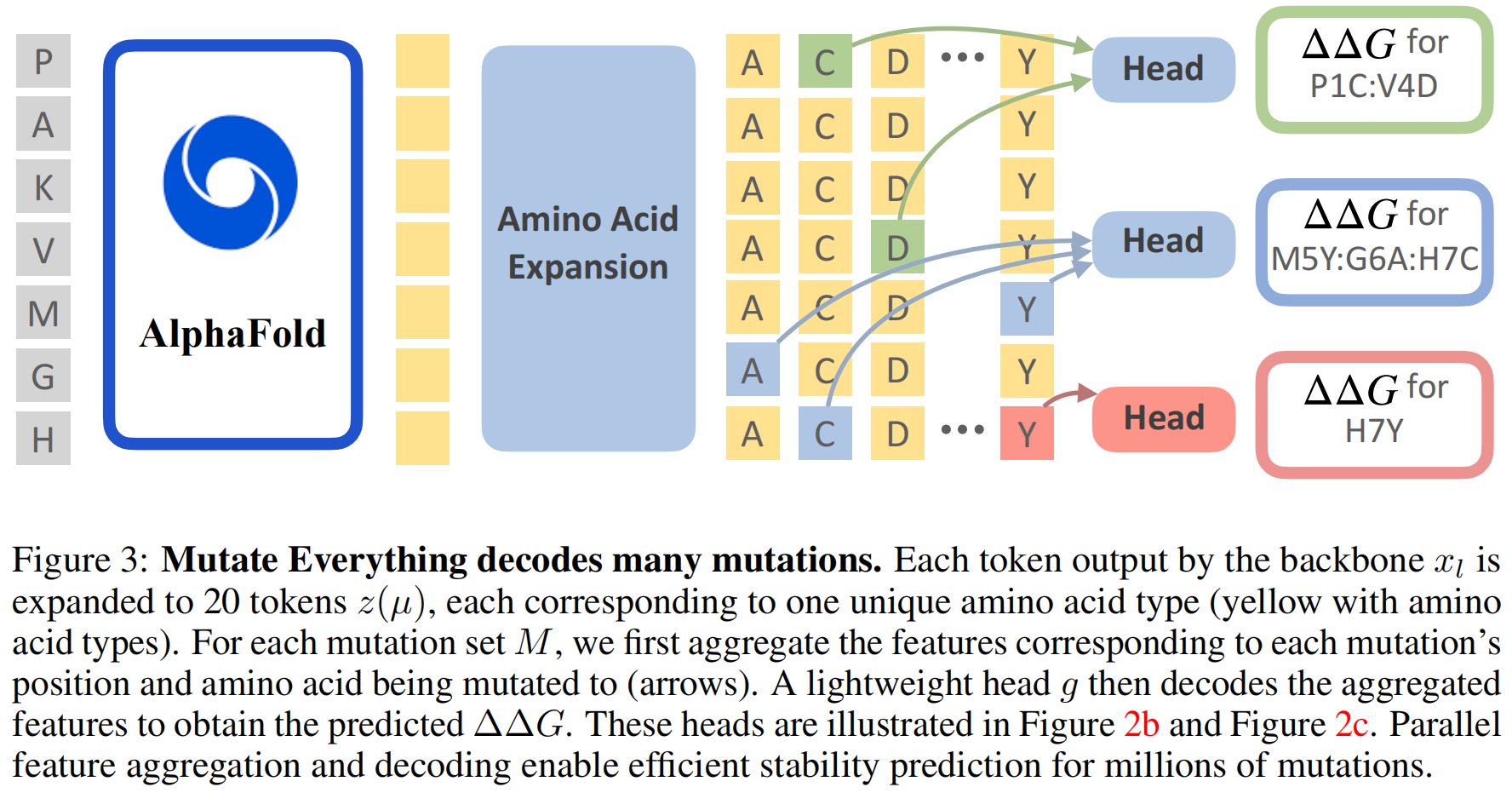
This section is the efficiency core: scoring millions of ΔΔG values at once (Figure 3). The key idea is to precompute mutation features for every site mutating to all 20 amino acids, then reuse them for all queries.
Steps:
- For a sequence of length L, compute representations for all L×20 single mutants, forming Z = { z((p,t)) : p ∈ [1,…,L], t ∈ AA } where AA is the 20 amino acids. Each position’s feature x_l expands to 20 mutant representations (including the wild-type identity at that site).
- For a given protein, backbone feature extraction and this mutation expansion run once.
- To score any mutation set (single- or higher-order), index the precomputed Z for the relevant single mutants, sum their representations, and proceed in parallel for many sets. For K = 2 (doubles), the paper uses an outer-summation for parallelism; for K > 2, a gather operation.
- The lightweight decoder g computes ΔΔG in parallel for each aggregated mutant representation.
Training
The objective is Huber loss, a compromise between MSE and MAE that is less sensitive to outliers than MSE alone.

A practical benefit is that losses for all labeled mutants of a protein can be updated in one backpropagation pass, unlike pipelines that backprop per mutant. Training uses single- and double-mutant data, averaging ~2,000 mutants per protein.
Only ~3% of double mutants in the training data are stabilizing (ΔΔG < −0.5 kcal/mol). To avoid underfitting these rare positives, the authors subsample non-stabilizing doubles so their count is at most 8× the number of labeled stabilizing doubles, improving recognition of stabilizing combinations.
5 Results
5.1 Implementation Details
The main feature extractor is AlphaFold, implemented with OpenFold. MSAs are from ColabFold. Sequence features from Evoformer and the Structure Module are aggregated as decoder input. An adapter maps backbone hidden size to D = 128. Amino-acid projection and the single-mutation decoder use linear layers; the higher-order decoder uses a 2-layer MLP on aggregated embeddings, followed by a 3-layer MLP for ΔΔG.
Training data come from the cDNA display proteolysis dataset: noisy ΔΔG measurements for >100,000 single and double mutants across 100 mini-proteins from high-throughput proteolysis screening with NGS. Proteins highly similar to any benchmark sequence are removed from training (MMseqs2).
Training fine-tunes the pretrained backbone on single mutants for 20 epochs, then jointly on singles and doubles for 100 epochs with a cosine schedule (10 warmup epochs). Batch size is 3 proteins because of AlphaFold memory. Learning rate is 3×10⁻⁴ with weight decay 0.5. Total training takes ~6 hours on 3 A100 GPUs.
5.2 Finding Stabilizing Double Mutations
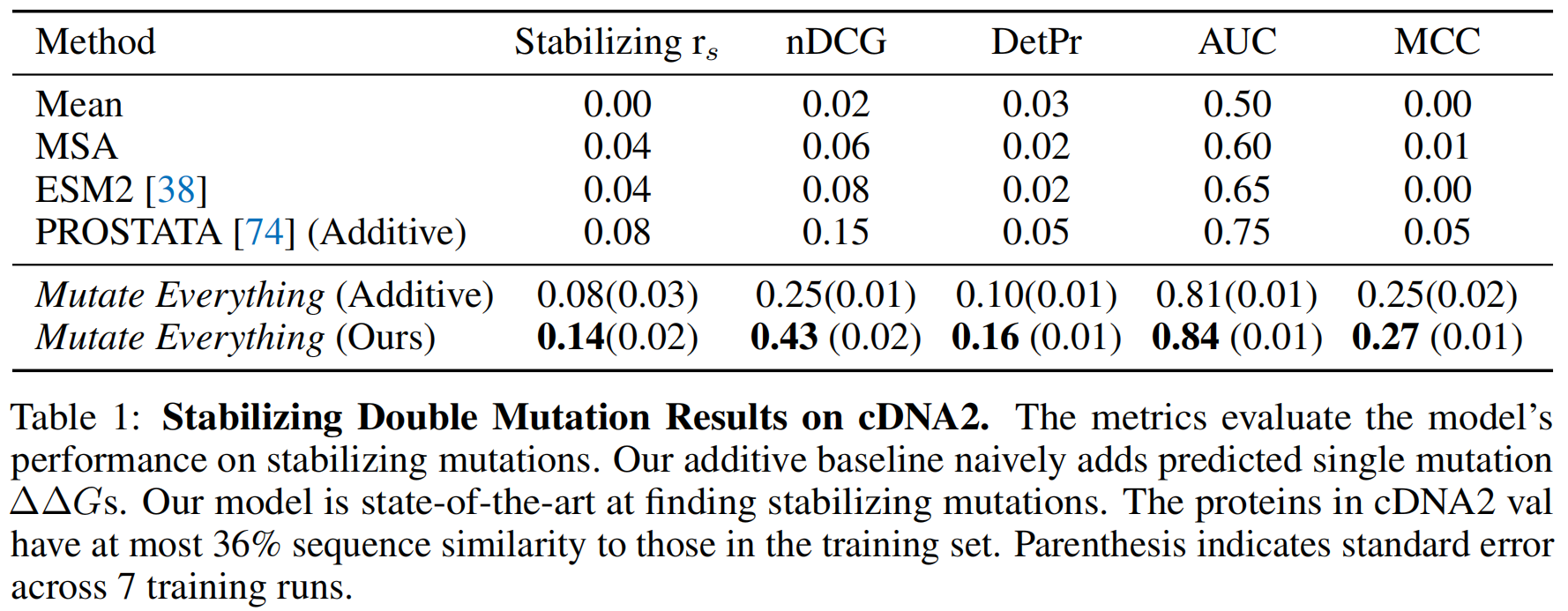
This section tests prioritization of stabilizing mutations on cDNA2, the validation split of the cDNA double-mutant set: 18 mini-proteins and 22,000 double mutants. Validation proteins share at most 36% identity with the cDNA training set. Only 198 mutants (~0.8%) are stabilizing (ΔΔG < −0.5 kcal/mol).
Table 1 compares methods on stabilizing mutants. Normalized discounted cumulative gain (nDCG) scores ranked lists using experimental ΔΔG and rank position. Detection precision (DetPr) is the fraction of experimentally stabilizing mutants among the top K = 30 predictions.
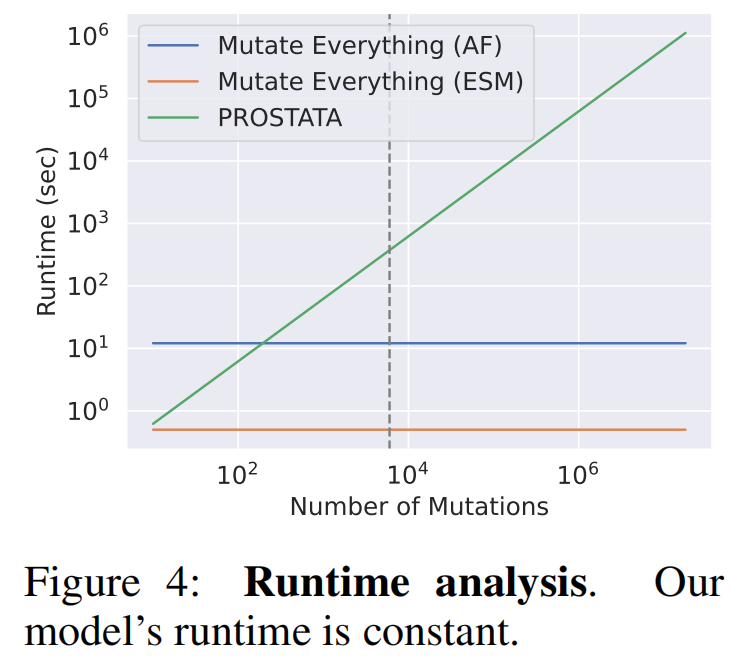
Figure 4 reports runtime on a 317-residue protein on an A100. The dashed line marks the transition from scoring singles to doubles. Mutate Everything predicts all single and double ΔΔG values in one forward pass. With ESM2 as backbone, runtime is 0.6 s; with AlphaFold, 12.1 s. PROSTATA with the same ESM2 backbone must feed wild-type and mutant sequences separately; scoring all doubles takes 306 hours at batch size 768 (~1.5 days on an 8-GPU node). Mutate Everything’s runtime is essentially constant in the number of mutants scored.
5.3 Higher-order Mutation Results
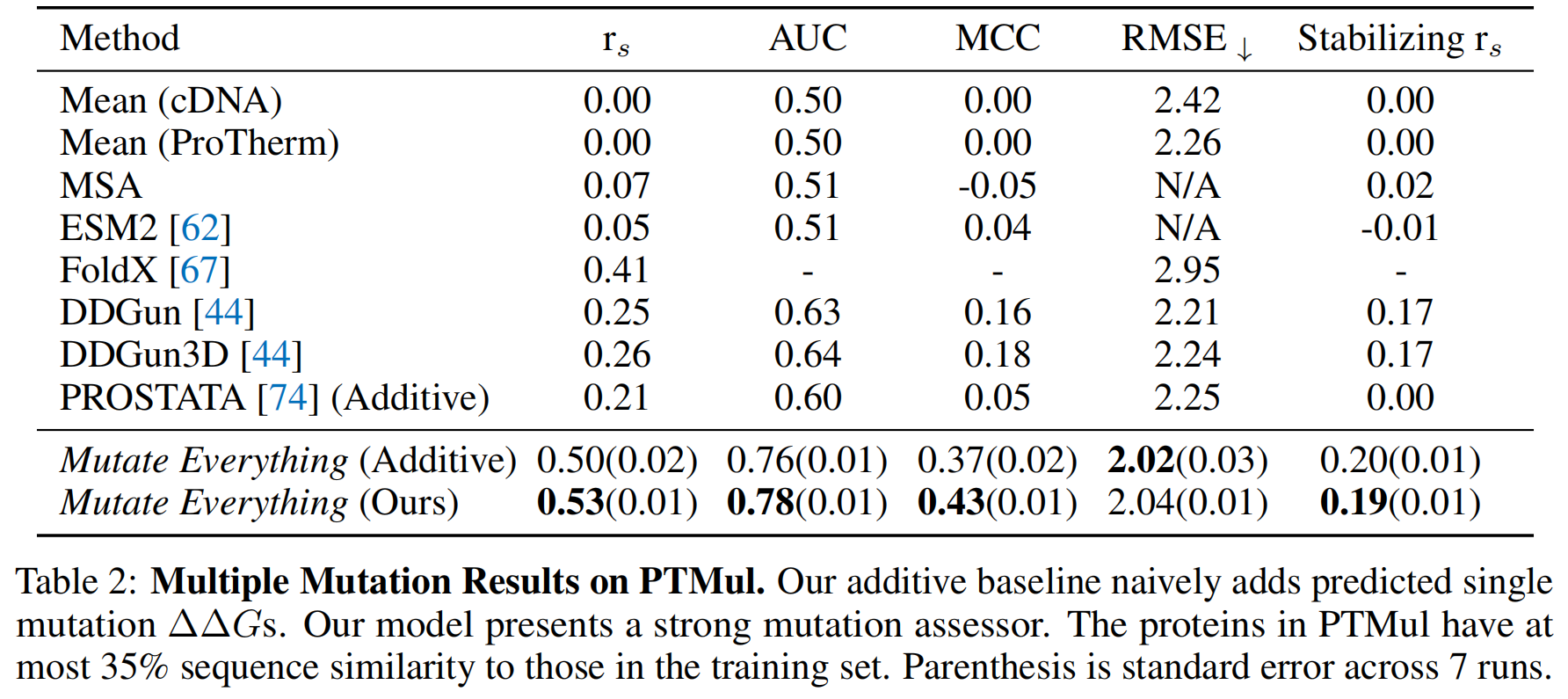
This section evaluates higher-order stability changes on ProTherm, a database of experimental ΔΔG and ΔTm for literature mutants. The ProTherm Multiple (PTMul) subset contains 858 higher-order ΔΔG entries; after removing 4 duplicates and 8 ambiguous cases, 846 remain (536 doubles, 183 triples). PTMul proteins share at most 35% identity with the training set.
Table 2 reports PTMul results. Additive baselines sum predicted ΔΔG for individual changes, isolating the model’s ability to learn epistasis (non-additive combinatorial effects). Mutate Everything reaches Spearman rs = 0.53 (state of the art); the additive baseline is 0.50. Table 6 breaks down performance on doubles versus >2 mutations.
5.4 Single Mutation Results
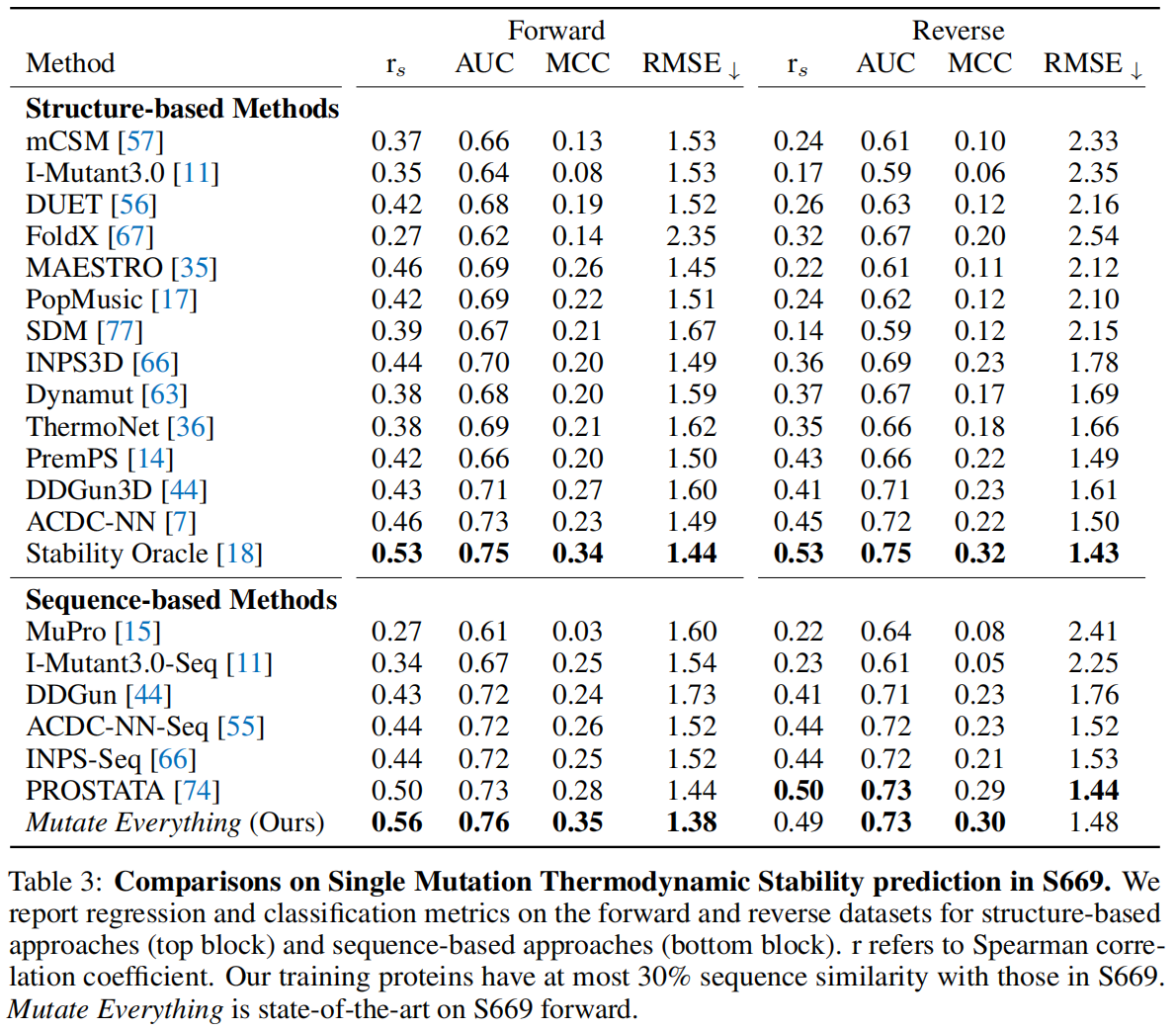
The authors also benchmark single-mutant ΔΔG on S669, designed to reduce leakage and enable fair comparison. They additionally evaluate the common reverse setup: input the mutant sequence and predict ΔΔG for reverting to wild type (labels are negated wild-type→mutant ΔΔG). S669 spans 94 proteins and 669 mutants; sequences share at most 30% identity with training.
Table 3 compares to prior work. Mutate Everything reaches Spearman 0.56 (state of the art), versus 0.53 previously.
5.5 Generalization to other Phenotypes
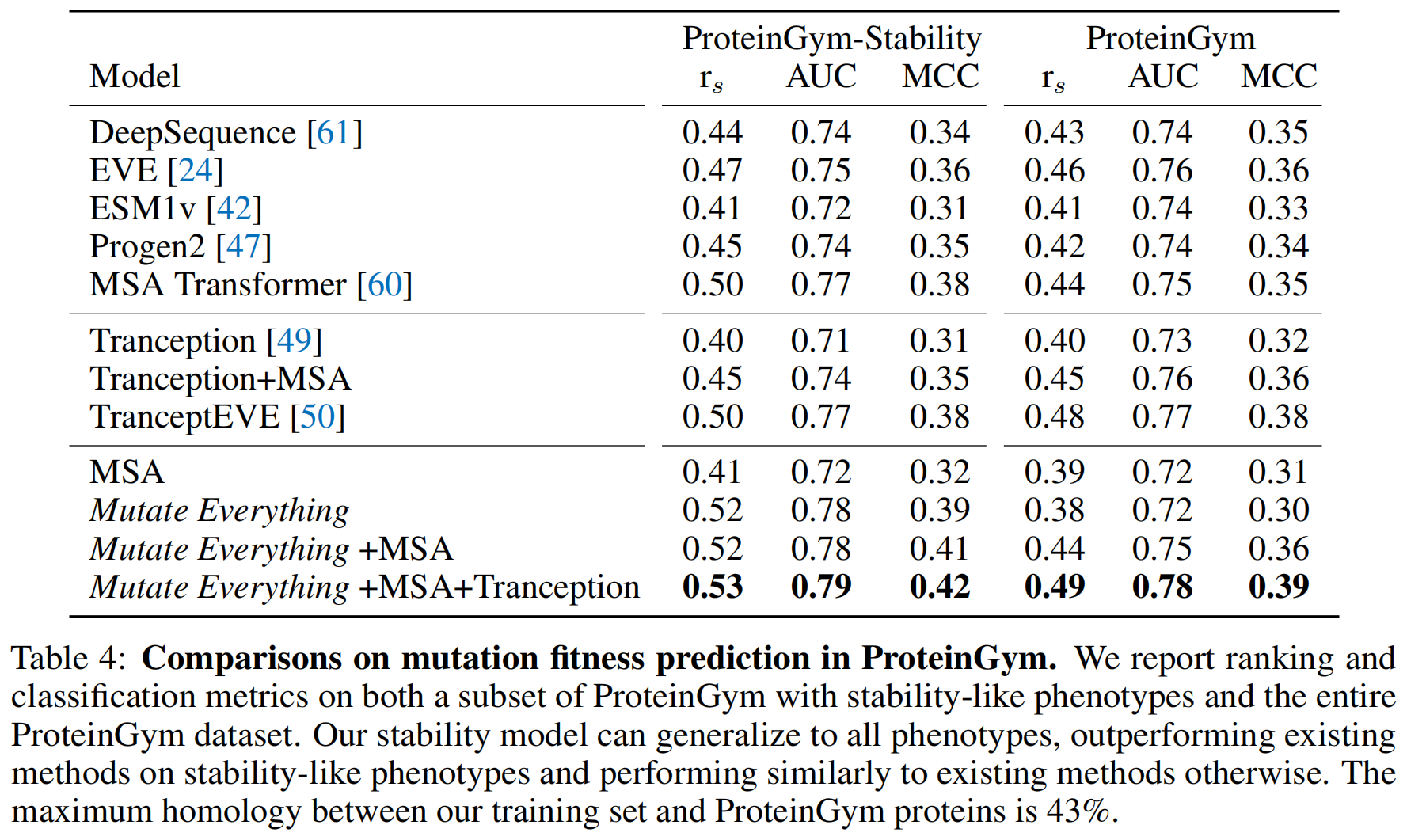
The stability predictor also generalizes to other phenotypes. ProteinGym substitutions covers 87 proteins and 1.6M mutation sets with generic fitness labels (activity, growth, expression, etc.), with up to 20 substitutions per set; 14 proteins include higher-order mutants. ProteinGym-Stability holds 7 proteins and 26,000 mutants whose fitness correlates with thermodynamic stability (thermal stability, abundance, expression). ProteinGym sequences share at most 45% identity with training. Proteins are truncated to 2,000 residues for memory.
5.6 Ablation Studies
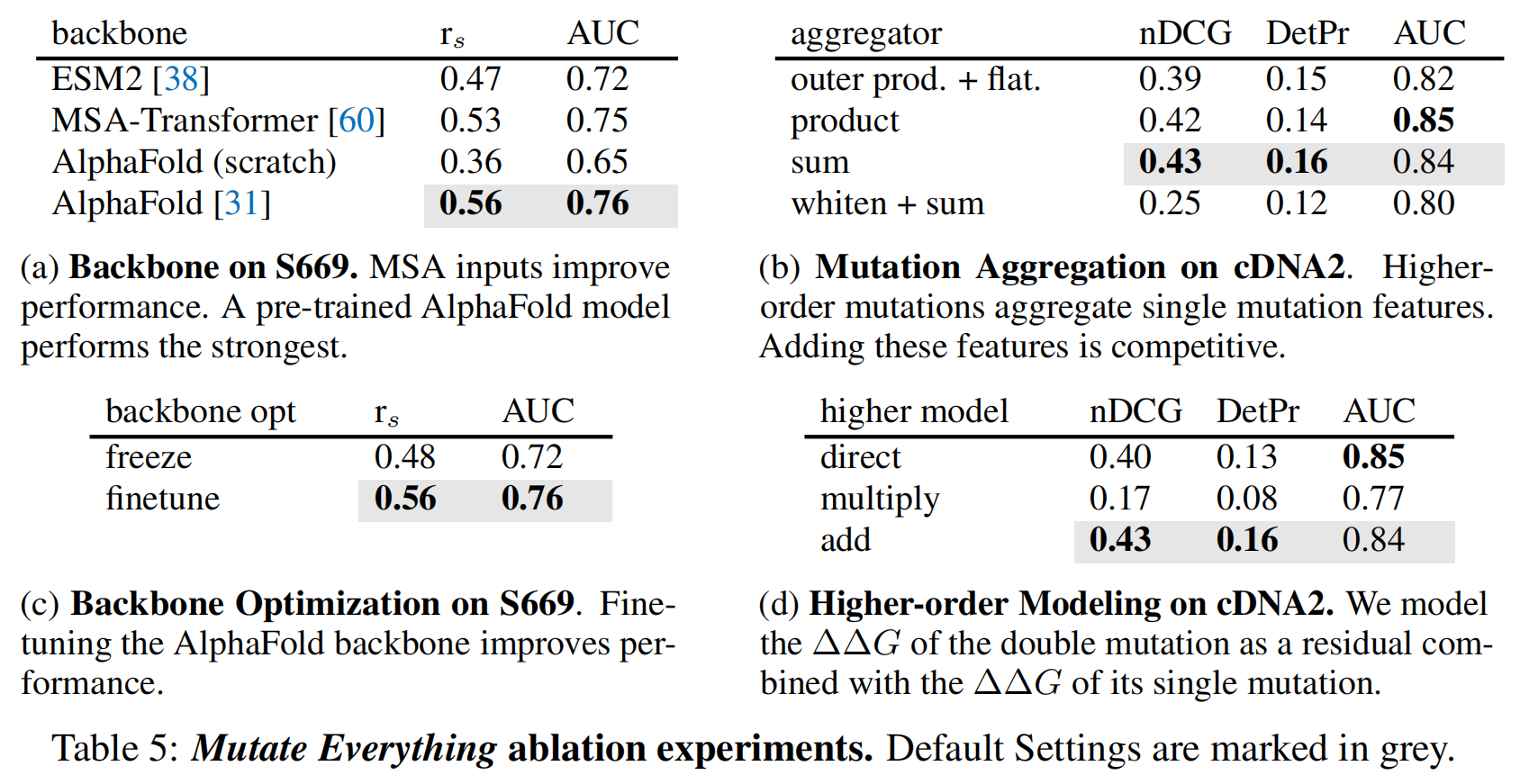
Table 5 ablates architectural choices. Core design is evaluated on S669; multi-mutation-specific choices on cDNA2.
- Backbone (Table 5a): Compares feature extractors for single-mutant stability. ESM2 is sequence-only; MSA-Transformer and AlphaFold take sequence plus MSA. ESM2 and MSA-Transformer use masked language modeling; AlphaFold also trains on structure prediction. MSA input helps; AlphaFold architecture and pretraining help further. Pretrained AlphaFold performs best.
- Backbone optimization (Table 5c): Fine-tuning vs freezing AlphaFold during stability fine-tuning; fine-tuning improves performance.
- Aggregation (Table 5b): Ablates how higher-order representations are combined. When using outer product and flatten, head width is reduced for dimension control. On doubles, product and sum aggregations are similar; the authors choose summation for easier extension to more mutations.
- Higher-order modeling (Table 5d): The direct model predicts ΔΔG outright. Product and sum models learn how singles interact; the multi-mutation head outputs an additive bias or multiplicative scale relative to the sum of single-mutant ΔΔG. Learning an additive bias (sum model) works best among the three.