
ICML-2017 Model-Agnostic Meta-Learning for Fast Adaptation of Deep Networks
Paper: Model-Agnostic Meta-Learning for Fast Adaptation of Deep Networks
Code: https://github.com/cbfinn/maml
Blog: http://bair.berkeley.edu/blog/2017/07/18/learning-to-learn/
MAML: Model-Agnostic Meta-Learning for Fast Adaptation of Deep Networks
Abstract
A model-agnostic meta-learning approach compatible with any model trained by gradient descent. The main goal is to train across diverse tasks so that, when facing a new task with very few data points, the learned model can be fine-tuned efficiently.
Introduction
The authors propose a general model-agnostic meta-learning algorithm, with a primary focus on deep neural networks. The key idea is to learn an initialization such that, on a new task, a small number of gradient steps yield strong performance. The learning process can be viewed as maximizing the sensitivity of the new task’s loss with respect to the parameters.
Model-Agnostic Meta-Learning
Meta-Learning Problem Set-Up
| In few-shot meta-learning, the objective is to train a model that can adapt quickly to new tasks using only a handful of data points and training iterations. We consider a model $f$ that maps observations $x$ to outputs $a$. During meta-learning, the model is trained to adapt to a large or effectively unbounded set of tasks. Each task $T={L(x_1,a_1,…,x_H,a_H),q(x_1),q(x_{t+1} | x_t,a_t),H}$ consists of a loss function $L$, an initial observation distribution $q(x_1)$, a transition distribution $q(x_{t+1} | x_t,a_t)$, and a horizon $H$. |
In the meta-learning setting, we assume a task distribution $p(T)$ over all tasks. A new task is drawn from $p(T)$; the model is trained on $k$ samples and the corresponding loss is computed, then evaluated on held-out samples. Performance is ultimately measured by sampling fresh tasks from $p(T)$.
A Model-Agnostic Meta-Learning Algorithm
Prior methods either require the full dataset or combine with nonparametric components at test time. The intuition behind the proposed method is that a subset of the internal parameters is transferable across tasks.
For a parametric model $f_\theta$ with parameters $\theta$, when adapting to a new task $T_i$, the parameters are updated from $\theta$ to $\theta_i’$.

The model parameters are trained by optimizing the performance of $f_{\theta’}$ on tasks sampled from $p(T)$ with respect to $\theta$, in an average sense over local optima across tasks.

Meta-optimization across tasks is performed with stochastic gradient descent (SGD), updating the model parameters $\theta$ as follows:

The full procedure is summarized below.
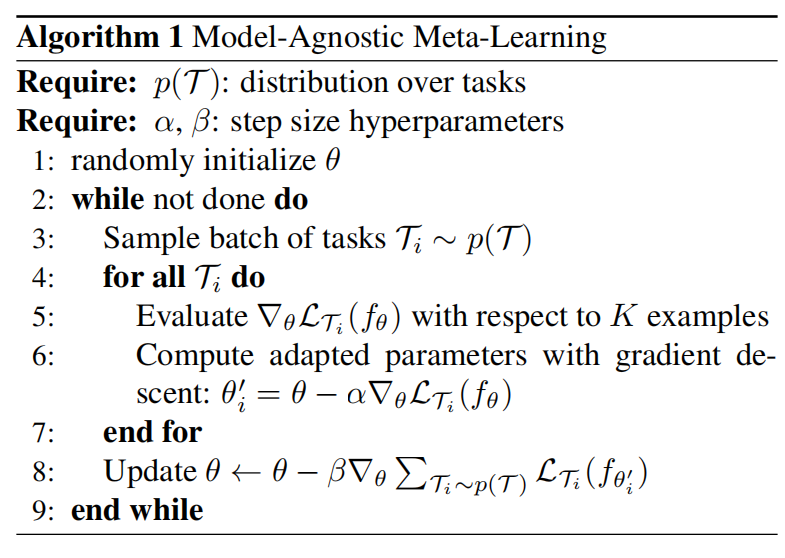
The outer loop updates $\theta$; the inner loop updates each task to obtain the fine-tuned parameters $\theta_i’$.
Note that when $\theta$ is updated in the outer loop, the gradient is not taken directly with respect to $\theta$; instead, performance is assessed indirectly through $\theta_i’$. In other words, we do not care how well $\theta$ itself performs—we care how well $\theta$ performs after a few adaptation steps.
Experiment
Three main questions:
- Can MAML truly learn new tasks quickly?
- Can MAML meta-learn across domains, including supervised regression, classification, and reinforcement learning?
- Can models learned by MAML keep improving with additional gradient updates?
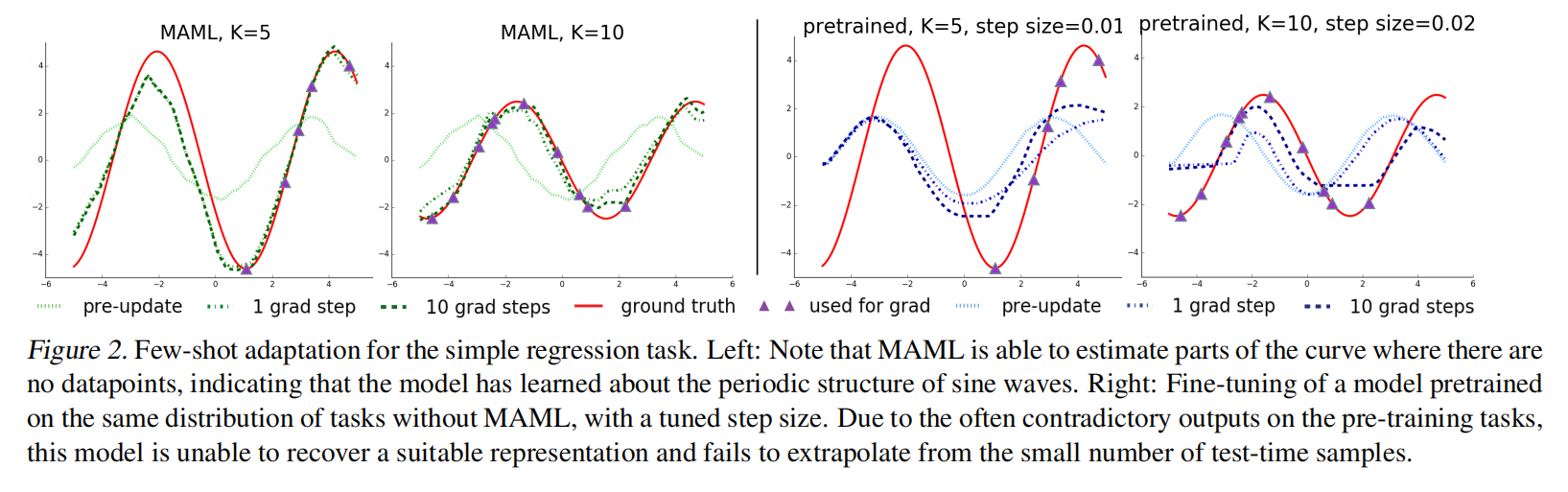
After roughly ten gradient updates, MAML already captures the underlying pattern, whereas a pretrained model struggles to adapt in the same regime. The analogy is that MAML acts like a coach: what matters is how well the “student” performs after training, not how good the coach is in isolation. A pretrained model is optimized to be strong at initialization, but a few fine-tuning steps need not help—and may even hurt—because the weights are already near a single-task optimum.
<HR align=left color=#987cb9 SIZE=1>